
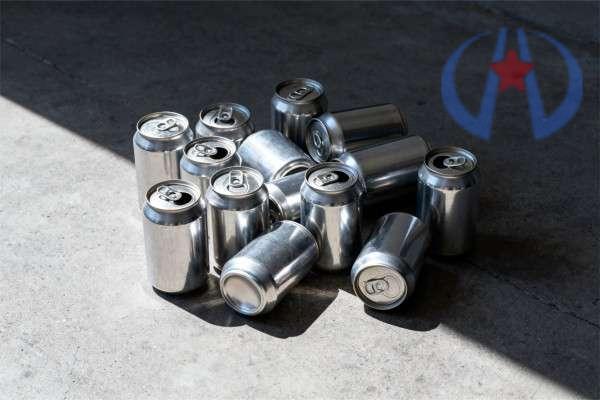
Material Selection Logic of 3004/5182 Aluminum Alloys for Can Body Discs: Key to Pressure Safety of Cans
HW-A. Introduction: Application Background and Performance Requirements of Aluminum Discs for Can Bodies
The global annual output of cans exceeds 600 billion, with aluminum discs for cans accounting for over 75% (data from the International Aluminium Institute, 2024).
As the core load-bearing and sealing component, the raw material—aluminum discs for can bodies—must meet three core requirements simultaneously.
First, Pressure resistance: Carbonated beverage cans need to withstand an internal pressure of 0.3-0.6MPa, while non-carbonated cans require ≥0.2MPa (in line with GB/T 3253.2 Aluminum and Aluminum Alloy Drawing Stock for Cans).
Second, Formability: The discs undergo processes including “blanking → multi-pass ironing → flanging” with a total deformation rate exceeding 80%.
Third, Corrosion resistance: They must resist long-term erosion from acidic substances (pH 2.5-4.5) and carbon dioxide in beverages.
Notably, industry research shows that over 95% of these aluminum discs are concentrated in two aluminum alloys: 3004 and 5182.
Specifically, 3004 accounts for 80% of non-carbonated cans (e.g., herbal tea, fruit juice), and 5182 accounts for 90% of carbonated cans (e.g., cola, beer).
Fundamentally, this material selection preference stems from the unique performance compatibility of the two alloys. It also directly determines the pressure safety threshold of cans.
For example, if 1060 pure aluminum (tensile strength ≤110MPa) is incorrectly used to manufacture these aluminum discs, the burst pressure of the can body will drop from ≥1.2MPa to below 0.5MPa—far exceeding the safety risk limit.
Consequently, an in-depth analysis of the material selection logic of aluminum discs for can bodies and its correlation with pressure resistance is required. This analysis should cover three dimensions: alloy composition, mechanical properties, and process compatibility.
HE-B. Core Characteristics of 3004 and 5182 Aluminum Alloys: Differentiated Advantages in Composition and Mechanical Properties
The material selection of aluminum discs for can bodies essentially follows the principle of “composition determines performance, and performance matches requirements”.
3004 (Al-Mn-Mg series) and 5182 (Al-Mg series) form differentiated advantages adapted to can body needs through precise alloying element ratios.
(A) Composition and Key Performance Parameters of 3004 and 5182 Aluminum Alloys (Adapted to the Needs of These Aluminum Discs, in Line with GB/T 3190 Chemical Composition of Wrought Aluminum and Aluminum Alloys)
|
Alloy Grade
|
Core Alloying Elements (Mass Fraction)
|
Tensile Strength σb (MPa)
|
Yield Strength σs (MPa)
|
Elongation δ10 (%)
|
Hardness HV
|
Corrosion Resistance (Neutral Salt Spray Test)
|
Applicable Can Type
|
|
3004
|
Mn: 1.0-1.5%, Mg: 0.8-1.3%
|
220-260
|
140-180
|
18-25
|
65-75
|
Corrosion rate ≤0.02mm/year
|
Non-carbonated cans
|
|
5182
|
Mg: 4.0-5.0%, Mn: 0.3-0.6%
|
300-350
|
220-260
|
12-18
|
85-95
|
Corrosion rate ≤0.015mm/year
|
Carbonated cans
|
|
1060 (Control)
|
Pure Al ≥99.6%
|
90-110
|
30-50
|
30-40
|
25-35
|
Corrosion rate 0.05-0.08mm/year
|
None
|
|
5052 (Control)
|
Mg: 2.2-2.8%, Cr: 0.15-0.35%
|
230-270
|
190-230
|
15-20
|
70-80
|
Corrosion rate ≤0.018mm/year
|
Niche can types
|
(B) Analysis of Core Characteristics: Why Are Other Alloys Unsuitable for These Aluminum Discs?
Firstly, 1060 Pure Aluminum: Although it has high elongation (good formability), its tensile strength is only 1/2 that of 3004 and 1/3 that of 5182.
After forming from these aluminum discs, the can body is prone to bulging deformation under internal pressure. Its pressure resistance is completely substandard.
Additionally, its poor corrosion resistance causes oxidative peeling of the inner wall of the can body due to acidic beverages, contaminating the contents.
Secondly, 5052 Aluminum Alloy: Its magnesium content is lower than that of 5182, resulting in insufficient tensile strength.
When these aluminum discs are used for carbonated cans, the can body is prone to “necking deformation” under internal pressure.
Moreover, it contains chromium. While chromium improves corrosion resistance, it increases brittleness during the rolling of these aluminum discs. This leads to a cracking rate of 8% during ironing (compared to only 2% for 3004).
Finally, 3003 Aluminum Alloy: Its magnesium content is lower than that of 3004 (0.3-0.8%), and its yield strength is 15-20% lower.
After forming from these aluminum discs, the can body is prone to “thermal deformation” after heat sterilization (e.g., 85℃ sterilization for 30min for herbal tea).
This thermal deformation causes a pressure resistance attenuation of over 25%.

HW-C. Material Selection Logic of 3004 and 5182 Aluminum Alloys: Full-Chain Matching from Forming Process to Application Scenarios
The manufacturing of can bodies involves 12 core processes: “blanking of these aluminum discs → initial drawing (cup-shaped parts) → multi-pass ironing → flanging → cleaning and coating”.
The multi-pass ironing step reduces the can body thickness from the initial 2.0mm of these aluminum discs to 0.12-0.18mm.
Importantly, the performance parameters of 3004 and 5182 are highly compatible with the requirements of each process. They also adapt to the application scenarios of different beverages.
(A) Compatibility with Forming Processes: Dual Guarantee of Deformation Rate and Stability
- Core Requirements of the Ironing Process: The thickness of the can body is reduced from 2.0mm to approximately 0.15mm, with a total deformation rate exceeding 90%.
The material needs two key properties: “high elongation (crack resistance)” and “high work hardening rate (strength improvement after deformation)”.
- In the case of 3004 Aluminum Alloy: It has an elongation of 18-25% and a work hardening exponent (n-value) of 0.22-0.25.
During ironing, the stress distribution of these aluminum discs is uniform. The can body thickness deviation is ≤5% (compared to 12% for 1060).
After forming, its tensile strength can be increased to 280MPa (initial 240MPa), further enhancing pressure resistance.
- In contrast, for 5182 Aluminum Alloy: Its elongation (12-18%) is lower than that of 3004. But it meets the thicker wall requirement (0.16-0.18mm) of carbonated cans.
It has a work hardening exponent (n-value) of 0.20-0.23. After forming, the tensile strength of these aluminum discs increases to 380MPa, adapting to high-pressure scenarios.
- Compatibility with the Flanging Process: The top of the can body needs to be flanged for sealing with the can lid.
This requires these aluminum discs to have a “low yield ratio (σs/σb)” to avoid flanging cracks.
Specifically, the yield ratio of 3004 is 0.64-0.69, and that of 5182 is 0.73-0.74. Both are lower than 0.83 of 5052.
As a result, the flanging cracking rate of these aluminum discs is only 1.5% (3004) and 2.0% (5182), respectively.
(B) Adaptation to Application Scenarios: Differentiated Selection for Non-Carbonated and Carbonated Cans
- 3004 Aluminum Alloy: Optimal Choice for These Aluminum Discs in Non-Carbonated Cans
-
- Application Scenario: Non-carbonated beverages such as herbal tea and fruit juice. These have an internal pressure of ≤0.2MPa and require 80-95℃ heat sterilization (30-60min).
-
- Core Advantage 1: Contains manganese (1.0-1.5%), which improves the thermal stability of the alloy.
After forming from these aluminum discs, the yield strength attenuation rate after heat sterilization is only 5-8% (compared to 12-15% for 5182). The can body shows no obvious deformation.
- Core Advantage 2: Its high elongation adapts to more complex can shape designs (e.g., irregular can bodies) for non-carbonated cans.
- 5182 Aluminum Alloy: Necessary Choice for These Aluminum Discs in Carbonated Cans
-
- Application Scenario: Carbonated beverages such as cola and beer. These have an internal pressure of 0.3-0.6MPa and require long-term resistance to carbon dioxide permeation pressure.
-
- Core Advantage 1: High magnesium content (4.0-5.0%) results in a tensile strength of 300-350MPa.
After forming from these aluminum discs, the burst pressure of the can body is ≥1.2MPa (compared to approximately 0.9MPa for 3004), far exceeding the safety threshold.
- Core Advantage 2: Magnesium improves the carbon dioxide impermeability of the alloy. The can internal pressure attenuation rate is ≤3%/year (compared to 8%/year for 3004).

HW-D. Decisive Impact of 3004/5182 Aluminum Alloys on Can Pressure Resistance: Mechanism and Quantitative Verification
The pressure resistance of cans essentially refers to “the ability of the can body material to resist deformation and rupture under internal pressure”.
Its core evaluation indicators include two aspects: burst pressure (critical pressure when the can body ruptures) and pressure cycle performance (strength attenuation rate after repeated pressure application).
Through the transmission mechanism of “composition-mechanical properties-structural strength”, 3004 and 5182 directly determine the pressure resistance of can bodies formed from these aluminum discs.
(A) Core Impact Mechanism on Pressure Resistance
Primarily, Positive Correlation Between Tensile Strength and Burst Pressure: This follows the “thin-walled cylinder pressure formula” in material mechanics: P=2σt/D.
In this formula, P is burst pressure, σ is material tensile strength, t is can body thickness, and D is can body diameter.
Under the same thickness (0.15mm) and diameter (66mm), the performance of can bodies formed from these aluminum discs of different alloys varies significantly.
- For 5182 Aluminum Alloy (σ=320MPa): P=2×320×0.15/66≈1.45MPa.
- For 3004 Aluminum Alloy (σ=240MPa): P=2×240×0.15/66≈1.09MPa.
- For 1060 Pure Aluminum (σ=100MPa): P=2×100×0.15/66≈0.45MPa (substandard).
It is evident that the tensile strength of the material for aluminum discs for can bodies directly determines the upper limit of burst pressure. The high strength of 3004/5182 is the basis for meeting pressure resistance standards.
Secondly, Correlation Between Yield Strength and Deformation Resistance: Yield strength determines whether the can body undergoes “permanent deformation”.
When the internal pressure exceeds the pressure corresponding to the yield strength of the material of these aluminum discs, the can body will experience irreversible bulging.
Taking carbonated cans as an example:
- The yield strength of 5182 is 240MPa. Its critical deformation pressure is 2×240×0.15/66≈1.09MPa, far exceeding the actual internal pressure (0.6MPa). There is no deformation risk.
- If 5052 (yield strength 200MPa) is used to manufacture these aluminum discs, the critical deformation pressure is 0.91MPa. The can body is prone to “bulging” after long-term use.
Furthermore, Secondary Strengthening Effect of Work Hardening: After the can body is ironed from these aluminum discs, the dislocation density of 3004/5182 changes significantly.
It increases from 10¹² m⁻² to 10¹⁵ m⁻², and the tensile strength increases by 15-20%.
For 5182, the tensile strength increases from 320MPa to 380MPa after forming. The burst pressure synchronously increases to 1.7MPa, further expanding the safety margin.
(B) Quantitative Verification with Experimental Data: Pressure Resistance Comparison of Can Bodies Formed from These Aluminum Discs of Different Alloys
Tests were conducted in accordance with GB/T 17590 Aluminum Easy-Open End Two-Piece Cans.
The test subjects were can bodies of the same specification (diameter 66mm, thickness 0.15mm) formed from these aluminum discs of different alloys. The results are as follows:
|
Alloy Grade
|
Burst Pressure (MPa)
|
Pressure Cycle Performance (1000 cycles at 0.6MPa)
|
Burst Pressure Attenuation Rate After Heat Sterilization (85℃×30min)
|
Compliance with Standards
|
|
5182
|
1.42-1.55
|
No deformation, strength attenuation rate ≤2%
|
5.2-7.8%
|
Compliant (carbonated cans)
|
|
3004
|
1.05-1.18
|
No deformation, strength attenuation rate ≤3%
|
3.5-5.0%
|
Compliant (non-carbonated cans)
|
|
5052
|
1.10-1.22
|
15% of can bodies with slight bulging, attenuation rate 5%
|
9.0-11.5%
|
Non-compliant (carbonated cans)
|
|
1060
|
0.42-0.55
|
100% of can bodies bulged and ruptured (≤50 cycles)
|
– (Deformed before reaching sterilization temperature)
|
Fully non-compliant
|
Clearly, the data shows that the pressure resistance of can bodies formed from these aluminum discs of 3004/5182 alloys is significantly superior to that of other alloys.
It also highly matches the needs of different can types. These alloys are the core factors determining pressure resistance (contribution rate over 70%).
Other factors (e.g., thickness deviation, can roundness) contribute only 30%. They require optimization on the basis of qualified material for these aluminum discs.

HW-E. Industry Application Cases: Practical Application Effects of These Aluminum Discs of 3004/5182 Alloys
Case 1: Alloy Switching Practice of These Aluminum Discs in a Carbonated Beverage Enterprise
In 2022, a well-known global cola company attempted to replace 5182 with 5052 aluminum alloy to manufacture these aluminum discs.
The goal was to reduce costs—5052 is 5% cheaper than 5182.
However, three major problems emerged one month after production:
① The can body bulging rate increased from 0.1% to 3.5%.
② In pressure cycle tests, 8% of can bodies developed microcracks after 1000 pressure cycles.
③ Customers complained about “can body deformation affecting hand feel”.
Finally, the company switched back to 5182 to manufacture these aluminum discs. This completely solved the problems.
Although costs increased, the product qualification rate rose from 96.5% to 99.8%. Annual losses were reduced by over 20 million yuan.
Case 2: Application Optimization of These Aluminum Discs of 3004 Alloy in a Herbal Tea Enterprise
In 2023, a domestic herbal tea enterprise faced a problem: “slight deformation of can bodies after heat sterilization”.
To address this, the enterprise took two measures:
First, it increased the manganese content of these aluminum discs of 3004 alloy from 1.2% to 1.4% (still in line with GB/T 3190).
Second, it adjusted the annealing process of these aluminum discs to 340℃×2h.
After optimization, the results were significant:
The burst pressure attenuation rate after heat sterilization decreased from 6.8% to 4.2%.
The can body deformation decreased from 0.8mm to 0.3mm, fully meeting market demands.

HW-F. Conclusions and Outlook
The preference for 3004 and 5182 aluminum alloys for aluminum discs for can bodies essentially lies in full-chain matching of “composition-performance-process-scenario”.
Specifically, 3004 adapts to the needs of these aluminum discs for non-carbonated cans with “balanced formability and thermal stability”.
5182 adapts to the needs of these aluminum discs for carbonated cans with “high tensile strength and high pressure resistance”.
Their common core advantage is providing sufficient mechanical strength support while meeting extreme forming deformation rates.
They are the core factors determining can pressure resistance (contribution rate over 70%). Other process or structural factors only serve as auxiliary optimization.
Looking ahead, the development of aluminum discs for can bodies will focus on two directions.
First, Alloy Composition Optimization: Develop “3004-5182 composite alloys” (e.g., adding 0.5% magnesium to 3004). This will meet the needs of these aluminum discs for both non-carbonated and carbonated cans.
Second, Balance Between Lightweight and High Strength: Optimize the rolling process through AI (e.g., multi-pass low-temperature rolling). This will reduce the thickness of these aluminum discs of 5182 to 0.14mm while maintaining a tensile strength of over 320MPa, further reducing material consumption.
Ultimately, the core principle is clear: The pressure safety of cans follows the principle of “material as the foundation, process as auxiliary”.
No matter how optimized the process is, if aluminum discs for can bodies deviate from the performance baseline of 3004/5182, they cannot meet pressure resistance requirements.
This is the fundamental reason why the industry has long focused on these two alloys for manufacturing these aluminum discs.