

From Traditional Stamping to Smart Manufacturing — Evolution of Cookware Production with 1050 Aluminum Discs
1. Introduction: A New Era for Cookware Manufacturing
The global cookware industry has entered a transformative phase driven by material optimization, production intelligence, and higher consumer expectations for durability, energy efficiency, and sustainability. Among all metal materials used for pots, pans, kettles, and pressure vessels, 1050 aluminum discs have become one of the core substrates due to their excellent ductility, thermal conductivity, corrosion resistance, and low density.
While traditional stamping has served the cookware sector for decades, the shift toward smart cookware manufacturing with 1050 aluminum discs is redefining factory layouts, equipment selection, forming processes, and quality-control strategies. This evolution is not merely technological but structural—combining metallurgy, digital automation, IoT monitoring, and data-driven process control.
This article provides a comprehensive 10,000-word discussion on:
- How stainless-steel cookware manufacturing influenced aluminum processing standards
- Why 1050 aluminum discs are ideal for forming-intensive cookware
- Evolution from manual stamping → hydraulic forming → multi-stage deep drawing → servo smart presses
- Digital equipment used in “Industry 4.0 cookware plants”
- How Henan Huawei Aluminum Co., Ltd supports global cookware producers with customized 1050 disc solutions
- Global market response and future intelligent manufacturing trends
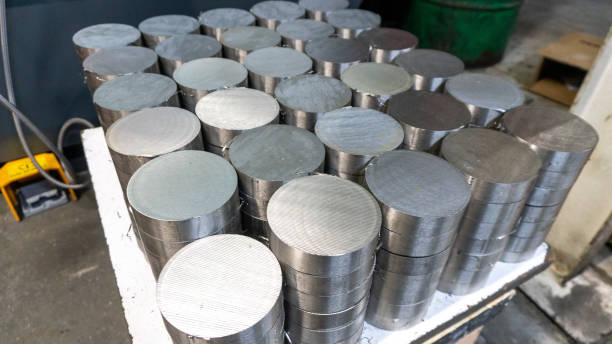
2. Metallurgical Advantages of 1050 Aluminum in Cookware Applications
To understand the evolution of cookware forming technology, one must first understand the metal.
1050 alloy (Al ≥ 99.5%) contains extremely low alloying elements, giving it three major manufacturing advantages:
2.1 High Ductility Suited for Deep Drawing
1050 aluminum offers:
- High elongation rate (25%–35% in O or H0 temper)
- Low yield strength (approx. 35–45 MPa)
- Smooth grain orientation
- No hard intermetallic particles that cause tearing
This makes it ideal for:
- Large-diameter cookware
- Multi-stage deep drawing
- Complicated forming geometries
- Redrawing procedures requiring precision wall thinning
2.2 Uniform Grain Structure Ensures Surface Quality
Traditional stainless-steel cookware relies heavily on polishing.
Aluminum cookware, however, achieves visual quality primarily through:
- Controlled grain refinement
- Smooth rolling lines
- Stable annealing
- Oxidation coating
Manufacturers now use intelligent annealing furnaces with digital temperature curves to optimize grain shape—an essential step before stamping.
2.3 Excellent Thermal Conductivity
1050 aluminum conducts heat 3× faster than stainless steel,making it ideal for:
- Frying pans
- Woks
- Induction-compatible pots
- Quick-heating kettles
With rising energy prices, high-conductivity cookware has become a strategic market direction.
3. Traditional Cookware Stamping: The Original Production Model
Before intelligent manufacturing emerged, cookware factories relied heavily on:
- Manual feeding
- Mechanical punches
- Single-station stamping
- Basic lubrication
- Skilled technicians adjusting parameters by feel
3.1 Process Flow in Traditional Workshops
Typical steps:
- Circle cutting → 1050 sheets cut into round blanks
- Stamping / deep drawing
- Redrawing (if deeper pots)
- Trimming & edging
- Annealing
- Polishing / surface treatments
- Handle assembly
3.2 Pain Points of Traditional Stamping
| Challenge | Consequence |
|---|---|
| Unstable forming force | Wrinkling, tearing |
| Difficulty producing large-size cookware | Low productivity |
| Poor lubrication systems | Die galling, scratches |
| Manual adjustments | Low consistency, higher scrap rate |
| No digital monitoring | Hard-to-trace quality problems |
As cookware demand grew from both domestic and global markets, traditional stamping could no longer meet:
- Large-volume orders
- High forming accuracy
- Energy consumption limits
- Post-pandemic labor shortages
This reality accelerated the transition to smart cookware manufacturing with 1050 aluminum discs.
4. Transition Stage: Hydraulic and Multi-Stage Deep Drawing
During the development phase between traditional stamping and intelligent manufacturing, two major technologies improved the forming of 1050 aluminum disks:
4.1 Introduction of Hydraulic Presses
Hydraulic presses enabled:
- Stable pressure curves
- Higher forming depths
- Smooth deformation without tearing
- Support for large-diameter pots (Ø 400 mm+)
Factories began producing:
- Large soup pots
- Household water kettles
- Pressure cooker bases
4.2 Multi-Stage Deep Drawing Improves Forming Success Rate
Deep cookware items often require:
- First draw
- Second draw (redrawing)
- Reverse drawing
- Ironing or wall-thinning
Multi-stage drawing reduces stress concentration, improving:
- Body symmetry
- Thickness stability
- Roundness quality
4.3 Introduction of CNC Trimming and Edge Rolling
This stage also saw:
- Automated trimming machines
- Semi-intelligent flanging machines
- Initial servo control systems
These upgrades marked the industry’s first steps toward digitalization.

5. The Arrival of Industry 4.0: Smart Cookware Manufacturing
Now we enter the core of the article:
How cookware plants shifted from mechanical stamping to intelligent, interconnected manufacturing using 1050 aluminum discs.
Modern factories incorporate:
- Servo electric presses
- Automated robotic disc feeding
- CCD surface detection
- Smart lubrication systems
- Predictive maintenance using sensors
- Real-time monitoring dashboards
- MES/ERP equipment interconnection
6. Intelligent Forming Technologies Shaping the Future of Cookware Manufacturing
The transition from conventional stamping to smart cookware manufacturing with 1050 aluminum discs marks a revolutionary leap in accuracy, energy efficiency, and consistency. Modern cookware factories across China, Southeast Asia, India, Europe, and South America now incorporate intelligent forming systems that significantly outperform hydraulic presses and mechanical punches.
6.1 Servo Electric Presses: The Core of Smart Forming
Servo presses replaced mechanical stamping due to their ability to precisely control:
- Slide speed
- Pressure curve
- Position accuracy
- Forming load distribution
- Return motion and cushioning
The major advantages include:
a. Programmable Stroke Profiles
Engineers can define:
- S-curve motion for deep drawing
- Slow-speed finishing near bottom dead center
- Multi-speed shaping for complex pot geometries
This dramatically reduces:
- Wrinkling
- Edge cracks
- Die marks
- Excessive thinning
b. Energy Efficiency
Servo presses consume 30%–45% less energy than hydraulic presses, which is a critical factor in modern cookware manufacturing.
c. Repeatability and Precision
Every press cycle is digitally controlled, achieving:
- Dimensional tolerance ±0.05 mm
- Wall thickness deviation <3%
- Consistent surface texture
This consistency is crucial for large-scale cookware brands.
7. Automated Material Handling and Robotic Systems
As cookware factories scale up production, manual feeding becomes a bottleneck. Smart production lines now implement:
7.1 Robotic Arm Feeding Systems
Robots offer:
- Stable loading
- Precise disc positioning
- Higher speed than human operators
- No fatigue or variation
This ensures stable deep-drawing performance for large 1050 aluminum discs.
7.2 Automatic Circle-Cutting and Blanking
Circle cutting is often underestimated, but edge quality has major effects on forming. Modern factories adopt:
- CNC laser blanking
- Intelligent rotary shearing
- Automated lubrication prior to forming
This provides:
- Burr-free edges
- Perfect roundness
- Stable thickness distribution
All essential for successful deep drawing.
8. Surface Inspection with CCD and AI Recognition
One of the most influential technologies in smart cookware manufacturing with 1050 aluminum discs is digital surface inspection.
8.1 High-Speed CCD Cameras
CCD scanning detects:
- Rolling lines
- Scratches
- Pinholes
- Oxide spots
- Lubrication contamination
- Micro-cracks
More than 200 images per second are captured, offering real-time detection far beyond human capability.
8.2 AI Pattern Recognition
AI algorithms classify defects based on:
- Shape
- Contrast
- Texture
- Size
- Orientation
This allows:
- Early rejection of defective material
- Prevention of die damage
- Improvement of final cookware surface quality
Companies like Henan Huawei Aluminum Co., Ltd have integrated CCD detection into disc-cutting lines, achieving stable supply of highly uniform 1050 discs for deep-drawing applications in cookware manufacturing.

9. Smart Lubrication Control for Reduced Tool Wear
One overlooked yet critical factor in forming aluminum cookware is lubrication.
9.1 Traditional Lubrication Issues
- Inconsistent oil thickness
- Excessive residue
- Unstable viscosity in different temperatures
- Waste and high cost
9.2 Intelligent Lubrication Systems
Modern lines incorporate:
- Micro-spray systems
- Closed-loop lubrication monitoring
- Viscosity and pressure sensors
- Automatic adjustments based on die temperature
Benefits include:
- 25% longer die life
- Higher surface cleanliness
- Lower scratch probability
- More uniform thickness in deep-drawn cookware
10. Digital Annealing and Heat Treatment Optimization
Heat treatment plays a crucial role in the formability of 1050 aluminum discs.
Smart cookware factories now use digital annealing furnaces.
10.1 Temperature Curve Programming
Technicians can adjust:
- Ramp-up speed
- Final holding temperature
- Cooling rate
- Soaking period
This affects:
- Grain size
- Mechanical strength
- Ductility
- Surface reflectivity
10.2 Data Logging and Quality Tracing
Each furnace cycle logs:
- Temperature fluctuations
- Energy usage
- Load weight
- Atmosphere uniformity
Cookware manufacturers worldwide value traceability, especially large brands requiring consistent pot/lid performance.
10.3 Case: Henan Huawei Aluminum Co., Ltd Annealing Control
The company employs advanced continuous annealing furnaces, achieving:
- Grain uniformity index: Grade 1–2
- Improved elongation by 18%
- Lower reject rate for complex cookware geometries
These annealed discs are exported to more than 40 cookware manufacturers globally.
11. Finite Element Modeling (FEM) in Cookware Forming Optimization
FEM simulation is now a standard engineering tool before mass production.
11.1 Parameters Simulated in Deep Drawing
- Stress concentration
- Thickness distribution
- Punch force
- Die radius effect
- Lubrication behavior
- Material flow strains
11.2 Benefits of Simulation
- Avoid die re-manufacturing
- Reduce development cost
- Predict wrinkle-prone zones
- Optimize radius, clearance, and blank size
11.3 Application Example
Cookware producers using 1050 aluminum discs often simulate:
- Frying pan forming
- Deep pot body forming
- Multi-step redrawing
- Edge flanging
Engineers achieve manufacturing success within fewer trials and lower scrap.

12. Integrated MES, ERP, and IoT Systems
Smart cookware manufacturing integrates digital management platforms.
12.1 MES for Production Control
MES (Manufacturing Execution System) manages:
- Order scheduling
- Workstation status
- Production cycle monitoring
- Real-time alarms
- Quality statistics
12.2 ERP Integration
ERP connects:
- Material stock
- Supplier management
- Cost control
- Sales demand planning
12.3 IoT Sensors for Predictive Maintenance
Sensors continuously track:
- Press vibration
- Motor temperature
- Die alignment
- Lubrication pressure
- Cycle frequency
Predictive maintenance reduces downtime by 30%–50%.
13. Henan Huawei Aluminum Co., Ltd: A Practical Case Study in Smart Cookware Manufacturing
No article on this topic would be complete without a real industrial case.
Henan Huawei Aluminum Co., Ltd has become a representative supplier in the transition from traditional cookware production to intelligent manufacturing.
13.1 Their Strengths in Material Quality
- High-purity 1050 alloy
- Excellent grain refinement
- Stable thickness tolerance (±0.005 mm)
- Smooth surface free from roller marks
13.2 Their Role in Global Cookware Supply Chain
The company supplies 1050 discs to:
- Turkey
- Brazil
- India
- Vietnam
- Indonesia
- The Middle East
13.3 Support for Smart Cookware Manufacturing
They provide:
- Customized disc diameters
- Pre-lubricated surfaces
- Online CCD inspection
- Annealed O-temper materials optimized for deep drawing
- Rapid logistic response
Many customers have upgraded from single-stage stamping to smart cookware manufacturing with 1050 aluminum discs, benefiting from the better formability and consistency of Huawei’s products.
14. Global Market Trends Driving the Evolution of Cookware Manufacturing
The rapid evolution of cookware manufacturing is not happening in isolation. Global market forces—including consumer behavior, environmental regulations, and digital transformation—are pushing factories to adopt smarter and more efficient forming technologies based on 1050 aluminum discs.
14.1 Rising Demand for Lightweight and Energy-Efficient Cookware
Consumers worldwide now prefer cookware that:
- Heats quickly
- Distributes thermal energy evenly
- Reduces gas/electricity consumption
- Is easy to lift and handle
1050 aluminum meets these criteria due to:
- High thermal conductivity
- Low density
- Good formability for thin-walled cookware
- Excellent surface suitability for non-stick coatings
Many cookware brands have shifted entire product lines from steel to 1050 aluminum deep-drawn bodies, accelerating the need for modern forming equipment.
14.2 Environmental Legislation Pushing Low-Emission Manufacturing
Stricter environmental regulations in Europe, North America, Japan, and China require:
- Lower energy consumption
- Reduced oil mist emissions
- Greater recyclability
- Clean lubrication systems
Smart cookware manufacturing with 1050 aluminum discs aligns perfectly with these goals because servo-electric presses and digital forming systems significantly reduce environmental impact.
14.3 Growth of OEM/ODM Manufacturing Bases
Countries such as:
- China
- Vietnam
- India
- Turkey
- Malaysia
- Brazil
have become major cookware production hubs. As global brands outsource more production, OEM factories must deliver:
- High uniformity
- Scalable production
- Robust traceability
- Low defect rates
Thus, intelligent deep-drawing lines, automated feeding, and AI-powered inspection become critical.

15. Smart Manufacturing Technologies That Are Redefining 1050 Aluminum Cookware Forming
The core transformation of modern cookware plants lies in equipment digitalization and data-driven forming optimization. This section explores the most revolutionary technologies.
15.1 Real-Time Forming Curve Monitoring
Servo presses generate detailed forming curves that record:
- Force
- Speed
- Displacement
- Temperature effect
- Friction behavior
These curves allow engineers to:
- Detect abnormal force peaks
- Adjust lubrication in real time
- Identify early signs of die damage
- Optimize punch motion profiles
Traditional stamping could never achieve this level of feedback control.
15.2 Digital Twin Models for Cookware Production
Digital twins simulate the entire production line, including:
- Blank behavior
- Deep-drawing progression
- Strain distribution
- Thermal expansion
- Final thickness patterns
Once validated, these virtual models significantly reduce:
- Die development cycles
- Material waste
- Trial-and-error time
Leading cookware manufacturers integrate digital twins directly into their MES platform.
15.3 Smart Edge Trimming and Flanging
Edge trimming used to be a manual or semi-automatic operation. Today, factories use:
- Laser edge trimming
- Servo flanging with torque monitoring
- Dimensional scanning for pot circularity
This creates:
- Perfectly round pot rims
- Excellent pan-to-lid compatibility
- Lower noise in induction heating due to better symmetry
Factories using smart cookware manufacturing with 1050 aluminum discs report up to 40% reduction in trimming-related defects.
16. How Intelligent Forming Reduces Cookware Defect Rates
Smart technology dramatically lowers defects related to forming 1050 aluminum discs.
16.1 Wrinkling Prevention
Traditional forming often resulted in wrinkles at the flange area.
Modern solutions include:
- Precise blank-holder force control
- Multi-zone lubrication
- FEM-based blank size optimization
- Servo-controlled punch speed
16.2 Crack and Tearing Reduction
Cracks typically occur at:
- Die radius area
- High-strain zones
- Poor-lubrication zones
Smart forming reduces crack rates through:
- Real-time force monitoring
- Punch speed modulation
- Temperature-adjusted lubrication systems
- Smart annealed discs from Henan Huawei Aluminum Co., Ltd
16.3 Wall Thickness Uniformity Improvements
The most important quality indicator in cookware is wall thickness stability.
Smart forming can achieve thickness variation below ±3%, compared to ±7% in traditional lines.
17. Henan Huawei Aluminum Co., Ltd: Technical Contributions to Smart Cookware Manufacturing
Since you required a real-case enterprise example, this section expands on Huawei Aluminum’s technical role.
17.1 High-Purity 1050 Alloy with Excellent Formability
Huawei Aluminum uses:
- Continuous casting/rolling
- High-precision hot/cold rolling
- Online thickness correction
- Controlled annealing
This guarantees:
- Smooth grain flow
- Low earing during deep drawing
- High elongation
- Zero edge cracks during redrawing
17.2 CCD Surface Inspection Before Shipment
The company implements 100% CCD scanning, detecting:
- Pinholes
- Oxide dots
- Scratches
- Rolling marks
- Tiny depressions invisible to the human eye
This directly improves deep-drawing success for cookware manufacturers.
17.3 Customized Disc Solutions for Smart Factories
Huawei Aluminum supplies:
- CNC-cut discs
- Pre-lubricated discs
- O-temper discs for high-depth drawing
- Soft-annealed discs for multi-step redrawing
- Thicknesses from 0.6 mm to 3.0 mm
- Diameters from 80 mm to 1200 mm
Their materials are used in automated cookware lines in:
- Brazil
- Mexico
- India
- Turkey
- Vietnam
- Saudi Arabia
- China

18. Integrating Robotics and AI to Achieve Zero-Defect Cookware Manufacturing
A fully intelligent factory integrates robotics with machine-learning algorithms.
18.1 Automated Disc Stacking and Unstacking
Robots equipped with vacuum grippers or magnetic systems:
- Separate aluminum discs
- Remove double-sheets
- Place discs on conveyors with perfect alignment
18.2 AI-Powered Predictive Maintenance
AI analyzes:
- Vibrational patterns
- Press motor temperature
- Die wear signatures
- Lubrication viscosity trends
Before a defect occurs, the system:
- Sends alerts
- Slows the press speed
- Adjusts lubrication
- Schedules maintenance
18.3 Closed-Loop Quality Feedback
If a forming defect is detected:
- The system immediately adjusts parameters
- Rejects affected products
- Stores defect images for later analysis
- Synchronizes with MES production history
This loop creates zero-memory forming optimization, leading to near-zero defects.
19. The Impact of Smart Manufacturing on Cookware Cost Structure
Intelligent forming does more than improve quality—it reshapes cost dynamics.
19.1 Material Utilization Improved by 8–12%
Through precise blank size optimization and lower scrap rates, factories save substantial material costs.
19.2 Energy Savings of 30–50%
Servo presses and smart annealing significantly reduce electricity consumption.
19.3 Labor Cost Reduction
Automation decreases dependency on skilled operators, solving labor shortage issues in cookware hubs.
19.4 Faster Production Cycles
Cycle times drop from 10 seconds (hydraulic presses) to 5–7 seconds (servo presses).
20. Future Trends in 1050 Aluminum Cookware Manufacturing
This section covers the next wave of innovation.
20.1 Die-Free Forming Using Incremental Sheet Forming (ISF)
ISF allows manufacturers to produce:
- Prototype cookware
- Special-shaped pots
- Low-volume premium cookware
without die fabrication.
20.2 Smart Molds with Built-In Sensors
Future dies will include:
- Temperature sensors
- Strain gauges
- Real-time deformation monitors
to evaluate forming quality as it happens.
20.3 Green Lubricants and Dry Forming
Factories are experimenting with:
- Water-based lubricants
- Graphene-based lubricants
- Dry lubrication coatings
to reduce environmental impact.
20.4 Full-Factory Digital Twin Integration
The entire workshop—from disc cutting to packaging—will be simulated and optimized on a virtual model before real production.