
The Foundation of High-End Mirror-Polished Cookware: A Comprehensive Analysis of Orange Peel Control Technology and Application for Premium 1060 Aluminum Circles
In the highly competitive high-end cookware market, the visual texture of a product is as crucial as its durability. A frying pan or saucepan that achieves a flawless mirror finish is not just a cooking tool but a piece of art in the kitchen and a direct carrier of brand value. However, many manufacturers on the quest for perfect gloss often encounter a stubborn challenge: Orange Peel. This microscopic, orange-skin-like waviness that appears on the metal surface after deep drawing is the “natural enemy” of mirror polishing. It causes uneven light scattering, significantly diminishes the mirror effect, and severely impacts the final product’s grade and yield rate.
This article provides an in-depth analysis of why Premium 1060 Aluminum Circles are recognized industry-wide as the ideal substrate for solving this problem and achieving mass production of top-tier mirror-polished cookware. We will conduct a systematic dissection, from its material genetics and the metallurgical causes of orange peel, to precise production control processes, and finally to stringent end-use applications and procurement evaluation.
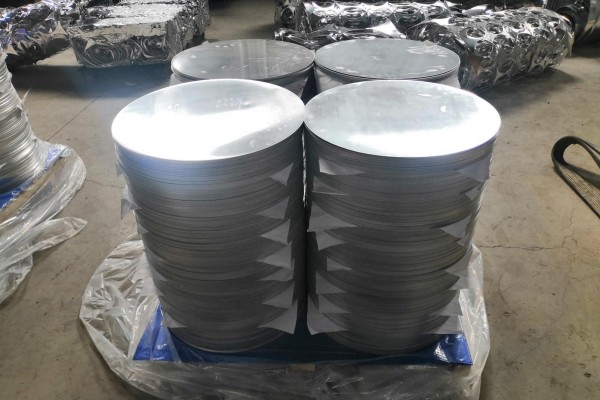
I. The Material Foundation: The High-Purity Genetics and Properties of 1060 Aluminum Alloy
As a quintessential representative of the 1000 series commercially pure aluminum, the core characteristic of the 1060 alloy lies in its exceptionally high purity (aluminum content ≥ 99.6%). This “purity” is the root of its superior workability.
I.1 Core Chemical Composition and Value
Its typical chemical composition (mass fraction %) is as follows:
| Element | Si | Fe | Cu | Mn | Mg | Zn | Al |
|---|---|---|---|---|---|---|---|
| Content | ≤0.25 | ≤0.35 | ≤0.05 | ≤0.03 | ≤0.03 | ≤0.05 | ≥99.6 |
- Advantage of Low Impurities: The extremely low content of impurity elements such as iron (Fe) and silicon (Si) means that the formation of hard secondary-phase particles within the alloy is minimal and fine. This directly brings two major benefits: first, the material’s internal structure is more uniform and consistent; second, during subsequent deep drawing deformation, the hindering effect of these hard particles on the material’s continuous flow is minimized, reducing the initiation of micro-defects.
- Manganese-Free Design: Compared to commonly used cookware alloys like 3003, 1060 contains no manganese. While manganese can provide some solid solution strengthening, it increases the alloy’s work hardening tendency and complicates the control of recrystallized grain size, inadvertently raising the risk of orange peel. The “purity” of 1060 makes its crystallographic behavior simpler and more controllable.
I.2 Key Physical Properties for High-End Cookware
- Exceptional Ductility and Deep Drawability: Its elongation can typically easily exceed 35%. Combined with a moderate work hardening rate, this allows the material to stretch uniformly and smoothly during severe plastic deformation processes like deep drawing and spinning, reducing the likelihood of cracking or local over-thinning.
- Excellent Thermal Conductivity: As a pure aluminum, its thermal conduction efficiency ranks among the highest in commonly used aluminum alloys, ensuring rapid and even heating of the cookware and meeting the conductive needs of professional cooking.
- Good Anodizing Characteristics: Its high purity allows for the formation of a more transparent and uniform oxide layer during anodizing, providing a good foundation for producing colored anodized or hard-anodized cookware.
II. The Mirror Finish Killer: An In-Depth Analysis of Orange Peel Formation
To defeat an enemy, one must first understand it. Orange peel is not a simple surface scratch but a “development” of the material’s microstructure under macroscopic deformation.

II.1 Definition and Manifestation
Orange peel is the irregular, matte microscopic undulation that appears on the surface of a metal sheet after plastic processing such as deep drawing or stretching. It may be difficult to detect before polishing, but once polished, these undulations cause diffuse light reflection, creating patches of uneven brightness and darkness, preventing the achievement of a clear, continuous mirror image.
II.2 Metallurgical Formation Mechanism
Its essence is the macroscopic manifestation of plastic deformation inhomogeneity in polycrystalline materials. The main reasons focus on the following points:
- Excessive and Inhomogeneous Grain Size: This is the most fundamental factor. Plastic deformation in metals primarily occurs through dislocation slip within grains. When grains are coarse, each grain acts as an independent deformation unit, with significant differences in its slip direction and deformation amount. Macroscopically, the deformation incompatibility among these “independent” large grains is amplified into a visible surface undulation. The more uneven the grain size distribution, the more chaotic this undulation becomes, and the more severe the orange peel.
- Improper Recrystallization Annealing Process: Aluminum circles after cold rolling require annealing to restore plasticity. If the annealing temperature is too high or the holding time is too long, it can trigger abnormal grain growth (secondary recrystallization), directly causing a sharp increase in orange peel propensity.
- Initial Texture and Anisotropy: The crystallographic orientation (texture) formed during the sheet rolling process, if too strong, can cause the material to have different deformation capabilities in different directions, exacerbating deformation inhomogeneity.
III. The Premium Secret: Systematic Orange Peel Control Technology
The difference between “Premium” grade 1060 aluminum circles and standard ones lies precisely in the systematic intervention throughout the entire process from casting to finished product, with grain control as the core.
III.1 Grain Refinement Engineering: From Casting to Cold Rolling
- Casting and Homogenization: High-purity aluminum ingots are used, and advanced melt purification and grain refiner addition techniques are employed to obtain a fine and uniform as-cast structure from the casting source.
- Hot Rolling and Finishing Temperature Control: Precise control of the finishing temperature during hot rolling aims to achieve an appropriate recovered/recrystallized structure, providing an ideal initial structure for subsequent cold rolling.
- Optimization of Cold Rolling Process: A high total reduction rate (typically >70%) is used with a reasonable pass schedule. Severe cold deformation stores high distortion energy in the material, providing a powerful driving force for forming uniform, fine recrystallized grains in subsequent annealing.
III.2 The Soul Process: Precise Annealing Regime
Annealing is the key step that imparts the final service properties (O-temper) to the material and locks in the grain state. Premium 1060 utilizes a dynamically controlled annealing curve:
- Step Heating and Precise Soaking: Prevents excessive temperature differences between surface and core caused by rapid heating, ensuring uniform heating throughout the sheet.
- Optimal Recrystallization Window: Strictly controls the annealing temperature within the optimized range of 330-360°C. This temperature is sufficient to drive complete recrystallization, forming fine equiaxed grains, while remaining well below the dangerous temperature for abnormal grain growth.
- Controlled Cooling: After the holding period, a programmed slow cooling rate is used to prevent the introduction of new internal stresses from overly rapid cooling or grain coarsening from staying too long in the high-temperature range.
Through the above combination of processes, the grain size of the final aluminum circle is stabilized and uniformly controlled within ASTM Grade 8-10 (fine grain range), laying a solid microstructural foundation for resisting orange peel.

III.3 Surface Integrity Assurance
Precision slitting, CNC blanking, or laser cutting are used to ensure the blank edges are burr-free, tear-free, and free of work-hardened layers. These edge defects can become stress concentration points and origins of orange peel in subsequent stamping.
IV. Stringent Verification: Performance Metrics and Testing Systems for Mirror-Polished Cookware
Having a superior substrate is only the first step; its performance must be verified through quantitative metrics and simulation tests.
IV.1 Core Performance Metric Requirements
| Performance Metric | Typical Requirement (Premium 1060-O) | Significance for Mirror Polishing |
|---|---|---|
| Elongation | ≥ 38% | Measures the material’s plastic limit. Higher values indicate better deep drawability and resistance to cracking. |
| Tensile Strength | 70-95 MPa | Ensures the formed cookware body has basic support strength. |
| Yield Strength | 20-35 MPa | The stress point at which permanent deformation begins, affecting forming force settings. |
| Earing Percentage | ≤ 2% | A key indicator. Reflects material anisotropy. Low earing means the edge of the stamped cup is uniform in height, with less scrap, and more uniform grain flow in the edge area, reducing the likelihood of local orange peel. |
| Surface Roughness (Ra) | ≤ 0.8 μm | The smoother the raw material surface, the lower the labor and consumable costs to polish it to a mirror finish (Ra ≤ 0.2 μm). |
IV.2 Advanced Quality Inspection and Simulation Systems
- Offline Precision Testing:
- Metallographic Analysis: Regular sampling to directly observe and rate grain size and secondary phase distribution under a microscope. This is the most direct microscopic method for assessing orange peel risk.
- Mechanical Property Testing: Tensile testing with a universal testing machine, Erichsen cupping test for evaluating stretch-forming performance.
- Surface Profilometry: Non-contact measurement of raw material surface roughness and flatness.
- Process Simulation Testing (Crucial):
- Limiting Drawing Ratio (LDR) Test: Evaluates the maximum formable depth of the material.
- Simulated Cupping + Polishing Experiment: Using laboratory-scale tooling close to production molds for small-sample stamping, followed by standard polishing of the cup sidewall (area of maximum deformation). This is the most effective “battle rehearsal” for orange peel before mass production.
V. Horizontal Comparison and Material Selection Decision-Making
Why 1060, and not other alloys? The table below clearly reveals its comprehensive advantages in high-gloss applications:
| Alloy Grade | Main Characteristics | Ductility | Orange Peel Sensitivity | Suitability for Mirror Polishing | Cost Consideration |
|---|---|---|---|---|---|
| 1060 | 99.6% pure Al, uniform structure | Excellent | Very Low | Optimal | Medium, high cost-performance |
| 1100 | Slightly lower purity (≥99.0%), similar performance | Excellent | Low | Excellent | Medium |
| 3003 | Contains ~1.2% Mn, higher strength | Good | Relatively High | Fair | Relatively High |
| 5052 | Contains 2.5% Mg, high strength, corrosion-resistant | Moderate | High | Not Suitable | High |
For cookware pursuing top-tier mirror finishes, 1060 achieves the best balance among “formability,” “surface quality control difficulty,” and “cost.” While 3003 or 5052 offer higher strength, their stronger anisotropy and higher orange peel risk make them more suitable for applications with lower surface gloss requirements, such as pressure cooker bodies or substrates for ordinary non-stick cookware.
VI. End Applications and Value Realization
The value of Premium 1060 aluminum circles is fully realized in the following high-end cookware categories:
- Mirror-Polished Stainless Steel Clad Cookware: As the intermediate aluminum core layer, its excellent deep drawability and orange-peel-free surface ensure that the clad sheet can be polished to a perfect mirror finish even after severe stamping.
- High-End Pure Aluminum Frying Pans, Saucepans: Used directly as the food-contact inner layer, undergoing anodizing or ceramic coating. A uniform and fine substrate structure is fundamental for strong coating adhesion and consistent color appearance.
- Commercial Catering Cookware: In scenarios requiring mass production with high consistency, a substrate with low orange peel risk can significantly increase the first-pass yield of the polishing process, reducing overall production costs.
- Designer Brand Decorative Cookware: Provides the purest and most reliable “canvas” for cookware that requires unique aesthetic effects through various surface treatments like polishing, brushing, and sandblasting.

VII. Key Technical Evaluation Points for Procuring High-End Substrates
Selecting Premium 1060 aluminum circles should not stop at the level of “alloy grade” and “O temper.” Instead, a system for technical dialogue and verification should be established.
VII.1 Order Technical Specifications That Must Be Clarified
- Temper: Clearly specify “O temper (fully annealed),” and optionally “suitable for deep drawing and mirror polishing.”
- Dimensional Tolerances: Thickness tolerance should be stricter than national standards, e.g., requiring ±0.02mm, diameter tolerance ±0.1mm.
- Surface Quality: Must be “Grade A surface,” free of scratches, roll marks, oil stains, or oxidation spots. Requesting sealed surface quality samples is advisable.
- Packaging: Require professional packaging that is moisture-proof (lined with VCI paper/bags) and impact-resistant (vertical stacking with interleaving), to prevent transportation damage.
VII.2 Quality Certification Documents That Must Be Requested
- Material Test Certificate (MTC): Lists the chemical composition for each melt heat number, confirming compliance with the 1060 standard.
- Mechanical Property Test Report: Includes key data such as yield strength, tensile strength, and elongation.
- Metallographic Test Report: Shows photomicrographs of grain structure and the grain size rating result (target: ASTM Grade 8-10).
- Process Performance Report (Ideal Scenario): Reports provided by the supplier on cupping value, simulated earing percentage, or deep draw test results.
VIII. Conclusion
In the field of high-end cookware manufacturing, material competition has long surpassed the realm of “usable” and entered the deep waters of “high-performing” and even “imbuing products with superior genes.” Controlling orange peel is, in essence, the ultimate pursuit of uniformity and stability in the microstructure of metal materials.
Premium 1060 aluminum circles, through their high-purity material essence combined with全程 grain refinement management from casting, rolling to annealing, successfully minimize the risk of orange peel. It is not merely a raw material but a high-performance solution integrating materials science, metallurgical processes, and quality management.
For brands committed to creating top-tier mirror-polished cookware, investing in such high-quality substrates brings returns—increased product yield, simplified polishing processes, and leaps in product gloss and grade—that far outweigh the incremental cost of the material itself. This is the astute choice for building core product differentiation and brand moats in a red ocean market. Choosing the right substrate is the first and most crucial step in the birth of a perfect mirror finish.