

1050 調理器具用アルミサークル: Comprehensive Technical Specification & Product Manual
1. Executive Product Overview
1.1 の紹介 1050 Cookware-Specific Aluminum Circles
の 1050 Cookware-Specific Aluminum Circle represents the pinnacle of high-purity forged aluminum disc substrates available in the global cookware manufacturing industry.
Engineered for versatility, this product adheres strictly to the American Aluminum Association (AA) standards and China’s national standard GB/T 3190-2020. With a guaranteed minimum aluminum purity of 99.5%, this product sits at the apex of the industrial pure aluminum series.
Unlike generic aluminum discs, this variant is the result of years of metallurgical refinement aimed specifically at solving the unique challenges faced by cookware OEMs and ODMs worldwide.
1.2 Metallurgical Genesis and Process Flow
Our production cycle integrates a closed-loop quality control system spanning from molten metal to finished coil. The process initiates with the smelting of virgin aluminum ingots, followed by homogenization, 熱間圧延, 冷間圧延, そして最後に, our proprietary Precision Gradient Annealing.
The circles are then blanked, leveled, and inspected. Each stage is monitored via Spectrometer analysis and ultrasonic scanning to ensure zero inclusions or pinholes. This meticulous process ensures the material is not merely a piece of metal, but a high-performance substrate ready for the most demanding forming operations.
1.3 Addressing Industry Pain Points
The primary historical challenge with standard aluminum circles in cookware production has been unpredictable failure during forming.
Issues such as edge cracking during deep drawing, orange peel texture during spinning, and inconsistent wall thickness have plagued manufacturers, leading to high scrap rates. 私たちの 1050 Cookware-Specific formulation directly targets these issues.
By optimizing the grain structure and eliminating intermetallic compounds through advanced fluxing and degassing techniques, we have developed a material that offers unparalleled plasticity.
This document will focus heavily on how our superior 伸び率 translates directly into higher profitability and product quality for your operations.

2. ディープダイブ: Core Alloy & Temper Parameters
2.1 Chemical Composition and Metallurgical Purity
The chemical fingerprint of our 1050 alloy is the bedrock of its performance. We maintain a stringent protocol where total impurities are capped at ≤0.5%.
- 鉄 (鉄) ≤ 0.40%: Controlled to optimize the formation of Al-Fe-Si phases which contribute to strength without sacrificing ductility.
- シリコン (そして) ≤ 0.25%: Kept low to ensure high plasticity and prevent the formation of hard silicon particles that can initiate cracks.
- 銅 (銅) ≤ 0.05%: Minimized to enhance corrosion resistance, particularly important for cookware exposed to acidic foods.
- 微量元素: Lead (鉛), 砒素 (として), and Cadmium (CD) are virtually eliminated to ensure 100% food-grade safety compliance.
競争環境: 1050 対. 1060 対. 1100
To illustrate why 1050 です “スイートスポット” for cookware manufacturing, consider the following expanded technical comparison:
| パラメータ | 1050 (Our Standard) | 1060 (Premium Alternative) | 1100 (Economic Alternative) |
|---|---|---|---|
| 純度 | ≥99.5% | ≥99.6% | ≧99.0% |
| 伸長 (に) | 28% – 32% | 30% – 33% | 22% – 26% |
| 抗張力 | 90 – 120 MPa | 85 – 115 MPa | 110 – 145 MPa |
| 粒子構造 | 大丈夫, ユニフォーム, 等軸 | Very Fine, Highly Uniform | 粗い, Less Uniform |
| コスト効率 | 高い (ベストバリュー) | 中くらい (Premium Cost) | 高い (Lowest Upfront Cost) |
| Scrap Rate Potential | < 1% | < 0.5% | 5% – 15% |
| 評決 | に最適 90% of mass-market and semi-premium cookware. | Best for extreme artistry/ultra-thin walls. | Risky for deep drawing; only for flatware. |
2.2 Specialized Temper Designations for Cookware
We do not offer just “材料”; we offer “process-ready” solutions through specific tempers:
- に (完全に焼きなまされた – 柔らかい): Achieved by heating above the recrystallization temperature and cooling slowly. This results in a ductility peak. 応用: Essential for pots requiring a depth-to-diameter ratio greater than 1:1, such as stockpots, 中華鍋, and high-sided saucepans.
- H14 / H24 (ハーフハード): H14 is strain-hardened; H24 is strain-hardened and partially annealed. They offer a balance. 応用: Perfect for fry pans and sauté pans where the base requires rigidity to avoid oil pooling (“oil canning”) but the sides require slight curvature.
- H18 (Full-Hard): Cold-worked to the hardest possible state for this alloy. 応用: Lids, base plates for induction cookware, and pizza trays where zero deformation is required.
3. Critical Performance Analysis: Focus on Elongation
3.1 Understanding Elongation (A50 Standard)
Elongation is the percentage increase in the gauge length of a test specimen before it breaks under tension. In cookware terms, it measures how far the metal can stretch before fracturing. We utilize the A50 standard (50mm gauge length) because it provides the most accurate simulation of real-world stretching in a press.
Detailed Mechanical Properties Table
| 気性 | 伸長 (A50) | 抗張力 (MPa) | 降伏強さ (MPa) | n値 (加工硬化指数) | r値 (塑性ひずみ比) |
|---|---|---|---|---|---|
| に | 28% – 32% | 90 – 120 | 40 – 80 | ~0.30 | ~0.60 |
| H14 | 8% – 18% | 130 – 160 | 110 – 140 | ~0.15 | ~0.50 |
| H18 | 3% – 5% | ≥160 | ≥140 | ~0.05 | ~0.40 |
- Why these numbers matter: The high elongation of our HO temper (28-32%) provides a massive “safety margin.” If a drawing operation requires 20% stretch, 標準 1100 might fail, but our 1050 performs flawlessly. 高い r値 indicates excellent deep drawability (resistance to thinning), 一方 n値 ensures uniform deformation rather than localized necking.
3.2 Physical Properties and Thermal Dynamics
- 熱伝導率 (230 W/m・K): Aluminum dissipates heat 3x faster than stainless steel. 私たちの 1050 circles ensure there are no “ホットスポット” which cause food to burn. During the spin-forming process, this property also helps dissipate frictional heat, preventing die sticking.
- 密度 (2.70 g/cm3): This low density allows for thicker gauge walls (for durability) without increasing the final product weight, improving the end-user experience.
- 弾性率:おおよそ 69 GPa. This ensures that while the material is ductile, it retains enough spring-back control for accurate dimensional stability after forming.
4. 仕様, Tolerances, and Dimensional Integrity
4.1 Comprehensive Size Range
We offer the widest range of diameters and thicknesses to suit every niche of the kitchenware market:
- Thickness Window: 0.3mm to 10.0mm.
- Sub-0.5mm:Used for disposable foil containers or ultra-light camping cookware.
- 0.5mm – 3.0mm:The sweet spot for consumer cookware.
- 3.0mm – 10.0mm:Heavy-duty commercial braising pans and induction bases.
- Diameter Window: 20mm to 1600mm.
- 小さい (<200mm):Components for appliances, 蓋, and butter warmers.
- 大きい (>1200mm):Commercial paella pans and industrial mixing bowls.
4.2 Precision Tolerance Standards
Our tolerance standards are twice as strict as typical commodity aluminum:
- 厚さの許容差: Held to ±0.02mm for thin gauges. なぜ? Because a 0.05mm deviation in thickness can cause a 10% variation in stretching force, leading to inconsistent forming heights and premature tool wear.
- エッジ品質: Cut edges are deburred and rounded (半径 > 0.1mm) to prevent stress risers. A sharp edge acts as a pre-existing crack, drastically reducing the effective elongation during drawing.

5. Advanced Manufacturing Processes
5.1 DC Casting vs. CC Continuous Casting
We operate both Direct Chill (直流) and Continuous Casting (CC) lines to serve different market segments:
- DCキャスティング (ダイレクトチル): Molten aluminum is poured into a water-cooled mold. This creates a thick slab with a highly directional solidification structure. It is excellent for thick-gauge products requiring high structural integrity.
- CC Casting (連続鋳造 & ローリング): Molten aluminum is fed through a twin-roll caster, creating a thin strip directly. This results in a much finer, more isotropic grain structure. アドバンテージ: Superior surface finish (no “ピンホール”) and approximately 30% better elongation consistency compared to DC cast material. Recommended for high-end non-stick cookware where surface perfection is mandatory.
5.2 The Science of Precision Annealing
Annealing is where the magic happens. 私たちの Gradient Annealing Furnaces utilize a 5-zone temperature profile.
- Recovery: Heating to remove internal stresses from rolling.
- 再結晶化: Heating to ~350°C to form new, strain-free grains.
- Grain Growth Control: Precisely holding temperature to achieve the “Goldilocks” grain size (~30-40 microns). Too small = stiff; too large = “orange peel.”
- 制御された冷却: Slow cooling to prevent re-introduction of thermal stress.
This scientific approach ensures that every circle leaving our facility possesses the exact elongation required for the job.
6. Surface Technology and Finishing Compatibility
6.1 Native Surface Characteristics
The as-rolled surface is protected by a thin, invisible oxide layer that prevents staining during transit. It is chemically clean, free of rolling oils, and ready for immediate processing. There are no “ローラーマーク” (ghosting) which can telegraph through to the final polished cookware surface.
6.2 Pre-Treatment and Conversion Coatings
私たちの 1050 alloy is the ideal substrate for value-added processes:
- 陽極酸化処理: The high purity ensures a thick, ユニフォーム, and clear anodic layer. We recommend our CC-cast material for hard anodizing to prevent pitting.
- ノンスティックコーティング (PTFE/Ceramic): The surface can be etched (chemically or mechanically) to create a micro-anchoring profile. Our material’s low impurity content ensures zero “popping” or outgassing during the high-temperature curing of non-stick coatings.
- 研磨: Due to the absence of hard intermetallic particles, our circles polish to a mirror finish faster and with less abrasive consumption than lower-purity alloys.

7. Strategic Product Advantages
- Yield Optimization: Our consistent elongation (28-32%) reduces your scrap rate from an industry average of 5% down to <1%. On a production run of 100,000 units, this saves 4,000 circles worth of material and labor.
- Tooling Longevity: Consistent material properties reduce shock loading on presses and spinning machines, extending tool life by up to 20%.
- Regulatory Peace of Mind: Full compliance with FDA 21 CFR, EU規制 1935/2004, and LFGB standards. Our material is certified for direct food contact, containing no heavy metals (鉛, CD, として).
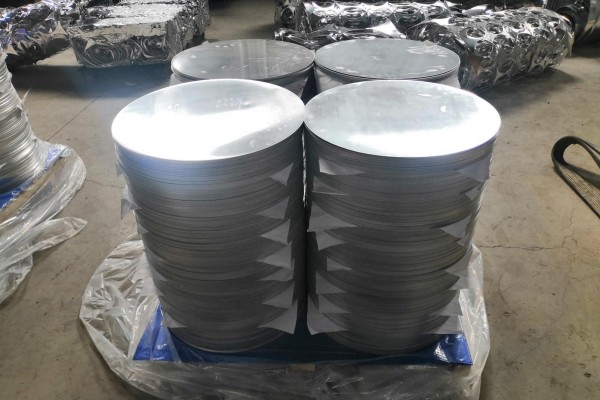
- Logistical Efficiency: We offer JIT (Just-in-Time) delivery programs. Our circles are interleaved with neutral craft paper or PE film to prevent scratching during automated feeding.
8. Expanded Application Portfolio
- Consumer Hardlines: High-end forged fry pans, clad stainless steel cookware cores, Dutch ovens.
- Small Appliances: Air fryer baskets, 炊飯器の内釜, 電気ケトル本体, coffee machine boilers.
- Commercial/HORECA: Hotel pans (Steam table pans), buffet chafing dishes, heavy-duty stockpots, ベーキングモールド.
- Specialty Items: Reflectors for lighting (utilizing the high reflectivity of pure aluminum), heat sinks for electronics.
9. Quality Assurance Infrastructure
9.1 Laboratory Capabilities
Our in-house lab is equipped with:
- Instron Universal Testing Machine: For precise tensile testing (伸長, UTS, YS).
- 金属顕微鏡: For grain size analysis (ASTM E112).
- Spectrometers: For instant chemical composition verification.
- Coating Adhesion Testers: To simulate non-stick application performance.
9.2 Certification Portfolio
- ISO 9001:2015: Quality Management System.
- ISO 14001:2015: Environmental Management System.
- FDA (アメリカ合衆国), DGCCRF (フランス), LFGB (ドイツ): Food Contact Compliance.
- 到着 & RoHS: Restriction of Hazardous Substances.
10. ロジスティクス, 包装, and Support
10.1 Export-Standard Packaging
- Eye-to-Sky or Eye-to-Wall: Orientation based on customer preference.
- Moisture Barrier: Each bundle is wrapped in LDPE sheeting and sealed with desiccant packs to prevent oxidation during sea freight.
- Wooden Crates: Heat-treated (ISPM-15 compliant) wooden crates for maximum protection against forklift damage.
10.2 Technical Partnership
We don’t just sell aluminum; we provide engineering support. Our technical team can assist with:
- Blank Diameter Calculation: Helping you determine the exact circle size needed for your specific pot shape to minimize trim scrap.
- Draw Reduction Ratios: Advising on the number of drawing stages required for deep pots to maximize success with our material.
- Sample Provision: Free samples (up to 5kg) are available for press trials and laboratory verification.