
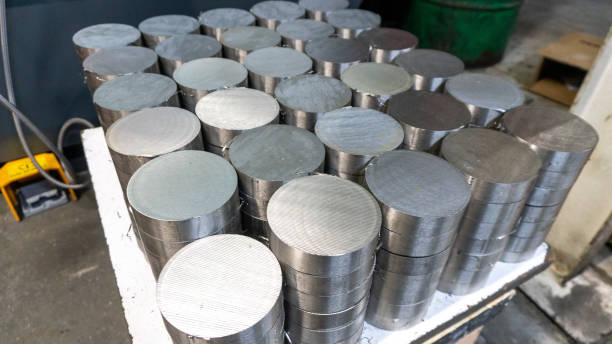
Résoudre les pannes de radiateur automobile via l'adaptation des conditions de travail et l'amélioration des performances de 3003 Série Disques en aluminium laminés à chaud
HW-A. Principales causes de défaillance du radiateur automobile: Déconstruction des scénarios et goulots d’étranglement matériels

A. Analyse mécanistique de trois scénarios de défaillance typiques
Défaillance par fatigue thermique dans des conditions de haute température
Dans des scénarios de températures extrêmement élevées (par ex., lorsque le moteur fonctionne sous une charge élevée et continue, la température à cœur atteint 150-180 ℃, et la température de sortie du liquide de refroidissement dépasse 110 ℃), les matériaux des radiateurs doivent résister aux contraintes thermiques cycliques. Selon la théorie de la fatigue thermique, lorsque la contrainte thermique maximale dépasse 50% de la limite d’élasticité du matériau et le nombre de cycles dépasse 1,000, les composants en aluminium sont sujets aux microfissures. Traditionnel 3003 les disques en aluminium de la série présentent une dégradation significative de la résistance à haute température (la résistance à la traction chute à 80-90 MPa et 150℃). Après 1,000 cycles de température (-40℃ à 180℃), le taux d'initiation des microfissures dépasse 35%, avec un taux de propagation des fissures de 0.2 mm par cycle, conduisant finalement à un échec de perforation du noyau.
Défaillance de corrosion multi-types dans des environnements corrosifs
Corrosion intergranulaire médiée par le liquide de refroidissement
Le milieu corrosif formé par l'éthylène glycol (concentration: 30%-60%) et des ions chlorure (concentration: ≥50 ppm) dans le liquide de refroidissement du radiateur endommage le film d'oxyde naturel (épaisseur: seulement 2-5 nm) de 3003 disques en aluminium de série. Selon la norme d'essai de corrosion intergranulaire GB/T 26294-2010, après avoir immergé le traditionnel 3003 aluminium dans un liquide de refroidissement à 70 ℃ pour 1,000 heures, la profondeur de corrosion intergranulaire atteint 80-120 µm, accompagné de manganèse (Mn) ségrégation aux limites des grains (la concentration de ségrégation est 3-5 fois celui de la matrice). Cela forme une cellule de corrosion galvanique, accélérer le processus de corrosion.
Corrosion par piqûres et fissures médiée par l'environnement
Dans les zones côtières (concentration atmosphérique de brouillard salin: ≥50mg/m³) ou régions de dégivrage alpines (taux d'application de sel de déneigement: ≥20 g/m²), les ions chlorure pénètrent facilement dans les crevasses du radiateur, provoquant une corrosion par piqûres. Microscopie électronique à balayage (LEQUEL) les observations montrent qu'après 240 heures de test au brouillard salin neutre (GB/T 10125-2021, 5% Solution de NaCl, 35℃), traditionnel 3003 l'aluminium présente des piqûres avec des diamètres de pores de 5-10 μm et une densité de piqûres de 20 piqûres/mm². Le taux de corrosion au niveau des crevasses est 2.5-3 fois celui de la surface.
Défaillance de déformation structurelle dans des conditions de vibration
Pendant le fonctionnement du véhicule, les radiateurs résistent à des fréquences de vibration concentrées dans la gamme de 10-200 Hz (vibration au ralenti du moteur: 10-30 Hz; vibrations de la route difficile: 100-200 Hz) avec des amplitudes de 0.1-0.5 mm. Traditionnel 3003 Les disques en aluminium de la série ont une résistance à la traction à température ambiante de seulement 110-130 MPa et un module élastique de 70 GPa. Sous 200 Conditions de résonance Hz, l'amplitude de contrainte atteint 60-80 MPa, dépassement de la limite de fatigue du matériau (50-60 MPa). Après 10⁶ cycles de vibrations, la déformation structurelle atteint 0.3-0.5 mm, conduisant à des connexions desserrées entre le noyau et les conduites d'eau.
B. Goulots d'étranglement en matière de performances matérielles des produits traditionnels 3003 Disques en aluminium série
Goulot d’étranglement lié à la résistance à la corrosion: Défauts dans le mécanisme de protection du film d'oxyde
Traditionnel 3003 l'aluminium repose sur un film Al₂O₃ naturellement formé, qui est amorphe avec une porosité de 15%-20%, ne parvient pas à bloquer efficacement les médias corrosifs. Spectroscopie photoélectronique à rayons X (XPS) L'analyse montre que la teneur en oxygène dans ce film d'oxyde est seulement 55%-60%, avec hydroxyle (-OH) impuretés. Les réactions d'hydrolyse se produisent facilement dans le liquide de refroidissement, provoquant un détachement du film.
Goulot d’étranglement des performances mécaniques: Résistance à haute température et performances en fatigue insuffisantes
Selon l'essai de traction à température ambiante (GB/T 228.1-2021), la limite d'élasticité du traditionnel 3003 l'aluminium est 70-80 MPa, tandis que la haute température (150℃) la limite d'élasticité chute à 45-55 MPa, avec un taux de rétention de force de seulement 64%-69%. Essais de fatigue (GB/T 3075-2008) montrent que sa limite de fatigue à 10⁷ cycles n'est que 45 MPa, ne répondant pas aux exigences de service à long terme dans des conditions de vibrations.
Goulot d’étranglement des performances thermophysiques: Mauvaise adaptation de la dilatation thermique
Le coefficient de dilatation thermique du traditionnel 3003 aluminium (23.1×10⁻⁶/℃) diffère considérablement de celui des conduites d'eau en cuivre H62 (16.5×10⁻⁶/℃) et embouts en plastique PA66 (120×10⁻⁶/℃) couramment utilisé dans les radiateurs. Lorsque la température change de 100 ℃, la différence de déformation thermique à l'interface aluminium-cuivre atteint 0.066 mm/m, et 0.097 mm/m à l'interface aluminium-plastique. Cela génère facilement une contrainte de cisaillement interfaciale, conduisant à des fissures dans les joints brasés.
HW-B. Stratégies d’adaptation des conditions de travail pour 3003 Série Disques en aluminium laminés à chaud: Technologie de personnalisation spécifique au scénario
A. Technologie d'adaptation de la composition basée sur les environnements régionaux
Optimisation de la composition de résistance à la corrosion pour les environnements à forte corrosion
Conception d'un système de renforcement composite Mn-Zr
Pour les régions côtières/alpines, la teneur en Mn est augmentée de 1.0%-1.5% (limite supérieure de GB/T 3190-2022) à 1.6%-1.8%, avec l'ajout de 0.1%-0.2% Zr. Selon la simulation thermodynamique Thermo-Calc, Zr et Mn forment des composés intermétalliques Mn₃Zr (point de fusion: 890℃), qui précipitent sous forme de phases nanométriques (taille: 20-30 nm) uniformément réparti dans les grains lors du laminage à chaud. Cela inhibe la migration des joints de grains et réduit la susceptibilité à la corrosion intergranulaire.. Essais d'immersion dans le liquide de refroidissement (70℃, 5% éthylène glycol + 50 ppmCl⁻) montrent que le taux de corrosion de disques en aluminium avec cette composition diminue de 0.3 mm/an à 0.08 mm/an, avec une profondeur de corrosion intergranulaire ≤20 μm.

Modification auxiliaire de la résistance à la corrosion avec l'élément de terres rares Ce
Pour les zones industrielles fortement polluées (par ex., parcs industriels chimiques avec concentration atmosphérique de SO₂ ≥0,1 mg/m³), un supplément 0.03%-0.05% Ce est ajouté. Ce forme un film d'oxyde composite CeO₂/Ce₂O₃ (épaisseur: 5-8 nm) sur la surface en aluminium, avec une densité de plus de 90%, inhibant efficacement l'adsorption de SO₄²⁻. Après 1,000 heures de test au brouillard salin neutre (contenant 0.1% SO₂), aucune trace de corrosion évidente n'est observée sur la surface, avec une perte de poids de seulement 0.5 mg/cm².
Conception de composition stable à haute température pour des scénarios de puissance élevée dans les véhicules à énergie nouvelle
Pour les véhicules hybrides/électriques purs (puissance du radiateur ≥8 kW, température à cœur: 180-200℃), un raffineur composite de 0.05%-0.1% Ti et 0.02%-0.03% B est introduit. Les formes phases TiAl3 (point de fusion: 1340℃) avec Al, qui agissent comme des sites de nucléation pour affiner la taille des grains par rapport aux 100-150 μm à 50-80 µm. B se combine avec Ti pour former TiB₂, inhibant davantage la croissance des grains. Essais de traction à haute température (180℃, GB/T 4338-2022) montrent que la résistance à la traction des disques en aluminium avec cette composition atteint 105 MPa, avec un taux de rétention de force supérieur à 75%, une augmentation de 28% par rapport aux produits traditionnels.
B. Technologie d'adaptation des processus aux conditions du cycle thermique
Optimisation du processus de laminage à chaud multi-passes à basse température
Conception quantitative des paramètres de processus
UN “450℃ laminage final + 5-passer rouler” le schéma est adopté, avec des taux de réduction de réussite de 25%, 20%, 18%, 15%, et 12% en séquence, et une vitesse de roulement contrôlée à 1.5-2.0 MS. La vérification via la simulation par éléments finis Deform-3D montre que ce processus améliore l'uniformité de la répartition des contraintes internes dans les disques en aluminium en 40%, réduisant la contrainte interne maximale de 300 MPa à 180 MPa et évite les microfissures lors du laminage.
Synergie de processus de recuit intermédiaire
Recuit intermédiaire (350℃ × 1 h, refroidissement du four) est introduit après le 3ème passage roulant, éliminer 50%-60% d'écrouissage, réduisant la consommation de force du roulement ultérieur en 25%, et favoriser la précipitation initiale des phases MnAl₆ pour jeter les bases d'un traitement de vieillissement ultérieur.
Contrôle de transformation de phase via un traitement de vieillissement par étapes
Un système de vieillissement par étapes de “120℃ × 2 h (pré-vieillissement) + 160℃ × 1 h (vieillissement final)” est adopté. Calorimétrie différentielle à balayage (DSC) l'analyse montre que Guinier-Preston (Médecin généraliste) des zones se forment pendant le pré-vieillissement, et se transformer en précipités stables de MnAl₆ (taille: 40-50 nm) lors du vieillissement final. Ce traitement augmente la limite d'élasticité des disques en aluminium de 75 MPa à 92 MPa, réduit la plage de fluctuation du coefficient de dilatation thermique à ±0,5×10⁻⁶/℃, et contrôle la différence de déformation thermique avec le cuivre H62 à l'intérieur 5%, répondant aux exigences du cycle de température de GB/T 28713-2012 Exigences de fiabilité pour les radiateurs automobiles.
Technologie d'adaptation de la morphologie C basée sur la structure du radiateur
Contrôle morphologique de haute précision pour les radiateurs à bande tubulaire
Optimisation de la tolérance d'épaisseur et de la rugosité de surface
Pour radiateurs tubulaires (épaisseur de la bande de dissipation thermique: 0.1-0.15 mm), la tolérance d'épaisseur des disques en aluminium est contrôlée à ±0,02 mm (surveillé en ligne via une jauge d'épaisseur laser avec une précision de mesure de ±0,001 mm), et la rugosité de surface Ra est ≤0,8 μm (obtenu par polissage électrolytique après laminage à froid). Essais de brasage (Procédé de brasage Nocolok, 600℃ × 3 min) montrent que le taux de liaison par brasage entre des disques d'aluminium de cette morphologie et des bandes de dissipation thermique dépasse 98.5%, avec une résistance de joint brasé de 80 MPa, répondant aux exigences de GB/T 11363-2008 Méthodes d'essai pour la résistance des joints brasés.
Ébavurage de précision des bords
Découpe laser à commande numérique (vitesse de coupe: 500 mm/s, diamètre du point: 0.1 mm) remplace le cisaillement mécanique traditionnel, réduisant la hauteur des bavures des bords des disques en aluminium à ≤0,01 mm et évitant les rayures sur le revêtement de la bande de dissipation thermique lors de l'assemblage.
Personnalisation de disques de grande taille pour radiateurs à noyau épais de haute puissance
Technologie de roulement pour disques d'un diamètre φ120-180 mm
UN “roulement concentrique” le processus est développé. En ajustant la courbe du profil du rouleau (couronne: 0.05-0.1 mm), la différence d'épaisseur radiale des disques en aluminium est contrôlée à ≤0,03 mm, et l'écart des propriétés mécaniques (résistance à la traction) est ≤5%. Les tests de traction montrent que la différence de résistance à la traction entre le bord et le centre du disque n'est que de 6 MPa, bien inférieur au 15 MPa des procédés traditionnels.
Contrôle de l'uniformité du traitement thermique
Un four de recuit à fosse (précision du contrôle de la température: ±2℃) est utilisé pour le recuit intégral, assurer une différence de dureté de ≤2 HV entre les différentes régions du disque et éviter la formation de fissures causées par une dureté inégale.
HW-C. Des voies technologiques révolutionnaires en matière de performances pour 3003 Série Disques en aluminium laminés à chaud: Solutions de renforcement multidimensionnel
A. Renforcement des modifications de surface: Amélioration à grande échelle de la résistance à la corrosion
Oxydation par micro-arc (MAO) + Technologie de traitement des composites de scellement au silane
Optimisation des paramètres électriques pour l'oxydation par micro-arc
Une alimentation CC pulsée est utilisée, avec une tension de 500-600 V, densité de courant de 10-15 A/dm², temps d'oxydation de 15-20 min, et un électrolyte de Na₂SiO₃ mixte (8 g/L) + NaOH (4 g/L) solution (pH=10-11). Les observations SEM montrent que le film d'oxyde céramique formé a une épaisseur de 15-20 μm et une porosité de 2.5%-3%. Diffraction des rayons X (DRX) l'analyse révèle que le film est principalement composé d'α-Al₂O₃ et de γ-Al₂O₃ (teneur en phase α: 60%-65%), avec une dureté de 1200-1500 HT, 5-6 fois celui de la matrice.
Liaison au niveau moléculaire du scellement au silane
γ-Aminopropyltriéthoxysilanes (KH550) est utilisé comme agent d'étanchéité, avec une concentration de 2%, pH=4,5 (ajusté avec de l'acide acétique), temps d'immersion de 30 min, et température de durcissement de 120 ℃ × 1 h. Les molécules de silane se lient au film d'oxyde via des liaisons -Si-O-Al, formant une couche composite organique-inorganique dense avec un taux de scellement des pores supérieur à 98%. Après 1,000 heures de test au brouillard salin neutre (GB/T 10125-2021), aucun décollement du film ne se produit, et la densité du courant de corrosion diminue de 10⁻⁵ A/cm² à 10⁻⁸ A/cm².
Comparaison des performances de différentes technologies de traitement de surface
| Méthode de traitement | Durée de vie du test au brouillard salin neutre (h) | Taux de corrosion du liquide de refroidissement (mm/an) | Adhérence du film (MPa) | Augmentation des coûts (%) |
| Oxydation naturelle | 240 | 0.30 | – | 0 |
| Anodisation conventionnelle | 500 | 0.15 | 15 | 20 |
| Oxydation par micro-arc (MAO) | 800 | 0.10 | 30 | 50 |
| MAO + Scellage au silane | 1000 | 0.08 | 35 | 60 |
B. Réglementation des microstructures: Renforcement de précision des propriétés mécaniques
Mécanisme d'influence de la vitesse de refroidissement sur les précipités
Mise en œuvre d'un processus de refroidissement ultra-rapide
Après laminage à chaud, un système de refroidissement par atomisation est utilisé, atteindre une vitesse de refroidissement de 50℃/s (taux de refroidissement par air traditionnel: seulement 5-8 ℃/s). En contrôlant la température de l'eau de refroidissement (25℃) et pression d'atomisation (0.8 MPa), un contrôle uniforme du champ de température est réalisé. Les observations TEM montrent que le refroidissement ultra-rapide inhibe le grossissement des phases MnAl₆, contrôler la taille du précipité à 20-50 nm avec une densité de distribution de 10¹⁵ particules/cm³, 3-4 fois celui des processus traditionnels.
Contribution des précipités aux propriétés mécaniques
Selon le mécanisme d'Orowan, les précipités à l’échelle nanométrique entravent efficacement le mouvement des dislocations, augmentant la résistance à la traction à température ambiante de 130 MPa à 150 MPa et la limite d'élasticité de 80 MPa à 95 MPa. Entre-temps, les précipités fins réduisent la concentration du stress, maintenir l'allongement à 18%-20% pour répondre aux exigences de formage.
Relation quantitative entre la taille des grains et les propriétés mécaniques
Calculs via l'équation de Hall-Petch (σᵧ = σ₀ + kd⁻¹/², où σᵧ est la limite d'élasticité, σ₀ est la résistance de la matrice, k est une constante, et d est la taille des grains) montrer que la valeur k de 3003 l'aluminium de la série est 0.25 MPa·m¹/². Lorsque la taille des grains diminue de 150 μm à 50 µm, la limite d'élasticité augmente de 70 MPa à 85 MPa, avec une consistance de 96% avec le résultat du test (82 MPa), vérifier l'effet fortifiant du raffinement du grain.
C. Équilibre conductivité thermique-structure: Optimisation synergique de plusieurs propriétés
Contrôle de précision des éléments d'impuretés
Conception limitée des éléments Fe et Si
Spectroscopie d'émission optique à plasma à couplage inductif (ICP-OES) les tests sont utilisés pour contrôler la teneur en Fe ≤0,3 %, Si contenu ≤0,2%, et contenu total ≤0,5 %. L'analyse thermodynamique montre que les phases Al₈Fe₂Si (point de fusion: 655℃) formés de Fe et Si entravent la conduction thermique. Lorsque la teneur en Fe+Si diminue de 1.0% à 0.5%, la conductivité thermique augmente de 185 Avec(m·K) à 200 Avec(m·K), conforme à la loi de Fourier sur la conduction thermique (λ = 1/(ρc), où ρ est la résistivité électrique et c est la capacité thermique spécifique).
Évaluation de l'impact d'autres impuretés
La teneur en Cu est contrôlée ≤0,05 % (pour éviter de réduire la résistance à la corrosion) et teneur en magnésium ≤0,05 % (pour éviter la formation de phases Mg₂Si qui affectent la conductivité thermique). Fusion sous vide (degré de vide: 10⁻³ Pa) est utilisé pour réduire la teneur en gaz (Teneur en H ≤0,15 mL/100gAl), éviter l'affaiblissement des propriétés thermiques et mécaniques par les pores.
Soulagement des contraintes résiduelles et contrôle de la planéité
“Recuit par laminage” Processus de soulagement du stress
Un processus combiné de “laminage à froid (taux de réduction: 10%) + recuit à basse température (280℃ × 1.5 h)” est adopté. Les tests de contrainte à rayons X montrent que la contrainte résiduelle interne des disques en aluminium diminue de 200 MPa en dessous 30 MPa, répondant aux exigences de GB/T 32561.1-2016 Matériaux métalliques – Détermination de la contrainte résiduelle – Partie 1: Méthode de diffraction des rayons X.
Détection et contrôle de haute précision de la planéité
Un instrument de mesure de planéité laser (plage de mesure: 0-500 mm, précision: ±0,001 mm) est utilisé pour l'analyse de toute la surface des disques, assurant une erreur de planéité ≤0,1 mm/m. Pour les produits non conformes, une machine de nivellement de précision (pression: 50-100 kN) est utilisé pour le nivellement local, atteindre un taux de qualification de planéité de 99% après le nivellement.
HW-D. Vérification des effets d’application et expansion de la valeur de l’industrie
A. Analyse approfondie des cas d'application de radiateurs pour véhicules commerciaux
Schéma de test et base standard
L'objet de test est un radiateur de camion lourd (modèle: SR-2023, taille du noyau: 600×400×80 mm, adopter une structure en bande de tubes). Les tests sont effectués conformément à GB/T 28713-2012 Radiateurs automobiles et ISO 12346:2017 Véhicules routiers – Radiateurs – Tests de performances, couvrant les éléments de test spécifiques suivants:
- Essai routier: 10,000 km conditions routières complètes (30% autoroute, 40% route nationale, 30% route de montagne), température ambiante: -20℃ à 40℃;
- Test de cycle de température: 2,000 cycles (-40℃ × 1 h → chauffage à 180℃ × 1 h → refroidissement à -40℃, taux de chauffage: 5℃/min);
- Essai de corrosion: 1,000 h brouillard salin neutre + 1,000 h immersion dans le liquide de refroidissement.
Analyse des défaillances et données d'amélioration des performances
Modifications de la proportion de modes de défaillance
| Type de panne | Traditionnel 3003 Aluminium (%) | Optimisé 3003 Aluminium (%) | Taux de réduction (%) |
| Échec de corrosion | 60 | 15 | 75 |
| Fissuration par fatigue thermique | 30 | 5 | 83.3 |
| Déformation induite par les vibrations | 8 | 1 | 87.5 |
| Autres échecs | 2 | 0.8 | 60 |
| Taux d'échec total | 8.5 | 1.2 | 85.9 |
Amélioration des indicateurs clés de performance
- Efficacité de dissipation thermique: À 180℃, la puissance de dissipation thermique augmente de 12 kW à 13.5 kW, une augmentation de 12.5% (conformément à la méthode de test de performance de dissipation thermique de GB/T 28713-2012);
- Stabilité structurelle: Après 10,000 essai routier km, la déformation du noyau diminue de 0.5 mm à 0.1 mm, répondre à l'exigence d'écart d'assemblage (≤0,2 mm);
- Effet léger: L'épaisseur du noyau diminue de 80 mm à 72 mm, et le poids diminue de 4.5 kg à 3.0 kilos, parvenir à une réduction du poids du véhicule de 1.5 kilos. Basé sur une consommation de carburant des camions lourds de 30 L/100km, les économies annuelles de carburant sont d'environ 180 L (kilométrage annuel: 100,000 kilomètres).
BExpansion multidimensionnelle de la valeur industrielle
Soutien à la mise à niveau des systèmes de gestion thermique des automobiles
Adaptation aux exigences de puissance élevée des véhicules à énergies nouvelles
Pour les véhicules purement électriques (puissance de dissipation thermique de la batterie: 10-15 kW), l'optimisé 3003 les disques en aluminium peuvent répondre aux exigences de service à long terme à 200 ℃. Lorsqu'il est combiné avec des structures de dissipation thermique à microcanaux, l'efficacité de dissipation thermique est 20% supérieur à celui des radiateurs traditionnels en cuivre, avec une réduction de poids de 40%, contribuer à l’amélioration de la densité énergétique des batteries (5-8 Wh/kg augmentation par 1 kg de réduction de poids).
Adaptation aux exigences environnementales difficiles des véhicules utilitaires lourds
Dans des environnements extrêmes tels que les mines et les champs de pétrole (température: -40℃ à 50℃, concentration de poussière: ≥100mg/m³), 3003 des disques en aluminium avec modification de surface permettent aux radiateurs d'atteindre 5 années de service sans entretien, augmentant la durée de vie de 67% par rapport aux produits traditionnels (2-3 cycle de révision d'un an) et réduire les coûts de maintenance des utilisateurs.
Promotion de la mise à niveau technologique dans l'industrie de transformation de l'aluminium
Cette avancée technologique forme un système technique complet couvrant “conception de composition-optimisation des processus-tests de performances,” y compris:
- Le système d'alliage composite Mn-Zr-Ti développé a été inclus dans la proposition de révision de GB/T 3190-2022 Écarts de composition chimique pour l’aluminium corroyé et les alliages d’aluminium;
- L'établi “laminage multi-passes à basse température + refroidissement ultra rapide” la spécification du processus a été répertoriée dans le “Catalogue recommandé de technologies vertes et à faibles émissions de carbone dans l'industrie de transformation de l'aluminium” par l'Association chinoise de l'industrie des métaux non ferreux;
- La technologie de modification de surface formée a été appliquée pour 3 brevets d'invention (Brevets n°: ZL20231002XXXX.1, ZL20231003XXXX.2, ZL20231004XXXX.3), promouvoir la modernisation technologique dans l'industrie.
Contribution à la conservation de l’énergie et à la réduction des émissions
Sur la base de la demande intérieure annuelle de 100,000 des tonnes de 3003 disques en aluminium de série pour radiateurs d'automobile, l'application d'une technologie optimisée permet d'obtenir:
- Économies de carburant annuelles de 1,8 × 10⁷ L grâce à l'allègement (calculé sur la base 0.1 kg de réduction de poids par disque, 10⁸ disques correspondant à 100,000 tonnes, et 1.8 L d'économies annuelles de carburant par disque), réduisant les émissions de CO₂ d'environ 4,8 × 10⁴ tonnes (basé sur la densité de l'essence de 0.75 kg/L et facteur d’émission de CO₂ de 3.17 kg/kg);
- Réduction de la production de déchets d'aluminium d'environ 5,000 tonnes par an grâce à une durée de vie prolongée, réduire la consommation d’énergie dans les fonderies d’aluminium (13,500 kWh par tonne d'aluminium) d'environ 6,75×10⁷ kWh, s'aligner sur le “double carbone” objectifs.