

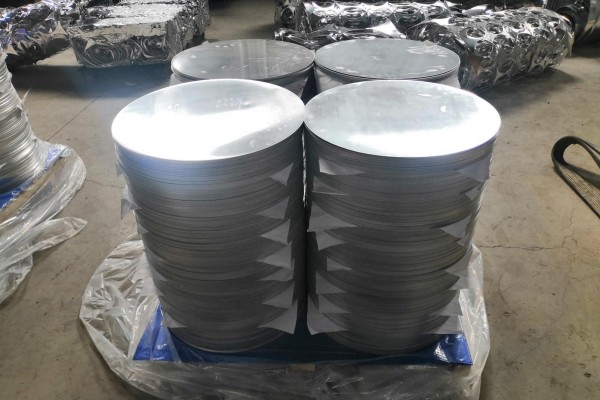
High-quality cooking and kitchenware production special 1100 aluminum round sheet
1. Industry Background: Why is Cookware Manufacturing Heavily Reliant on 1100 Aluminum Circles?
In the modern cookware manufacturing system, the thermal conductivity, ductility, and stamping stability of the base material directly determine the quality grade and market competitiveness of the final product, be it drawn pots, wok blanks, steamers, saucepans, or rice cooker inner pots. As a representative material of the 1000 series commercial pure aluminum, 1100 aluminum circles are a core raw material for deep-drawing cookware due to their high purity (Al ≥ 99.0%) and excellent plastic deformation capability.
Compared to alloys like 3003 and 5052, 1100 aluminum emphasizes:
- Exceptional ductility
- Superior thermal conductivity
- Excellent surface quality
- Controllable cost
- Good food contact safety
Therefore, 1100 aluminum circles have long held a significant market share in the base blank sector for mid-to-high-end kitchen utensils.

2. In-Depth Analysis of 1100 Aluminum Alloy’s Fundamental Properties
2.1 Chemical Composition and Material Nature
| Element | Content Range (%) |
|---|---|
| Al | ≥ 99.00 |
| Si+Fe | ≤ 0.95 (Typically Si<0.2, Fe<0.4 for better grades) |
| Cu | 0.05 – 0.20 |
| Others | ≤ 0.15 |
Material Nature: 1100 is a commercially pure aluminum, strengthened primarily by strain hardening (cold working) rather than heat treatment. Its properties are finely tuned through cold working and annealing processes, offering a wide range of achievable mechanical states.
2.2 Key Physical and Chemical Properties
| Property | Typical Value / Description |
|---|---|
| Density | 2.71 g/cm³ |
| Thermal Conductivity | ~222 W/(m·K) |
| Electrical Conductivity | ~59% IACS |
| Melting Point | ~660 °C |
| Coefficient of Linear Expansion | 23.6 x 10⁻⁶ /K |
| Corrosion Resistance | Fair. Forms a protective oxide layer. Requires surface treatment (e.g., anodizing, coating) for food use. |
High thermal conductivity is its core advantage, enabling rapid, uniform heating and energy efficiency.
2.3 Mechanical Properties by Temper (Key for Cookware)
The ‘Temper’ designation defines the processing history and final properties. For 1100 cookware circles, the most common are:
| Temper | Tensile Strength (MPa) | Yield Strength (MPa) | Elongation (%) | Primary Application in Cookware |
|---|---|---|---|---|
| O (Annealed) | 90 – 110 | ≥ 35 | ≥ 30 | Deep drawing for complex shapes (e.g., wok body, first draw). Maximum formability. |
| H14 (Half Hard) | 110 – 145 | ≥ 95 | 8 – 12 | Moderate draws or parts requiring some stiffness post-forming. Excellent balance. |
| H24 | 130 – 160 | ≥ 110 | 6 – 10 | Similar to H14. Used for parts needing higher strength after forming. |
Selection Principle: Use softer tempers (O) for severe draws and harder tempers (H14/H24) for final shape or parts needing rigidity.
3. Irreplaceable Advantages in Cookware Production
3.1 Superior Deep Drawability: The Micro-Mechanism
- High Strain Hardening Exponent (n-value): Promotes uniform deformation, resisting localized thinning (necking), allowing a higher Limiting Drawing Ratio (LDR).
- High Plastic Strain Ratio (r-value): Indicates resistance to thinning in the thickness direction, favoring material flow into the die cavity for deeper draws.
- Fine, Equiaxed Grain Structure: Achieved through proper annealing. This is the microstructural foundation for excellent formability, preventing “orange peel” surface and cracking.
- Low Planar Anisotropy: Results in low and uniform “earing” (wavy edges after drawing), maximizing material utilization and minimizing trim scrap.
3.2 Exceptional Thermal Conductivity
With a thermal conductivity approximately 5x that of stainless steel, 1100 aluminum:
- Enables rapid response to heat input.
- Creates a uniform thermal field across the cooking surface, preventing hot spots.
- Improves energy efficiency in both home and commercial kitchens.

3.3 Surface Quality: The Foundation for Coatings
The durability of non-stick (PTFE, ceramic) or hard-anodized coatings depends entirely on the substrate.
- Cleanliness: Essential for coating adhesion. Any rolling oil or contaminant residue can cause blistering and peeling.
- Surface Profile: A properly controlled, uniform surface roughness provides a mechanical “anchor” for coatings (mechanical interlocking).
3.4 Cost-Effectiveness
- Lower melting/alloying costs.
- Easier forming, reduced tool wear, faster production cycles.
- High scrap value and easy recyclability.
4. Core Applications and Manufacturing Processes
4.1 Woks / Frying Pans
- Process: Deep drawing often followed by spinning to finalize shape and wall thickness.
- Material Requirement: Extremely high n-value and r-value to withstand severe deformation.
- Finish: Interior often receives hard anodizing or non-stick coating. Exterior may be polished, painted, or clad with a magnetic layer (for induction).
4.2 Rice Cooker Inner Pots
- Process: Multi-stage deep drawing. Demands exceptional thickness uniformity and zero surface defects.
- Material Requirement: High purity is critical. Impurities or inclusions can become initiation points for coating failure under thermal cycling.
- Finish: Interior non-stick coating (fluoropolymer or ceramic).
4.3 Stock Pots, Steamers, Saucepans
- Process: Single or moderate drawing, followed by flanging/crimping.
- Material Requirement: High planar isotropy for uniform rim properties and consistent wall height after flanging. Tight thickness tolerance is key for large-diameter pots.
5. Production Process and Quality Control for High-Quality 1100 Circles
Core Process Flow: Melting & Casting → Homogenization → Hot Rolling → Cold Rolling → Intermediate Annealing → Finish Rolling → Final Annealing → Blanking/Circle Slitting → Surface Cleaning → Inspection & Packing.
| Key Control Point | Target & Impact |
|---|---|
| Annealing | Controls final grain size and uniformity. Directly determines deep draw performance. |
| Cold Rolling | Affects surface finish, flatness, and thickness tolerance. |
| Blanking Die | Ensures precise diameter and minimal burr. |
| Cleaning Line | Achieves a chemically clean, active surface for subsequent coating. |
Key Quality Metrics:
- Grain Size: Typically ASTM 6-8 for optimal formability.
- Earing Percentage: Should be minimized (<3% for premium grades).
- Dimensional Tolerance: Thickness tolerance of ±0.02mm or tighter for high-end applications.
- Surface Cleanliness: Verified by water-break test or instrumental analysis.
6. Purchasing and Selection Guidelines
6.1 Technical Specification
Define requirements referencing standards like ASTM B209, EN 485, or GB/T 3880, with tighter “cookware-specific” criteria.
6.2 Key Inspection Items
- Chemistry: Mill test certificate for each heat.
- Mechanical Properties: Tensile test per specified temper.
- Formability Tests: Erichsen Cupping Test (IE value) or, ideally, Limiting Drawing Ratio (LDR) test.
- Metallography: Grain size and inclusion rating.
- Dimensional & Dimensional Checks: Thickness, diameter, flatness.
- Surface Quality: Visual inspection under good lighting. Free of scratches, dents, stains, roll marks.
- Cleanliness: Water-break test or equivalent.
6.3 Supplier Assessment
Evaluate if the supplier has key equipment like a Continuous Annealing Line (CAL), online shape control, and surface inspection systems, which are critical for batch-to-batch consistency.
7. Detailed Comparison: 1100 vs. 3003 for Cookware
| Property | 1100 (Commercial Pure Aluminum) | 3003 (Al-Mn Alloy) | Selection Guide |
|---|---|---|---|
| Main Composition | Al≥99.0%, Cu 0.05-0.20 | Al bal., Mn 1.0-1.5 | |
| Strengthening | Strain Hardening | Solid Solution (Mn) + Strain Hardening | |
| Typical O-Temper Tensile | 90-110 MPa | 110-130 MPa | 3003 is ~20% stronger |
| Typical O-Temper Elongation | ≥30% | ≥25% | 1100 is more ductile |
| Thermal Conductivity | ~222 W/(m·K) | ~193 W/(m·K) | 1100 is ~15% better |
| Deep Drawability | Excellent, higher LDR | Good | For complex draws: Choose 1100 |
| Sag Resistance | Fair (softer at high temp) | Better | Consider 3003 for oven-use items |
| Cost | Lower | Slightly Higher | 1100 has cost advantage |
| Typical Use | Rice cooker pots, deep-drawn woks, pot bodies | Pressure cooker bodies, baking sheets, grids | Choose based on design and process challenge |
8. Future Trends and Evolving Requirements
- Ultra-Fine Grain Technology: Advanced thermomechanical processing to achieve submicron grains, enhancing strength while maintaining ductility.
- Ultra-High Surface Quality: For next-gen coatings (e.g., ceramic, diamond-like carbon), requiring nano-scale surface control. Processes like electropolishing and plasma cleaning will see wider use.
- Performance Customization: Tailoring sheet texture, anisotropy, and property curves based on customer’s CAE simulations for optimal “material-process-product” matching.
- Sustainability: Using higher proportions of recycled aluminum with advanced refining. Developing greener rolling/cleaning chemistries.
- Clad/Composite Materials: 1100 as a core, clad with other materials (stainless steel, copper, antimicrobial layer) for multi-functionality.
9. Frequently Asked Questions (FAQ) – Advanced
Q1: Our stock pots develop a rough “orange peel” surface after drawing. Why?
A: This is typically due to excessively coarse grains in the aluminum sheet. It can be caused by improper annealing (overheating). Request material with a certified fine grain size (e.g., ASTM 7 or finer) and review your own annealing processes if applicable.
Q2: How can we test if a 1100 circle is suitable for our new, complex pan design?
A: Besides standard Erichsen tests, perform a production-simulating draw test using a tool with similar geometry. The most scientific method is a Forming Limit Diagram (FLD) test. Best practice: collaborate with your material supplier, providing the part design and drawing ratio for their recommendation and trial tooling support.
Q3: Why does the non-stick coating on our pans flake off after some use? Could the substrate be the cause?
A: Quite possibly. Beyond coating process issues, substrate problems leading to adhesion failure include: 1) Surface contamination (oils). 2) Surface defects (micro-inclusions, pores). 3) Low material purity (impurity phase segregation at the interface). 4) Inadequate pre-treatment before coating. Analysis (e.g., SEM/EDS) of the failure interface is recommended to identify the root cause.
Q4: We want to make an induction-compatible wok using 1100 aluminum. How should we design it?
A: Pure aluminum is non-magnetic. The standard solution is a clad bottom: The 1100 aluminum body is combined with a magnetic stainless steel disk (e.g., 430 grade) on the exterior bottom via pressure welding, brazing, or mechanical bonding. Design must account for differential thermal expansion, often using a multi-layer clad structure (e.g., Al-SS-Al).
10. Conclusion
The position of 1100 aluminum circles in cookware manufacturing stems from their unique combination of properties: exceptional deep drawability, superior thermal conductivity, excellent suitability for surface finishing, and cost-effectiveness. It is not just a raw material, but an engineering enabler for innovative designs and high-quality mass production.
For cookware manufacturers, building strategic partnerships with suppliers, gaining a deep understanding of the complete supply chain process, and jointly developing material specifications tailored to specific product needs are key strategies to transcend commoditized competition and create reliable, high-value products. In the ever-evolving field of materials science, a profound understanding and极致 application of classic materials like 1100 aluminum often builds the most durable market advantage.