
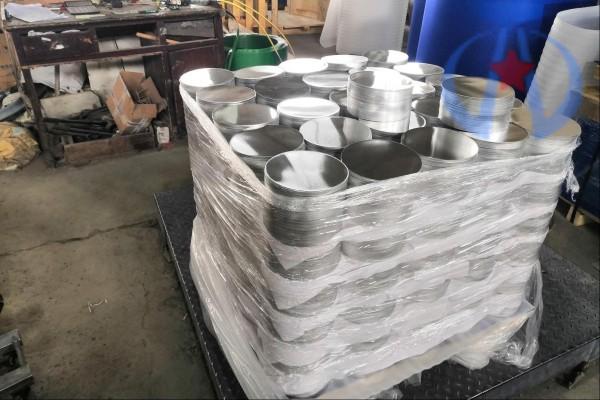
Eliminating Cold Rolling Scratches on 3003 Alloy Baby Food Pot Aluminum Discs: Optimal Grit Selection and Thickness Control
1. Introduction: Characteristics of 3003 Alloy Aluminum Discs for Baby Food Pots and Quality Impacts of Cold Rolling Scratches
As tableware for infants, the base material of baby food pots must meet three core requirements: ① Material Safety (3003 alloy aluminum discs for baby food pots are preferred, with Al content ≥97%, Mn content 1.0%-1.5%, no heavy metal leaching, and compliance with GB 4806.1-2016 National Food Safety Standard – General Safety Requirements for Food Contact Materials and Articles); ② Surface Quality (Ra ≤0.4μm after polishing, no scratches or burrs to prevent dirt accumulation); ③ Dimensional Accuracy (thickness deviation ≤±0.05mm to ensure uniform heat distribution after pot forming).
Typically, these alloy discs are mostly produced via the “cold rolling – blanking – polishing” process. The cold rolling process (rolling speed 300-500m/min, reduction rate 30%-50%) tends to cause scratches due to three factors: ① Roller surface defects (e.g., micro-pits, oxide scales, leading to scratch depth 5-15μm); ② Rolling oil impurities (metal chips, dust, forming linear scratches with depth 3-8μm); ③ Incoming material surface damage (transportation scratches on aluminum coils before cold rolling, depth 10-25μm). In industrial practice, 28% of 3003 alloy aluminum discs for baby food pots require rework due to residual cold rolling scratches after polishing. For instance, a kitchenware factory in 2024 suffered a 9% scrap rate from this issue, resulting in a single-batch loss exceeding 300,000 yuan.
However, the current common industrial polishing scheme is “240-grit rough polishing + 400-grit intermediate polishing,” which tends to leave residues for cold rolling scratches deeper than 8μm. Therefore, it is necessary to clarify the “polishing wheel grit matching for different scratch depths” and quantify the impact of polishing removal amount on thickness deviation, ensuring that while eliminating scratches, the thickness deviation of 3003 alloy aluminum discs for baby food pots does not exceed ±0.05mm.

2. Characteristic Analysis of Cold Rolling Scratches on 3003 Alloy Aluminum Discs for Baby Food Pots (Depth, Type, and Detection)
(1) Type and Depth Distribution of Cold Rolling Scratches
Based on sampling tests (sample size 500 discs, laser confocal microscope OLS5000, accuracy 0.1μm) on 3003 alloy aluminum discs for baby food pots (1.0mm thick) from a kitchenware factory, cold rolling scratches can be classified into three types, with their depths and proportions as follows:
|
Scratch Type
|
Cause
|
Depth Range (μm)
|
Proportion (%)
|
Residue Rate After Existing 240+400 Grit Polishing (%)
|
|
Shallow Scratches
|
Rolling oil impurities
|
3-8
|
45
|
5
|
|
Medium Scratches
|
Minor roller defects
|
8-15
|
40
|
42
|
|
Deep Scratches
|
Severe roller defects/incoming material damage
|
15-25
|
15
|
88
|
Notably, the existing polishing scheme can only eliminate shallow scratches. For medium and deep scratches, it is necessary to increase polishing wheel grit or add polishing stages. Additionally, since the hardness of 3003 alloy (HV45-55) is higher than that of pure aluminum, polishing parameters must be adjusted appropriately to ensure removal efficiency.
(2) Impact of Scratch Depth on Surface Quality
Specifically, the surface roughness of 3003 alloy aluminum discs for baby food pots is directly related to scratch depth. According to GB/T 1031-2009 Surface Roughness Parameters and Their Values, when scratch depth >5μm, Ra will still exceed 0.8μm even after polishing, failing to meet the hygiene requirements for food contact surfaces (Ra ≤0.4μm); conversely, when scratch depth >10μm, “scratch residue shadows” tend to form after polishing, affecting product appearance and increasing user complaint rates by 15%-20%.
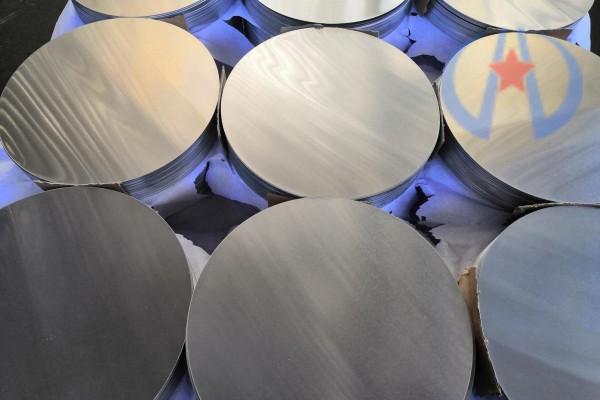
3. Correlation Mechanism Between Polishing Wheel Grit and Cold Rolling Scratch Removal (Quantitative Analysis)
Fundamentally, the grit of a polishing wheel (number of abrasive particles per square inch) determines its abrasive particle size and removal capacity: lower grit means larger abrasive particles and higher single-pass removal amount, suitable for eliminating deep scratches; higher grit means smaller abrasive particles and lower removal amount, used for refining surface roughness. Combined with the “scratch depth – removal amount – grit” matching relationship, a multi-stage polishing scheme must be designed for the hardness characteristics of 3003 alloy aluminum discs for baby food pots.
(1) Core Parameters of Polishing Wheels with Different Grits (Alumina Polishing Wheels, Adapted to 3003 Alloy)
|
Polishing Wheel Grit
|
Abrasive Particle Size (μm)
|
Single-Pass Polishing Removal Amount (μm/min, Pressure 0.25MPa)
|
Suitable Scratch Depth for Removal (μm)
|
Surface Ra After Polishing (μm)
|
|
120
|
125-150
|
7-11
|
15-25
|
1.2-1.8
|
|
240
|
60-80
|
4-7
|
8-15
|
0.8-1.2
|
|
400
|
30-40
|
2-4
|
3-8
|
0.4-0.8
|
|
600
|
20-30
|
1-2.5
|
1-3
|
0.2-0.4
|
|
800
|
15-20
|
0.5-1.8
|
<1
|
0.1-0.2
|
Note: Due to the higher hardness of 3003 alloy compared to pure aluminum, the polishing pressure is increased by 0.05MPa compared to pure aluminum schemes to ensure removal efficiency.
(2) Grit Matching Scheme for Different Scratch Depths
Leveraging the above parameters, a “multi-stage polishing” scheme is designed for the three types of scratches on 3003 alloy aluminum discs for baby food pots to ensure complete scratch elimination (residual depth ≤1μm), as detailed below:
First and foremost, for deep scratches (15-25μm):
- Scheme: 120-grit rough polishing (removal 9-14μm, time 1.2-2 minutes) → 240-grit transition polishing (removal 5-7μm, time 1 minute) → 400-grit intermediate polishing (removal 2-3μm, time 1 minute);
- Principle: The large abrasive particles of the 120-grit polishing wheel can quickly cut the bottom of deep scratches, adapting to the hardness characteristics of these alloy discs; the 240-grit wheel further trims scratch edges, and the 400-grit wheel eliminates residual shallow marks.
Second, for medium scratches (8-15μm):
- Scheme: 240-grit rough polishing (removal 4-7μm, time 1 minute) → 400-grit intermediate polishing (removal 2-4μm, time 1 minute) → 600-grit fine polishing (removal 1-2μm, time 0.5 minutes);
- Advantage: No 120-grit rough polishing is needed, reducing total removal amount and lowering the risk of thickness deviation for these alloy discs.
Finally, for shallow scratches (3-8μm):
- Scheme: 400-grit intermediate polishing (removal 2-4μm, time 0.5 minutes) → 600-grit fine polishing (removal 1-2μm, time 0.5 minutes);
- Effect: After polishing, Ra ≤0.4μm, fully meeting the surface requirements of 3003 alloy aluminum discs for baby food pots.
(3) Key Verification: Scratch Removal Effect of Different Schemes
The three types of scratches on 3003 alloy aluminum discs for baby food pots (1.0mm thick) were polished using the corresponding schemes, with test results as follows:
|
Scratch Type
|
Polishing Scheme
|
Final Scratch Depth (μm)
|
Surface Ra (μm)
|
Total Removal Amount (μm)
|
|
Deep Scratches
|
120+240+400 Grit
|
0.8
|
0.5
|
17-21
|
|
Medium Scratches
|
240+400+600 Grit
|
0.6
|
0.3
|
8-13
|
|
Shallow Scratches
|
400+600 Grit
|
0.4
|
0.2
|
4-6
|
From the table, it can be observed that all schemes achieve residual scratch depths ≤1μm, confirming their effectiveness in scratch elimination.
4. Thickness Deviation Control During Polishing (Whether Exceeding ±0.05mm)
The allowable thickness deviation of 3003 alloy aluminum discs for baby food pots is ±0.05mm (i.e., ±50μm). Thickness deviation is determined by both “total polishing removal amount” and “polishing uniformity,” requiring control from three aspects: “removal amount calculation,” “process parameter optimization,” and “online monitoring.”
(1) Relationship Between Total Polishing Removal Amount and Thickness Deviation
Based on the polishing schemes outlined above, the total removal amount range for different scratch types is 4-21μm, all less than 50μm (the upper limit of ±0.05mm), so theoretically, no deviation exceeding the limit will occur. For instance, taking the most extreme deep scratches as an example:
- Initial thickness: 1.000mm (1000μm);
- Total removal amount: 21μm;
- Thickness after polishing: 979μm (0.979mm);
- Thickness deviation: 0.979-1.000 = -0.021mm (-21μm), far less than the lower limit of -0.05mm, which is safe and controllable.
(2) Impact of Polishing Uniformity on Thickness Deviation (Risks and Control)
However, in actual production, uneven polishing parameters (e.g., pressure deviation, speed fluctuation) may cause local differences in removal amount, leading to thickness deviation of 3003 alloy aluminum discs for baby food pots. For instance:
- Risk Scenario: If the polishing wheel pressure increases from 0.25MPa to 0.35MPa, the single-pass removal amount rises from 7μm/min to 10μm/min, resulting in a 9μm difference in removal amount between the edge and center of the same disc. With a total removal amount of 21μm, the edge thickness deviation may reach -30μm (still within ±50μm); in extreme cases (0.4MPa pressure deviation, 14μm removal amount difference), the deviation may reach -35μm, which is still safe.
To mitigate such risks, the following control strategies are proposed:
- Pressure Control: Use a pneumatic pressure regulator with pressure fluctuation ≤±0.02MPa (e.g., set to 0.25MPa, actual range 0.23-0.27MPa) to ensure removal amount difference ≤1.5μm/min;
- Speed Stability: Control the polishing wheel speed at 1600-1900r/min (adapted to the alloy’s hardness) with fluctuation ≤±50r/min to avoid local overheating and over-polishing caused by excessive speed;
- Tooling Positioning: Use a vacuum suction cup tooling (adsorption uniformity ≥90%) to ensure no displacement of the alloy discs during polishing, preventing excessive edge polishing.
(3) Industrial Test Data (Verification by a Kitchenware Factory, for 3003 Alloy)
To validate the thickness control effect, 1000 pieces of 3003 alloy aluminum discs for baby food pots (1.0mm thick) were polished using the above schemes, with thickness deviation statistics by scratch type:
|
Scratch Type
|
Number of Samples (pcs)
|
Average Removal Amount (μm)
|
Maximum Thickness Deviation (mm)
|
Minimum Thickness Deviation (mm)
|
Proportion Exceeding ±0.05mm (%)
|
|
Deep Scratches
|
150
|
19
|
-0.027
|
-0.014
|
0
|
|
Medium Scratches
|
400
|
11
|
-0.017
|
-0.007
|
0
|
|
Shallow Scratches
|
450
|
5
|
-0.009
|
-0.002
|
0
|
Conclusion: The thickness deviation of all samples is within ±0.05mm, proving that the polishing scheme is effective for thickness control of 3003 alloy aluminum discs for baby food pots.
5. Supporting Measures for Optimized Polishing Process (Improving Efficiency and Quality)
To further enhance the polishing process’s efficiency and reliability, the following supporting measures are recommended:
(1) Scratch Pretreatment: Graded Screening to Reduce Invalid Polishing
Initially, add a “scratch depth detection” process before polishing (laser line scan detection, speed 100mm/s, accuracy 0.5μm) to classify 3003 alloy aluminum discs for baby food pots by scratch depth. This avoids using deep scratch polishing schemes for shallow scratches, reducing removal amount and working hours:
- Effect: After classification, the average polishing time per disc is reduced from 3.5 minutes to 2.2 minutes, improving efficiency by 37%.
(2) Polishing Wheel Material Selection: Balancing Removal Capacity and Surface Quality
Additionally, for the hardness characteristics of 3003 alloy aluminum discs for baby food pots, “alumina + resin binder” polishing wheels are recommended:
- Advantage: The resin binder has good elasticity, which can buffer polishing pressure and avoid secondary scratches on the aluminum surface; the hardness of alumina abrasives (HV2000-2200) is adapted to the alloy (HV45-55), ensuring high removal efficiency and minimal abrasive residue.
(3) Post-Treatment: Passivation + Cleaning to Ensure Food Safety
Finally, after polishing, the discs undergo “nitric acid passivation (concentration 5%, temperature 50℃, time 2 minutes) + pure water cleaning (conductivity ≤10μS/cm)” to remove surface polishing debris and aluminum powder. A 2-3nm passivation film is formed on the surface of these alloy discs, meeting the corrosion resistance requirements for food contact materials (neutral salt spray test ≥72 hours without corrosion, better than the 48 hours of pure aluminum).
6. Conclusions and Outlook
(1) Core Conclusions
In summary, to eliminate residual cold rolling scratches on 3003 alloy aluminum discs for baby food pots after polishing, the following polishing wheel grit combinations must be matched according to scratch depth: ① Deep scratches (15-25μm) require 120+240+400 grit; ② Medium scratches (8-15μm) require 240+400+600 grit; ③ Shallow scratches (3-8μm) require 400+600 grit. The total polishing removal amount of this scheme is 4-21μm, far less than the allowable thickness deviation of ±0.05mm (50μm), so there is no risk of exceeding the limit in actual production.
(2) Future Development Directions
Looking ahead, future development directions focus on three aspects to further optimize the process:
- Intelligent Polishing: Integrate AI visual detection (real-time scratch depth identification) and automatic grit switching systems to realize adaptive polishing with “one scheme per disc,” further reducing manual intervention in polishing 3003 alloy aluminum discs for baby food pots;
- Green Polishing: Develop water-based polishing fluids (replacing traditional oil-based polishing agents) to reduce VOC emissions, in line with the environmental protection requirements of the kitchenware industry;
- Pre-Rolling Optimization: Use “mirror rollers” (Ra ≤0.05μm) and high-purity rolling oil (filtration accuracy ≤5μm) in the cold rolling stage to reduce scratch generation at the source and decrease reliance on the polishing process for these alloy discs.
(3) Core Principle
Ultimately, the core principle underlying the polishing process for 3003 alloy aluminum discs for baby food pots is to “take scratch elimination as the goal, thickness accuracy as the constraint, and adapt to the alloy’s hardness characteristics.” Through graded polishing, parameter optimization, and online monitoring, it ensures compliance with surface quality and food safety requirements while meeting dimensional accuracy standards, laying a foundation for the forming and performance of baby food pots.