
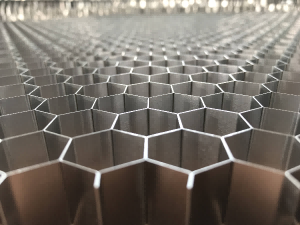
Kerajang Sarang Lebah Kekuatan Sederhana: Sifat Berprestasi Tinggi dan Aplikasi Ketepatan
Kerajang sarang lebah berkekuatan sederhana berfungsi sebagai bahan struktur teras dalam pembuatan termaju. Ia mengimbangi kapasiti galas beban dan reka bentuk ringan untuk keperluan industri yang kritikal. Artikel ini meneroka sifat teknikal dan nilai aplikasinya.
1. Komposisi Kimia Kerajang Sarang Lebah Kekuatan Sederhana
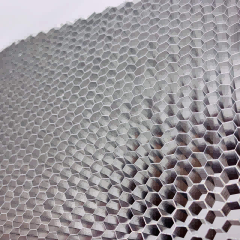
Kerajang sarang lebah berkekuatan sederhana bergantung pada sistem aloi untuk mencapai prestasi mekanikal yang disasarkan. Elemen utama mengawal kekuatan, Rintangan kakisan, dan kebolehprosesan.
| Siri Aloi | Aluminium (Al) kandungan | Magnesium (Mg) kandungan | Mangan (Mn) kandungan | Silikon (Dan) kandungan | Fungsi Utama Bahan Tambahan |
| 3003-H18 | 96.8% – 97.5% | ≤ 0.05% | 1.0% – 1.5% | 0.3% – 0.8% | Mn meningkatkan kekuatan tegangan; Si meningkatkan kebolehbentukan |
| 5052-H34 | 95.8% – 96.8% | 2.2% – 2.8% | ≤ 0.10% | ≤ 0.25% | Mg meningkatkan kekuatan hasil; mengawal kakisan antara butiran |
| 6061-T6 | 97.9% – 98.8% | 0.8% – 1.2% | ≤ 0.15% | 0.4% – 0.8% | Mendakan Si-Mg mengoptimumkan rintangan rayapan; Cu (0.15%-0.40%) meningkatkan kekerasan |
Pemilihan aloi secara langsung memberi kesan kepada prestasi foil sarang lebah. 3003-H18 sesuai dengan senario perindustrian umum. 5052-H34 cemerlang dalam persekitaran lembap. 6061-T6 memenuhi keperluan kestabilan suhu tinggi. Unsur surih (≤0.1% Fe, ≤0.05% Zn) mengelakkan kerapuhan yang disebabkan oleh kekotoran.
Komposisi foil sarang lebah berkekuatan sederhana mengelakkan logam berat. Ia mematuhi piawaian RoHS dan REACH untuk pembuatan mesra alam. Ini memastikan keserasian dengan aplikasi hubungan makanan dan perubatan.
2. Parameter Teknikal Utama Kerajang Sarang Lebah Kekuatan Sederhana
Parameter mentakrifkan kebolehsuaian foil sarang lebah berkekuatan sederhana kepada kejuruteraan ketepatan. Toleransi dan dimensi mesti memenuhi piawaian khusus industri.
| Kategori Parameter | 3003-Spesifikasi H18 | 5052-Spesifikasi H34 | 6061-Spesifikasi T6 | Standard Ujian |
| Ketebalan Kerajang | 0.08mm – 0.20mm | 0.10mm – 0.25mm | 0.12mm – 0.30mm | ASTM B209 |
| Saiz Sel Sarang Lebah | 3mm – 12mm (heksagon) | 4mm – 15mm (heksagon) | 5mm – 20mm (heksagon) | ISO 1942 |
| Kelurusan Dinding Sel | ≤ 0.1mm/m | ≤ 0.08mm/m | ≤ 0.05mm/m | DARI 4102 |
| Kekasaran Permukaan | Ra 0.8μm – 1.6μm | Ra 0.6μm – 1.2μm | Ra 0.4μm – 1.0μm | ISO 4287 |
| Pekali Pengembangan Terma | 23.1×10⁻⁶/℃ | 23.8×10⁻⁶/℃ | 23.6×10⁻⁶/℃ | ASTM E228 |
Ketepatan ketebalan menjejaskan integriti dinding sel. Sisihan 0.1mm boleh mengurangkan kapasiti beban dengan 8%-12%. Saiz sel menentukan ketumpatan teras—sel yang lebih kecil (3mm-5mm) sesuai dengan persekitaran getaran frekuensi tinggi. Kekasaran permukaan memastikan kekuatan ikatan pelekat dalam struktur komposit.
Kerajang sarang lebah berkekuatan sederhana menawarkan parameter yang boleh disesuaikan. Pengilang melaraskan saiz dan ketebalan sel bagi setiap reka bentuk CAD pelanggan. Fleksibiliti ini menyokong pembangunan prototaip dan pengeluaran besar-besaran.
3. Sifat Mekanikal Kerajang Sarang Lebah Kekuatan Sederhana
Prestasi mekanikal mentakrifkan peranan struktur foil sarang lebah berkekuatan sederhana. Ujian mengesahkan kelakuannya di bawah beban statik dan dinamik.
| Harta Mekanikal | 3003-Nilai H18 | 5052-Nilai H34 | 6061-Nilai T6 | Kaedah Ujian | Kepentingan Perindustrian |
| Kekuatan tegangan | 140MPA – 170MPA | 230MPA – 260MPA | 310MPA – 340MPA | ASTM D3039 | Menentang ubah bentuk paksi dalam panel struktur |
| Kekuatan hasil | 110MPA – 130MPA | 190MPA – 220MPA | 270MPA – 300MPA | ASTM D3039 | Menghalang set kekal di bawah beban operasi |
| Kekuatan Mampatan | 8MPA – 12MPA | 15MPA – 18MPA | 22MPA – 25MPA | ASTM C365 | Menyokong beban menegak di lantai dan rak |
| Kekuatan ricih | 3MPA – 5MPA | 6MPA – 8MPA | 9MPA – 11MPA | ASTM C273 | Menahan daya sisi dalam pengangkutan |
| Kehidupan Keletihan (10⁷ kitaran) | ≥ 80MPa | ≥ 120MPa | ≥ 180MPa | ASTM D3479 | Memastikan ketahanan dalam senario beban kitaran |
Sifat mekanikal berbeza mengikut suhu aloi. H18 perangai (bekerja sejuk) meningkatkan kekuatan tetapi mengurangkan kemuluran. T6 perangai (dirawat penyelesaian) mengimbangi kekuatan dan ketangguhan. Ini membolehkan jurutera memadankan kerajang sarang lebah untuk memuatkan profil.
Kerajang sarang lebah berkekuatan sederhana menunjukkan tingkah laku anisotropik. Kekuatan mampatannya ialah 30%-40% lebih tinggi di sepanjang paksi sel. Prestasi berarah ini mengoptimumkan kecekapan struktur dalam reka bentuk aeroangkasa dan automotif.
4. Ciri-ciri Teras Kerajang Sarang Lebah Kekuatan Sederhana
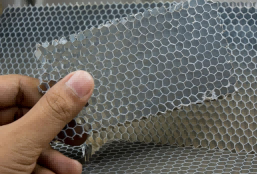
Ciri-ciri unik kerajang sarang lebah berkekuatan sederhana menangani masalah kesakitan industri. Ciri-ciri ini membezakannya daripada alternatif berkekuatan rendah dan berkekuatan tinggi.
4.1 Kecekapan Struktur
Struktur sel heksagonnya mengagihkan beban secara merata ke seluruh permukaan. Reka bentuk ini meminimumkan penggunaan bahan sambil memaksimumkan kekakuan. Teras sarang lebah setebal 10mm mempunyai berat 300g/m²-500g/m², 70%-80% lebih ringan daripada kepingan aluminium pepejal dengan ketebalan yang sama. Atribut ringan ini mengurangkan penggunaan tenaga dalam aplikasi pengangkutan.
4.2 Penebat Terma dan Akustik
Struktur sel tertutup memerangkap udara, menyediakan rintangan haba (nilai R: 1.2 m²·K/W – 2.5 m²·K/W). Ia mengurangkan pemindahan haba dalam fasad bangunan dan penutup elektronik. Secara akustik, ia menyerap gelombang bunyi (20dB – 40pengurangan dB dalam 1kHz – 4julat kHz), meningkatkan keselesaan dalam kabin pesawat dan dalaman kereta api.
4.3 Rintangan kakisan
Komposisi aloi (5052-H34, 6061-T6) membentuk lapisan oksida padat. Lapisan ini tahan semburan garam (5000+ jam setiap ASTM B117) dan pendedahan kimia. Kerajang sarang lebah berkekuatan sederhana tidak memerlukan salutan tambahan dalam kebanyakan persekitaran perindustrian, mengurangkan kos penyelenggaraan.
4.4 Keserasian Proses
Ia terikat dengan pelbagai helaian muka (aluminium, gentian karbon, FRP) menggunakan pelekat struktur. Ia menahan suhu pengawetan (80℃ – 180℃) tanpa ubah bentuk. Keserasian ini membolehkan penyepaduan ke dalam struktur komposit untuk aplikasi berprestasi tinggi.
5. Kelebihan Teknikal Kerajang Sarang Lebah Kekuatan Sederhana
Berbanding dengan bahan teras yang bersaing (buih, kayu balsa, sarang lebah kertas), kerajang sarang lebah berkekuatan sederhana menawarkan faedah teknikal yang berbeza.
5.1 Nisbah Kekuatan-ke-Berat Unggul
Nisbah kekuatan kepada beratnya (200MPa·g⁻¹·cm³ – 400MPa·g⁻¹·cm³) melebihi buih (50MPa·g⁻¹·cm³ – 150MPa·g⁻¹·cm³) dan kayu balsa (80MPa·g⁻¹·cm³ – 120MPa·g⁻¹·cm³). Kelebihan ini membolehkan lebih nipis, struktur yang lebih ringan tanpa menjejaskan kapasiti beban. Dalam tudung automotif, ia mengurangkan berat badan sebanyak 25%-35% berbanding teras keluli.
5.2 Kestabilan Dimensi
Ia mengekalkan ketepatan dimensi (±0.1mm/m) merentasi julat suhu (-40℃ – 120℃). Tidak seperti sarang lebah kertas, ia tidak menyerap lembapan atau membengkak. Kestabilan ini memastikan prestasi jangka panjang dalam persekitaran luar dan lembap, seperti sekat laut.
5.3 Tahan Api
Ia memenuhi piawaian keselamatan kebakaran (UL94 V-0, ASTM E84 Kelas A). Ia tidak mengeluarkan asap toksik apabila terdedah kepada nyalaan. Ini menjadikannya sesuai untuk bangunan awam, kapal terbang, dan kenderaan transit massa di mana keselamatan kebakaran adalah kritikal.
5.4 Kitar semula
Ia terdiri daripada 95%+ aluminium boleh dikitar semula. Kitar semula memerlukan 5% tenaga yang diperlukan untuk menghasilkan aluminium primer. Ini sejajar dengan matlamat ekonomi bulat dalam pembuatan, mengurangkan kesan alam sekitar berbanding teras buih yang tidak boleh dikitar semula.
6. Aplikasi Ketepatan Kerajang Sarang Lebah Kekuatan Sederhana
Sifat teknikal foil sarang lebah berkekuatan sederhana membolehkan penggunaannya dalam industri permintaan tinggi. Setiap aplikasi memanfaatkan sifat khusus untuk prestasi optimum.
6.1 Aeroangkasa dan Penerbangan
Dalam pesawat komersial, ia membentuk panel dalaman (dinding sisi, siling, tong bagasi). 5052-Kerajang sarang lebah H34 memenuhi keperluan mudah terbakar FAA (JAUH 25.853). Ia mengurangkan berat kabin sebanyak 18%-22%, mengurangkan penggunaan bahan api oleh 3%-5% setiap penerbangan. Dalam dron, 3003-Kerajang sarang lebah H18 menghasilkan sayap ringan dengan kekakuan lentur yang tinggi, melanjutkan masa penerbangan dengan 20%-25%.
Pengeluar aeroangkasa menggunakan foil sarang lebah 6061-T6 untuk struktur sekunder (pelapik nacelle enjin). Kestabilan suhu tingginya (sehingga 150 ℃) menahan haba enjin. Penebat akustiknya mengurangkan hingar kabin dengan 15%-20%, meningkatkan keselesaan penumpang.
6.2 Automotif dan Pengangkutan
Dalam kenderaan elektrik (EV), ia menjadikan penutup pek bateri. 5052-Kerajang sarang lebah H34 menyediakan rintangan hentaman (menyerap 20kJ/m² – 30kJ/m² tenaga) dan penebat haba. Ia melindungi sel bateri daripada kerosakan luaran dan turun naik suhu, memanjangkan hayat bateri dengan 10%-15%. Di bumbung EV, ia mengurangkan berat badan sebanyak 40%-50% berbanding teras plastik bertetulang kaca, meningkatkan julat oleh 5%-8%.
Dalam kereta api laju, ia membentuk panel lantai dan sekatan dinding. 3003-Kerajang sarang lebah H18 tahan getaran (10Hz – 200Hz) dan tekanan mekanikal. Ketahanan apinya memenuhi EN 45545-2 Piawaian HL3 untuk kenderaan rel. Ia juga mengurangkan bunyi dalaman dengan 25%-30%, meningkatkan pengalaman penumpang.
6.3 Bangunan dan Pembinaan
Dalam seni bina moden, ia berfungsi sebagai bahan teras untuk dinding langsir dan pelapisan. 6061-Kerajang sarang lebah T6 menyokong beban angin (sehingga 5kPa) dan penebat haba (nilai-U: 0.3 W/m²·K – 0.5 W/m²·K). Ia mengurangkan penggunaan tenaga bangunan dengan 15%-20% berbanding dengan pelapisan aluminium pepejal. Dalam bangunan modular, ia mencipta panel lantai ringan yang mempercepatkan pemasangan di tapak dengan 30%-40%.
Ia juga membuat siling akustik di ruang komersial (pejabat, auditorium). 3003-Kerajang sarang lebah H18 menyerap bunyi dalam 500Hz – 2000Julat Hz, mengurangkan masa dengung sebanyak 0.5s – 1.0s. Ini meningkatkan kefahaman pertuturan dan keselesaan akustik keseluruhan.
6.4 Elektronik dan Peralatan Perindustrian
Dalam kandang elektronik (rak pelayan, panel kawalan), ia menyediakan sokongan struktur dan pelesapan haba. 5052-Kekonduksian haba kerajang sarang lebah H34 (110W/m · k – 130W/m · k) memindahkan haba dari komponen sensitif. Perisai EMInya (40dB – 60dB pada 1GHz) melindungi elektronik daripada gangguan elektromagnet.
Dalam jentera perindustrian, ia membentuk meja kerja dan pengawal keselamatan. 6061-Kerajang sarang lebah T6 tahan hentakan (100J – 200J) dan beban berat (sehingga 5kN/m²). Ia mengurangkan berat jentera dengan 30%-35%, meningkatkan mobiliti dan kecekapan tenaga.
6.5 Marin dan Luar Pesisir
Dalam bot dan kapal layar, ia mencipta panel badan kapal dan dek. 5052-Kerajang sarang lebah H34 tahan kakisan air masin (10,000+ jam pendedahan semburan garam). Reka bentuknya yang ringan mengurangkan berat badan kapal sebanyak 25%-30%, meningkatkan kelajuan dan kecekapan bahan api. Di platform luar pesisir, ia membentuk sekat dan ruang penyimpanan. Ketahanan apinya memenuhi piawaian IMO SOLAS, memastikan keselamatan dalam persekitaran marin yang keras.
7. Ujian Prestasi dan Kawalan Kualiti
Kerajang sarang lebah berkekuatan sederhana memerlukan ujian yang ketat untuk memastikan pematuhan dengan piawaian industri. Proses kawalan kualiti mengekalkan konsistensi dan kebolehpercayaan.
7.1 Pengujian Bahan
Pengilang menjalankan ujian tegangan (ASTM D3039) untuk mengesahkan sifat kekuatan. Ujian mampatan (ASTM C365) mengukur kapasiti galas beban di bawah tekanan paksi. Ujian ricih (ASTM C273) menilai rintangan kepada daya sisi. Setiap batch menjalani analisis kimia (Spektroskopi XRF) untuk mengesahkan komposisi aloi.
7.2 Pemeriksaan Dimensi
Menyelaraskan mesin pengukur (CMM) periksa ketebalan kerajang dan saiz sel. Pengimbas laser mengesahkan kerataan permukaan dan kelurusan dinding sel. Pemeriksaan ini memastikan toleransi dimensi dalam ±0.05mm untuk aplikasi kritikal.
7.3 Pengujian Alam Sekitar
Bilik persekitaran mensimulasikan kitaran suhu (-40℃ hingga 120 ℃) dan kelembapan (95% RH) untuk menguji kestabilan. Ruang semburan garam (ASTM B117) menilai rintangan kakisan. Ujian kebakaran (UL94, ASTM E84) mengesahkan kalis api.
7.4 Pensijilan Kualiti
Pengeluar bereputasi mempunyai pensijilan seperti ISO 9001 (pengurusan kualiti), ISO 14001 (pengurusan alam sekitar), dan AS9100 (kualiti aeroangkasa). Pensijilan ini memastikan kerajang sarang lebah berkekuatan sederhana memenuhi piawaian industri tertinggi.
8. Perkembangan dan Inovasi Masa Depan
Kerajang sarang lebah berkekuatan sederhana terus berkembang untuk memenuhi keperluan industri yang muncul. Penyelidikan berterusan memberi tumpuan kepada peningkatan prestasi dan pengembangan aplikasi.
8.1 Pembangunan Aloi Termaju
Penyelidik sedang membangunkan aloi baru (mis., 3003-5052 kacukan) untuk meningkatkan kekuatan dan rintangan kakisan. Aloi ini bertujuan untuk meningkatkan kekuatan tegangan dengan 15%-20% sambil mengekalkan kebolehbentukan. Penambahan nanokomposit (mis., Nanozarah Al₂O₃) boleh meningkatkan lagi sifat mekanikal.
8.2 Pengoptimuman Proses Pembuatan
Barisan pengeluaran automatik mengurangkan sisa bahan dengan 10%-15%. 3D pencetakan struktur sarang lebah membolehkan geometri sel yang kompleks (bentuk bukan heksagon) untuk prestasi yang disesuaikan. Inovasi ini mengurangkan kos dan mengembangkan kemungkinan reka bentuk.
8.3 Kawasan Permohonan Baru
Dalam tenaga boleh diperbaharui, kerajang sarang lebah berkekuatan sederhana boleh membentuk teras bilah turbin angin. Reka bentuknya yang ringan dan rintangan keletihan boleh meningkatkan kecekapan bilah. Dalam peranti perubatan, ia boleh mencipta ringan, kandang steril untuk peralatan diagnostik. Rintangan kakisan dan kebolehkitar semulanya sejajar dengan piawaian industri perubatan.
8.4 Integrasi Pintar
Integrasi dengan penderia (tolok terikan, penderia suhu) sedang dalam pembangunan. Ini “bijak pandai” struktur sarang lebah boleh memantau beban, suhu, dan kerosakan dalam masa nyata. Ini membolehkan penyelenggaraan ramalan dalam aeroangkasa dan aplikasi automotif, mengurangkan masa henti dan kos.
9. Kesimpulan
Kerajang sarang lebah berkekuatan sederhana memberikan keseimbangan kekuatan yang unik, reka bentuk yang ringan, dan fleksibiliti. Komposisi kimianya yang tepat, parameter teknikal, dan sifat mekanikal menjadikannya sesuai untuk aplikasi berprestasi tinggi. Kelebihan utama—nisbah kekuatan kepada berat yang unggul, kestabilan dimensi, tahan api, dan kebolehkitar semula—memisahkannya daripada bahan yang bersaing.
Dalam aeroangkasa, automotif, pembinaan, elektronik, dan industri marin, ia membolehkan inovatif, reka bentuk yang cekap. Perkembangan berterusan dalam aloi, pembuatan, dan integrasi pintar akan mengembangkan lagi potensinya. Apabila industri mengejar lebih ringan, lebih mampan, dan penyelesaian berprestasi tinggi, kerajang sarang lebah berkekuatan sederhana akan kekal sebagai bahan kritikal dalam pembuatan termaju. Peranannya dalam mengurangkan penggunaan tenaga, meningkatkan keselamatan, dan menyokong matlamat ekonomi pekeliling menggariskan nilai jangka panjangnya dalam pasaran perindustrian global.
Untuk jurutera dan pengilang, kerajang sarang lebah berkekuatan sederhana menawarkan yang terbukti, penyelesaian yang boleh disesuaikan kepada cabaran struktur yang kompleks. Fleksibiliti teknikal dan kebolehpercayaannya menjadikannya asas kejuruteraan ketepatan moden, memacu inovasi merentasi pelbagai sektor industri.