
Impact of Annealing and Forming Performance of 1050 Aluminum Discs on Cookware Quality
1. Introduction
Cookware quality is heavily influenced by the properties of the base material used in its manufacture. Among aluminum alloys, 1050 aluminum discs stand out due to their excellent corrosion resistance, high ductility, and superior thermal conductivity, making them ideal for pots, pans, and other kitchen utensils.
The annealing and forming performance of these discs play a crucial role in determining the final cookware quality. Proper annealing ensures uniform mechanical properties and eliminates residual stresses, while precise forming techniques maintain structural integrity, surface finish, and dimensional accuracy.
In this article, we will explore how annealing and forming of 1050 aluminum discs directly impact cookware quality, addressing aspects such as durability, corrosion resistance, heat distribution, and aesthetic performance.

2. Material Properties of 1050 Aluminum Discs
2.1 Chemical Composition
1050 aluminum belongs to the 1xxx series, characterized by a high aluminum content (≥99.5%). This high purity provides exceptional corrosion resistance, excellent workability, and thermal performance. Trace elements like iron and silicon enhance mechanical strength without compromising ductility.
| Table 1 – Typical Chemical Composition of 1050 Aluminum Alloy (%) | |
|---|---|
| Aluminum (Al) | ≥99.5 |
| Iron (Fe) | 0.4 max |
| Silicon (Si) | 0.25 max |
| Copper (Cu) | 0.05 max |
| Manganese (Mn) | 0.05 max |
| Magnesium (Mg) | 0.05 max |
| Zinc (Zn) | 0.05 max |
| Titanium (Ti) | 0.03 max |
| Others (each) | 0.03 max |
| Others (total) | 0.10 max |
This composition ensures that the aluminum discs maintain excellent corrosion resistance in contact with water, acidic or alkaline food ingredients, and heat.
2.2 Mechanical Properties
| Property | O-Temper | H14 Temper | H18 Temper |
|---|---|---|---|
| Tensile Strength (MPa) | 110 | 120 | 125 |
| Yield Strength (MPa) | 70 | 90 | 105 |
| Elongation (%) | >35 | 20–25 | 15–18 |
| Hardness (HV) | 25 | 35 | 45 |
| Density (g/cm³) | 2.71 | 2.71 | 2.71 |
The high ductility of O-temper discs is particularly advantageous for deep drawing and stamping, allowing cookware components to be formed without cracking or tearing. The strain-hardened tempers (H14, H18) provide higher strength but require intermediate annealing to restore formability during complex forming operations.
2.3 Thermal and Corrosion Properties
- Thermal Conductivity: 230–235 W/m·K, ensuring even heat distribution in cookware.
- Melting Point: ~660 °C, allowing safe operation in high-temperature cooking.
- Corrosion Resistance: Naturally forms an oxide layer (Al₂O₃) which protects the material from food acids and moisture.
These properties make 1050 aluminum discs an excellent choice for cookware, where even heating, durability, and food safety are critical.
3. Annealing Process and Its Effects
3.1 Purpose of Annealing
Annealing is a controlled heat treatment that serves to:
- Relieve Residual Stress: Rolling and forming introduce internal stresses that can cause warping or cracking. Annealing stabilizes the disc’s microstructure.
- Restore Ductility: Cold work from rolling or stamping increases hardness but reduces elongation. Annealing recovers formability.
- Refine Grain Structure: Uniform, equiaxed grains improve mechanical properties and prevent localized deformation during stamping or deep drawing.
3.2 Annealing Methods
1050 aluminum discs typically undergo:
- Full Annealing (O-Temper): 350–400 °C for 1–2 hours, followed by slow air cooling. Produces maximum ductility and uniform microstructure.
- Partial Annealing (H14/H18): 200–300 °C for 30–60 minutes. Restores partial ductility while retaining some hardness, suitable for semi-deep-drawing applications.
| Table 2 – Annealing Parameters and Mechanical Effects on 1050 Aluminum Discs | |
|---|---|
| Temper | Annealing Temp (°C) |
| O-Temper | 350–400 |
| H14 | 250–300 |
| H18 | 200–250 |
3.3 Effects on Forming Performance
Proper annealing affects forming performance in several ways:
- Improved Deep Drawing Capability: Reduces risk of cracks in cookware like pots or pans.
- Uniform Wall Thickness: Prevents thinning or uneven deformation.
- Surface Finish Stability: Minimizes scratches, rolling lines, or tearing marks.
- Dimensional Accuracy: Ensures lids, handles, and fitting components align correctly.
3.4 Microstructure Optimization
- Grain Refinement: Annealing produces fine equiaxed grains that distribute strain evenly during forming.
- Dislocation Reduction: Minimizes work-hardening induced brittleness.
- Oxide Layer Stability: Maintains corrosion resistance and food safety properties.
Proper control of annealing temperature and duration is essential; overheating may cause grain growth, reducing strength and edge definition, while insufficient annealing leaves the disc brittle, leading to cracks during stamping or deep drawing.
4. Forming Techniques and Mechanical Performance
4.1 Deep Drawing
Deep drawing is the primary technique for transforming 1050 aluminum discs into pots, pans, and container shells. The annealing process directly influences deep drawing performance:
- O-Temper Discs: Maximum ductility allows single-step drawing with minimal risk of cracks. Ideal for complex cookware shapes.
- H14/H18 Discs: Partial hardness requires intermediate annealing to prevent tearing during multi-stage drawing.
Key parameters affecting forming performance:
- Blank Diameter: 1.5–2 times the final part diameter.
- Punch Radius: Rounded to minimize tensile stress.
- Lubrication: Oil-based or graphite to reduce friction and prevent surface scratches.
- Drawing Speed: Moderate speed prevents localized tearing.
4.2 Progressive Stamping
For discs requiring multiple features (flanges, embossing, ribbing), progressive stamping is used:
- Each die station forms part of the geometry gradually.
- Reduces strain concentration and minimizes defects.
- Combined with proper annealing, allows high-volume, high-precision production.
4.3 Impact of Cold Work and Strain Hardening
Forming without annealing introduces strain hardening, which increases hardness and strength locally but reduces overall elongation. Excessive strain can lead to:
- Edge cracks
- Wall thinning
- Difficulty in achieving final shape
Controlled annealing restores ductility while maintaining necessary mechanical strength, ensuring high-quality cookware components.

5. Impact on Cookware Quality and Durability
5.1 Dimensional Stability
Properly annealed 1050 aluminum discs produce cookware with:
- Uniform wall thickness
- Precise lid and handle alignment
- Consistent roundness and flatness
Dimensional accuracy is critical for stackability, sealing, and aesthetic appeal in commercial and household cookware.
5.2 Mechanical Strength and Resistance
Annealing and forming affect:
- Yield Strength: Adequate to resist denting during normal use.
- Elongation: High elongation prevents cracking during thermal expansion.
- Hardness: Controlled hardness ensures durability without brittle behavior.
5.3 Thermal Performance
Uniform thickness and fine-grain structure improve heat distribution, critical for cooking performance:
- Even browning in pans and baking trays
- Reduced hot spots in pots
- Longer lifespan of cookware due to minimized warping under heat
5.4 Corrosion Resistance
Annealed discs maintain a stable Al₂O₃ oxide layer, enhancing resistance to:
- Acidic foods (tomato, vinegar)
- Alkaline ingredients
- Prolonged moisture exposure
Cookware formed from properly annealed discs exhibits superior long-term durability and hygiene.
6. Common Defects and Mitigation Strategies
| Defect | Cause | Solution |
|---|---|---|
| Edge cracks | Insufficient annealing, sharp punch radius | Proper O-temper annealing, adjust die fillet radius |
| Wall thinning | Overdrawing without intermediate annealing | Use staged forming, maintain optimal blank size |
| Surface scratches | Poor lubrication during stamping | Apply high-quality lubricants, regular roll maintenance |
| Warping | Uneven annealing or rapid cooling | Controlled furnace temperature, slow air cooling |
| Work hardening-induced brittleness | Excessive cold work | Implement annealing cycles between forming steps |
7. Surface Quality and Finish
7.1 Surface Smoothness
Cookware quality depends on surface smoothness:
- Reduces food sticking
- Facilitates cleaning
- Enhances aesthetic appeal
Controlled annealing prevents micro-cracks and uneven grain growth that could affect surface smoothness.
7.2 Oxide Layer Formation
- Uniform oxide layer improves corrosion resistance
- Protects cookware during repeated heating cycles
- Ensures food safety by preventing metallic contamination
7.3 Optional Coatings
Some cookware may receive non-stick coatings or anodized layers:
- Requires highly uniform discs with controlled microstructure
- Annealing ensures coating adhesion and prevents blistering
- Proper forming avoids surface defects that compromise coating integrity
8. Applications and Industry Trends
8.1 Applications
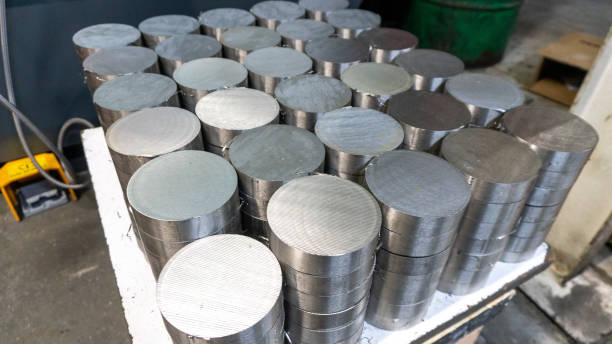
1050 aluminum discs are used to manufacture:
- Pots and pans: O-temper discs for deep-drawn pots
- Bakeware: Sheets for trays, pans, and liners
- Cookware lids: Stamped discs with embossed handles
- Kitchen tools: Shallow bowls, strainers, and containers
8.2 Market Trends
- Increasing demand for lightweight, corrosion-resistant cookware
- Growing focus on eco-friendly aluminum replacing heavier steel or coated materials
- Advanced annealing and forming techniques enable more complex designs without compromising quality
8.3 Technological Advancements
- Automated Annealing Furnaces: Ensure uniform temperature control and repeatable results
- Laser Inspection Systems: Detect surface micro-defects in real-time
- AI-Driven Forming Simulations: Optimize punch-die design to reduce defects and material waste
| Table 3 – Forming Performance Metrics for 1050 Aluminum Discs | |
|---|---|
| Parameter | Value / Range |
| Max Drawing Ratio | 2.0–2.5 |
| Maximum Elongation (%) | 35 (O-temper) |
| Hardness after Forming (HV) | 25–35 |
| Surface Roughness (Ra) | 0.2–0.3 μm |
| Typical Disc Thickness | 1–5 mm |
| Table 4 – Impact of Annealing on Cookware Quality | |
|---|---|
| Property | Annealed Disc |
| Ductility | High |
| Edge Crack Tendency | Minimal |
| Wall Thickness Uniformity | Excellent |
| Heat Distribution | Even |
| Corrosion Resistance | Excellent |
| Surface Finish | Smooth |
9. Conclusion
The annealing and forming performance of 1050 aluminum discs directly determines the quality, durability, and reliability of cookware. Proper annealing restores ductility, relieves stress, and refines the microstructure, allowing safe and efficient forming.
Well-formed cookware exhibits:
- Uniform wall thickness and dimensional stability
- Excellent heat distribution for consistent cooking
- High corrosion resistance and long-term durability
- Smooth surface finish suitable for coatings or direct use
Advances in annealing and forming technologies, combined with quality inspection, ensure that 1050 aluminum discs remain the preferred choice for high-performance, lightweight, and sustainable cookware in modern kitchens.