
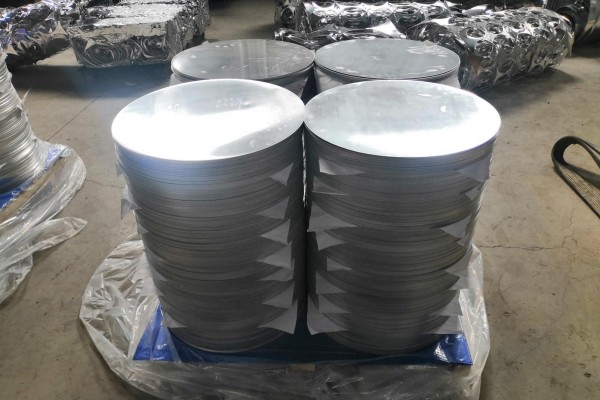
1050 Aluminum Alloy Circles: The 1mm Ideal Substrate for High-Performance Cookware
In the pursuit of efficient cooking and healthy living today, the quality of cookware materials directly determines the cooking experience and food safety. 1050 aluminum circles, especially in the standard 1mm thickness, have become a core material choice in modern cookware manufacturing for products like frying pans, saucepans, and woks, thanks to their outstanding comprehensive performance. This article provides an in-depth analysis of the material properties, manufacturing advantages, and application value of 1050 aluminum circles in the industry.

1. Material Definition: Why 1050 Aluminum Alloy?
1050 aluminum circles belong to the industrial pure aluminum (1xxx series), with an aluminum content of over 99.5%, making it a typical “high-purity aluminum” grade. Its extremely low content of alloying elements grants it a series of irreplaceable characteristics:
- Ultimate Purity: Extremely low impurity content ensures excellent food safety and material stability.
- Superior Plasticity: A pure crystal structure provides excellent ductility, forming the basis for complex deep-drawing.
- Stable Thermal Conductivity: High aluminum purity results in superior thermal conductivity, reaching approximately 222 W/(m·K), enabling fast and even heat transfer.
In cookware manufacturing, it is typically supplied as circular blanks, which are then formed into various pot bodies through processes like stamping and drawing.

2. Core Property Analysis: The Five Major Advantages of 1050 Aluminum Circles
1050 aluminum circles have become a favorite in cookware manufacturing due to a series of material advantages tailored for kitchen applications.
| Property Dimension | Specific Performance & Technical Advantage | Core Value for Cookware Manufacturing |
|---|---|---|
| 1. Superior Thermal Conductivity | Pure aluminum’s thermal conductivity is second only to copper, allowing quick response to temperature changes for even pan heating. | Prevents localized burning of food, improves cooking efficiency and dish quality, saves energy and time. |
| 2. Excellent Deep-Drawability | High elongation (can exceed 30% in O temper), excellent plastic strain ratio (r-value), can withstand severe deformation. | Suitable for one-stroke deep drawing of pots with high depth-to-diameter ratios (e.g., saucepans, deep fryers), simplifying processes, improving production efficiency and yield. |
| 3. Outstanding Surface Treatment Compatibility | Clean, highly active surface with strong coating adhesion. | Perfectly compatible with subsequent treatments like non-stick coatings (Teflon/ceramic), hard anodizing, polishing, meeting diverse, high-end surface requirements. |
| 4. Lightweight & Ease of Use | Low density (~2.71 g/cm³), weight is about one-third that of stainless steel of the same volume. | Creates lightweight and easy-to-handle cookware, especially favored by female users, enhancing the user experience. |
| 5. Safety & Corrosion Resistance | Pure, non-toxic material; naturally forms a dense oxide film (Al₂O₃) on the surface, providing good corrosion resistance. | Complies with food contact material standards, safe and reliable; basic corrosion resistance meets daily use and cleaning requirements. |
3. Why Choose 1mm Thickness? The Art and Science of Balance
1mm is a “golden thickness” for cookware aluminum circles, achieving the optimal balance between performance, cost, and processability.
| Consideration Factor | Advantages of 1mm Thickness | Impact on Manufacturing & Product |
|---|---|---|
| Structural Strength | Provides sufficient rigidity to prevent deformation during forming and use. | Ensures the pot maintains its shape when bearing weight, during stir-frying, and cleaning. |
| Heat Distribution & Response | Moderate thickness avoids hot spots from being too thin and slow response from being too thick. | Achieves fast preheating and even heat distribution, optimizing cooking performance. |
| Formability | Sufficient plasticity for high-speed, mass deep-drawing, with stamping force within reasonable equipment range. | Increases production line efficiency, reduces die wear, controls production costs. |
| Lightweighting & Cost | Maximizes lightweighting while meeting strength requirements, controlling material usage. | Provides the end product with significant weight advantage and a competitive cost structure. |
4. Application Scenarios: From Kitchenware to Professional Equipment
1050 aluminum circles are used throughout the kitchen ecosystem, their excellent formability making them suitable for many complex designs.
| Application Category | Typical Products | Why Choose 1050 Aluminum Circles? |
|---|---|---|
| Frying & Sautéing | Skillets, woks, grill pans | Superior thermal conductivity ensures even heating; good formability allows manufacturing pans with curved or special textured bottoms. |
| Stewing & Boiling | Saucepans, milk pans, steamer bodies | Excellent deep-drawability allows one-piece forming of sufficiently deep pots; lightweight for easy handling. |
| Baking & Accessories | Pizza pans, pie plates, pot lids | Easy to stamp into complex shapes; surface is easy to clean and can receive non-stick or anodized treatments. |
| Appliance Inner Pots | Base material for rice cooker, multi-cooker inner pots | High purity ensures food safety; excellent thermal conductivity improves energy efficiency with heating elements. |

5. Production Process and Key Quality Control Points
High-quality 1050 cookware aluminum circles originate from precise control at every production stage.
- Melting & Casting: Use high-purity aluminum ingots, precisely control impurity content like Fe, Si to ensure material purity.
- Hot & Cold Rolling: Obtain uniform, fine-grained structure via hot rolling; precisely roll to 1mm thickness via cold rolling, ensuring thickness tolerance (e.g., ±0.02mm) and flatness.
- Annealing (Key Process): Achieve O temper (soft temper) through full recrystallization annealing, crucial for optimal deep-drawability and ductility.
- Precision Blanking & Finishing: Use high-precision dies for blanking to ensure diameter accuracy and smooth, burr-free edges, followed by cleaning, oiling, etc.
Manufacturer’s Core Material Selection Checklist:
- [ ] Confirm material is in O temper, suitable for deep drawing.
- [ ] Verify thickness tolerance and surface quality (free of scratches, roll marks, oil stains).
- [ ] Request Material Test Certificate (MTC) from supplier to ensure composition meets 1050 standard.
- [ ] Conduct small-batch trial stamping to verify actual deep-drawing limits and coating adhesion.
Conclusion
1050 aluminum circles, especially in the 1mm specification, have become a critical material bridge connecting modern cookware’s innovative design with large-scale, efficient manufacturing. They perfectly combine excellent physical properties, superb processing characteristics, and reliable safety standards. As consumer demands for the cooking experience continue to rise and manufacturing processes keep innovating, 1050 aluminum circles, with their solid material foundation, will continue to play an indispensable core role in the cookware industry’s journey towards lightweighting, functionalization, and premiumization, bringing more efficient, safe, and enjoyable cooking possibilities to kitchens worldwide.