

1050 Aluminum Circle (0.5mm): A High-Performance Material Engineered for Lightweight Kitchenware
Abstract
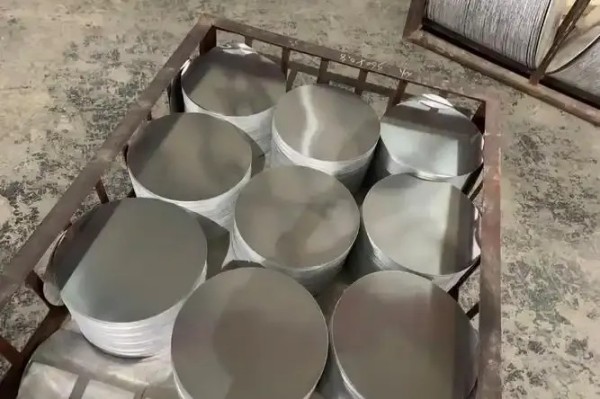
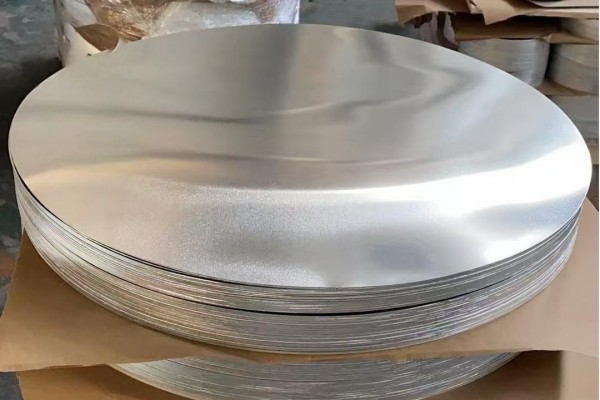
The 1050 aluminum circle (0.5mm) is a circular, thin-gauge blank made from high-purity 1050 aluminum alloy through precision rolling and blanking. With an aluminum content exceeding 99.5%, this material exhibits exceptional formability, excellent thermal conductivity, and safety compliance for food contact applications, making it an ideal choice for manufacturing various types of lightweight, high-performance kitchen utensils. This article provides a multi-dimensional, in-depth analysis of this foundational material behind “culinary art,” covering materials science, precision manufacturing, application design, and quality control.

1. Material Definition & Core Value: Why 1050 and 0.5mm?
The 1050 Aluminum Circle (0.5mm) is not an ordinary aluminum disc; it is the product of the precise integration of materials science and manufacturing needs.
- Positioning of 1050 Alloy: Belongs to the 1000 series (commercially pure aluminum) with Al content ≥99.5%. High purity translates to excellent corrosion resistance, superior ductility, good thermal/electrical conductivity, and guarantees safety and hygiene for food contact.
- Significance of 0.5mm Thickness: This gauge represents a balance between economy and functionality. It is thin enough to enable material reduction and cost savings, and is easy for complex deep drawing and stretching; yet it possesses the necessary stiffness and strength to meet the structural requirements of most lightweight kitchenware (e.g., containers, molds, lids).
- Core Value Proposition: Provides kitchenware manufacturers with a foundation blank that is easy to process, reliably performant, and cost-controllable, especially suitable for mass-producing cost-sensitive kitchen items requiring good formability.
2. Materials Science Foundation: In-Depth Analysis of 1050 Aluminum Alloy
2.1 Precise Chemical Composition
High performance stems from precise composition. The typical composition of 1050 alloy is as follows:
| Element | Content Range (wt.%) | Significance in Kitchenware Applications |
|---|---|---|
| Al | ≥ 99.50 | Matrix, determining core properties: formability, thermal conductivity, corrosion resistance, non-toxicity. |
| Si + Fe | ≤ 0.45 | Main impurities, strictly controlled to ensure plasticity. Trace amounts can slightly increase strength. |
| Cu | ≤ 0.05 | Very tightly controlled to avoid potential impacts on corrosion resistance and food compatibility. |
| Mn, Mg, Zn, etc. | Each ≤ 0.05 | Trace impurities, ensuring material purity. |
2.2 Detailed Key Performance Advantages
- Exceptional Formability (Core Advantage):
- High Ductility: O-temper (annealed) material has extremely high elongation, can withstand significant deep drawing, stretching, spinning deformation without cracking, prerequisite for manufacturing complex-shaped kitchenware (e.g., deep bowls, trays with flanged edges).
- Good Plastic Anisotropy: Uniform properties, conducive to stable workpiece shape after stamping, reducing phenomena like “earing.”
- Efficient Thermal Conductivity:
- Aluminum’s high thermal conductivity allows heat to distribute quickly and evenly in the utensil. For bakeware (e.g., cake pans, baking sheets), this means more even cooking and better finished product quality.
- Outstanding Corrosion Resistance & Safety:
- Naturally forms a dense oxide layer (Al₂O₃) on the surface, effectively resisting moisture, weak acids/bases (e.g., fruit juice, condiments), extending product life.
- Pure composition complies with various national food contact material standards (e.g., China GB 4806.9, US FDA, EU EU 10/2011), safe and non-toxic.
- Lightweight & Economical:
- Low density, lightweight finished products, better user experience.
- Compared to materials like stainless steel, aluminum is lower cost, and the 0.5mm thin gauge further saves material cost.
3. Core Manufacturing Process: The Journey from Ingot to Precision Circle
High-quality 0.5mm aluminum circles rely on a precise, clean production chain.
- Melting & Casting:
- Uses high-purity aluminum ingots, precise composition control in melting furnaces, followed by degassing and filtering for pure melt.
- Forms uniformly thick slabs via continuous cast-rolling.
- Hot Rolling & Cold Rolling:
- Hot Rolling: Slabs are heated and rolled, initially reducing thickness and improving microstructure.
- Cold Rolling (Key thinning process): Multi-pass rolling at room temperature, core to achieving the precise 0.5mm thickness. This process involves work hardening, requiring precise control of rolling force, speed, and lubrication.
- Intermediate Annealing:
- Performed when cold-rolled to a certain thickness to eliminate work hardening, restore material plasticity, ensuring it can be rolled thinner and ultimately achieve good O-temper properties.
- Finish Rolling & Annealing (Final Annealing):
- Rolled to the final 0.5mm thickness.
- Final annealing is performed to achieve O-temper (fully soft), the ideal state for deep drawing kitchenware. The annealing process (temperature, time, atmosphere) directly affects grain size and mechanical properties.
- Precision Blanking/Slitting:
- Uses high-precision presses or rotary shears to cut wide aluminum coils into circular blanks of specified diameter. Requires smooth, burr-free edges and precise diameter tolerance.
- Surface Treatment (Optional):
- Cleaning: Removes rolling oils and contaminants.
- Brushing/Polishing: For decorative surfaces.
- Anodizing: Further enhances surface hardness, corrosion resistance, and aesthetics, allowing for various colors.

4. Application in Practice: The Diverse Roles of 0.5mm 1050 Circles in the Kitchen
Its exceptional formability allows a simple circle to transform into various kitchen items.
| Application Category | Specific Product Examples | Core Material Properties Utilized |
|---|---|---|
| Bakeware | Cake pans, pie plates, cookie sheets, muffin cups | Deep Draw/Stretchability (forming complex cavities), Thermal Conductivity (even baking), Corrosion Resistance. |
| Food Containers & Storage | Disposable container lids, lunch boxes, food storage container lids, food prep bowls | Deep Drawability (forming container body), Light Weight, Safety & Hygiene. |
| Cookware Accessories | Steamer baskets, pot lids (lightweight type), heat diffuser plates | Stamping Formability, Thermal Conductivity. |
| Kitchen Tools & Trays | Tart pans, serving trays, kitchen funnels, measuring cups | Spinning/Stretchability, Easy Cleaning, Aesthetics (allows surface treatment). |
| Packaging & Decoration | Aluminum foil bases for premium foods, gift packaging boxes | Attractive metallic finish, Malleability. |
Design Note: For components requiring higher strength or wear resistance (e.g., spatulas subject to frequent scraping), 1050-O may be too soft. Consider H14 or other half-hard tempers, or apply anodizing for surface hardening.
5. Quality Control & Material Selection Guide: How to Identify Premium Aluminum Circles?
When procuring, establish a performance-based evaluation system, not just price-based.
- Verification of Key Performance Indicators:
- Temper & Mechanical Properties: Ensure it is O Temper, request mechanical property reports (Tensile Strength, Yield Strength, Elongation). Elongation is a direct indicator of deep drawability.
- Erichsen Value (IE): Quantifies the material’s limiting drawing ratio via the Erichsen cupping test. Higher value indicates better deep drawing performance.
- Thickness & Tolerance: Use a micrometer for multi-point measurement to ensure uniform thickness (e.g., 0.5mm ±0.02mm). Thickness variation can cause wrinkles or splits in stamped parts.
- Surface Quality: Check for scratches, roll marks, oil stains, oxidation spots. A clean, uniform surface is the foundation for high-quality coating or anodizing.
- Geometric Dimensions & Appearance:
- Diameter Accuracy: Affects automatic feeding and die positioning.
- Edge Condition: Should be burr-free and without flares, minimizing secondary processing.
- Compliance Documentation:
- Request Material Test Certificate (MTC/COA) and Food Contact Compliance Statement from the supplier (if applicable).
- Key Supplier Evaluation Points:
- Process Control Capability: Does it have full-process control? Is the annealing process stable?
- Testing Equipment: Does it have a well-equipped lab for the performance tests mentioned above?
- Trial Support: Can it provide small samples for stamping trials to verify actual processing performance?
6. Market Trends & Sustainability
- Lightweighting & Green Consumption: Consumer preference for lightweight kitchenware highlights aluminum’s advantage. Its 100%, infinitely recyclable nature strongly aligns with circular economy principles.
- Personalization & Design-Driven: The increasing importance of kitchenware aesthetics opens broad possibilities for subsequent processes on 1050 circles like anodizing/coloring, precision printing, special texturing.
- Functional Integration: Increasing demands for multifunctional kitchenware (e.g., induction cooktop compatibility) may require composite materials, but 1050 circles still play a vital role as a substrate.
- Smart Manufacturing: Places higher demands on the consistency and stability of stamping blanks, driving upstream aluminum circle production towards more digital, intelligent quality control.
Conclusion
The 0.5mm thick 1050 aluminum circle is like a “blank canvas” and “premium clay” for the kitchenware manufacturing industry. Its high purity provides a safe base, its excellent O-temper softness offers limitless shaping potential, and its 0.5mm thinness inscribes a note of economic efficiency.
For kitchenware manufacturers, a deep understanding of the properties of this “metal canvas,” and choosing partners who can consistently provide stable-performance, uniform-quality blanks, is the solid first step in transforming innovative designs into best-selling products. In the kitchen—a space full of warmth and creativity—the 1050 aluminum circle silently and reliably carries the essence of flavor and the beauty of life.