
How Aluminum Circle Grain Size Affects Deep-Drawing Performance
Aluminum circle grain size plays a decisive role in determining deep-drawing performance, influencing formability, tensile strength, earing rate, and the final surface quality of cookware and lighting products. Manufacturers rely on precise grain control to ensure that aluminum circles can withstand high deformation without cracking, wrinkling, or uneven wall thickness.
Why Grain Size Matters in Deep Drawing
Grain size affects how metal flows under stress. Smaller and more uniform grains allow the material to deform smoothly, while coarse or uneven grains lead to instability during drawing.
Key metallurgical principles:
- Fine grains → better ductility and formability
- Coarse grains → higher risk of cracking and orange-peel surface
- Uniform microstructure → stable deep-drawing force and lower earing
During deep drawing, aluminum circles experience multidirectional stretching; therefore, grain uniformity is just as important as grain size.
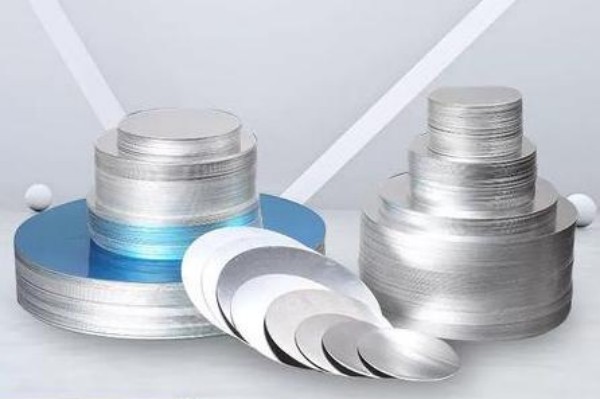
Relationship Between Grain Size and Deep-Drawing Performance
1. Effect on Plasticity and Formability
| Grain Size Level | Microstructure Characteristics | Effect on Deep Drawing |
|---|---|---|
| Fine Grain (Grade 4–5) | Dense, uniform crystal matrix | Best formability, low force required |
| Medium Grain (Grade 6–7) | Balanced strength and ductility | Acceptable for cookware, slightly higher earing |
| Coarse Grain (Grade 8+) | Large, uneven grains | High risk of cracking and orange peel |
Industry standards (ASTM E112) recommend Grade 5–6 grain for most cookware deep-drawing applications.
2. Influence on Earing Rate
Earing is caused by anisotropy in the rolling direction. Grain size affects anisotropy:
- Fine grain → low earing (<2%)
- Coarse grain → high earing (>4%)
Lower earing reduces trimming loss and improves production efficiency.
3. Influence on Surface Quality
Coarse grains often lead to:
- Orange-peel effect
- Rippled walls
- Uneven gloss after anodizing
Fine grains deliver:
- Smooth finish
- Consistent reflectivity
- Better final coating quality

Case Study: Henan Huawei Aluminum Co., Ltd Grain Optimization for Deep-Drawing Clients
Henan Huawei Aluminum Co., Ltd (HWALU) is a leading aluminum circle manufacturer supplying cookware, lighting, and automotive stamping industries worldwide.
Challenge
A Middle Eastern cookware brand reported:
- Cracking on the sidewall
- High earing rate (4.8%)
- Oil-wave surface after anodizing
Testing revealed grain size Grade 7–8, caused by insufficient annealing control.
Solution by Henan Huawei Aluminum
HWALU implemented:
- Precision annealing at 350–420°C
- Extended soaking time to homogenize grains
- Cross-rolling process to reduce anisotropy
Results
| Parameter | Before HWALU Upgrade | After HWALU Optimization |
|---|---|---|
| Grain Size | Grade 7–8 | Grade 5–6 |
| Earing Rate | 4.8% | 1.9% |
| Deep-Drawing Cracks | 6.2% defect rate | 0.8% defect rate |
| Surface After Anodizing | Noticeable orange peel | Uniform mirror-like finish |
The improvement allowed the cookware brand to reduce trimming waste by 21% and increase production stability.

How to Control Grain Size in Aluminum Circle Production
1. Alloy Composition
Purity strongly affects grain refinement.
- 1050 / 1060 / 1070 → naturally fine grains
- 3003 → requires controlled annealing to achieve uniformity
Manganese in 3003 alloy can delay recrystallization if temperature is too low.
2. Rolling Reduction Ratio
High reduction during cold rolling leads to finer recrystallized grains.
| Reduction Ratio | Resulting Grain Structure | Deep-Drawing Effect |
|---|---|---|
| > 85% | Very fine recrystallized grain | Excellent |
| 70–85% | Good balance | Good |
| < 70% | Coarse grain clusters | Poor |
3. Annealing Control
Annealing is the most critical step.
- Low temp → incomplete recrystallization → coarse grains
- High temp → grain growth → weak strength
Optimized annealing window:
350–420°C for 2–3 hours (depending on alloy thickness)
4. Surface Treatment Compatibility
Fine grains ensure better outcomes for:
- Anodizing
- Polishing
- Coating
- Embossing
Manufacturers producing high-end cookware prefer Grade 5 grains for premium surface finishing.

Comparison Table: Fine vs Coarse Grain Aluminum Circles
| Parameter | Fine Grain (G5–6) | Coarse Grain (G7–8) |
|---|---|---|
| Formability | Excellent | Poor |
| Earing Rate | <2% | Up to 5% |
| Crack Risk | Very low | High |
| Surface Finish | Smooth | Orange peel |
| Suitable Uses | Premium cookware, deep pots, complex shapes | Low-forming applications |
Practical Example: Grain Size Effects on Deep Pot Manufacturing
A manufacturer producing 2.5 L deep-draw stock pots reported frequent:
- Sidewall thinning
- Edge cracks
- Non-uniform gloss after polishing
Microscopic testing found mixed coarse + fine grains.
After switching to Henan Huawei Aluminum’s refined 1050 O-state circles, results changed significantly:
- Drawing depth improved by 18%
- No cracking even at high-speed presses
- Polishing produced uniform mirror reflectivity
This confirmed that grain consistency is as important as grain size itself.
FAQs: Aluminum Circle Grain Size & Deep Drawing
1. What is the ideal grain size for deep drawing?
Grade 5–6 under ASTM standards is typically ideal.
2. Does annealing always refine the grain?
No. Too high temperatures cause grain growth; proper control is required.
3. Why does coarse grain cause orange-peel?
Large surface grains deform unevenly, causing a textured surface.
4. Which alloy is easiest to deep draw?
1050 and 1060 because of their high purity and soft O-temper state.
5. Can grain size solve all deep-drawing problems?
No, lubrication, press speed, and mold design also matter.