
Why Aluminum Discs Crack During Deep Drawing and How to Prevent It
Aluminum disc cracking remains one of the most persistent production challenges in cookware and industrial stamping lines, particularly as manufacturers push deeper draw ratios, faster cycle speeds, and tighter dimensional standards. Understanding the metallurgical, mechanical, and process-level causes behind fracture allows engineers to stabilize forming efficiency, reduce scrap, and predict the performance window more precisely.

1. Metallurgical Foundations: Why Cracking Happens at the Microstructural Level
Cracking during deep drawing is driven by localized strain concentration that exceeds the material’s uniform and total elongation limits. Common metallurgical contributors include:
- Coarse or non-uniform grain structure → uneven plastic flow, early necking
- Excessive work hardening in H-tempers → reduced ductility
- Impurities or segregated inclusions → stress concentrators
- Edge micro-notches from poor blanking → crack initiation sites
- Residual stress from incomplete annealing → unpredictable fracture zones
When these microstructural characteristics interact with aggressive tooling geometries or high draw ratios, the metal cannot redistribute strain and fails along the weakest path.
2. Mechanical Forces and Geometry Factors That Drive Failure
From a mechanics standpoint, failure is typically associated with:
- High circumferential (hoop) stress around the punch shoulder
- Insufficient lubrication, causing friction-induced stress peaks
- Small die radius, which intensifies deformation at the material bend point
- Excessive blankholder force, restricting metal flow in the flange
- Draw ratio beyond 2.2–2.5 for 3003-O discs
- Thickness variation across the blank from coil crown or slitting issues
These influences create asymmetrical thinning, wrinkling-then-tearing, or direct fracture along grain boundaries.
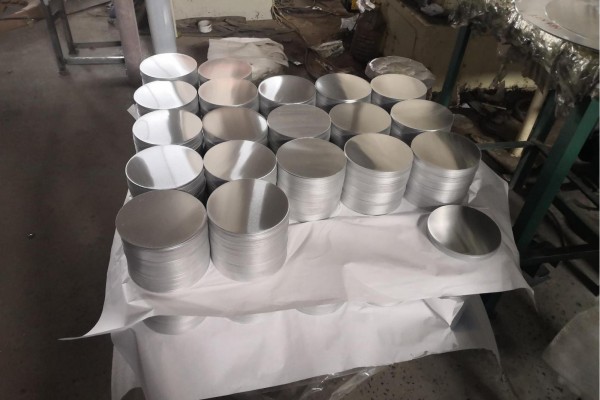
3. Table 1 — Technical Summary of the Most Common Root Causes
| Failure Mode | Mechanical Cause | Metallurgical Cause | Typical Appearance | Severity |
|---|---|---|---|---|
| Shoulder Cracking | Excessive strain at punch radius | Coarse grains / low elongation | Thin band fracture at the upper wall | High |
| Flange Splitting | Over-high blankholder force | Residual stress in blank | Radial cracks near outer edge | Medium–High |
| Wall Tearing | Poor lubrication, high friction | H-temper too hard | Long vertical cracks during drawing | High |
| Earing-Induced Tears | Anisotropy from rolling texture | Non-uniform grain orientation | Uneven flange → localized cracks | Medium |
| Base Cracking | Die radius too small | Inclusions or impurities | Central star-shaped cracks | High |
4. Table 2 — Coil & Disc Quality Requirements (Comparative)
| Quality Parameter | Safe for Deep Drawing | Risky for Deep Drawing | Notes |
|---|---|---|---|
| Temper | O (annealed) | H12 / H14 without process adjustment | O temper offers highest elongation |
| Elongation (%) | ≥ 20% | < 15% | A key predictor of draw success |
| Thickness Tolerance | ±3% | > ±5% | Variability leads to wall thinning |
| Grain Size | Fine–medium, uniform | Coarse or banded | Affects strain distribution |
| Edge Quality | Deburred, polished | Rough, sheared only | Notches trigger cracks |
| Pinhole Density | ≤ 50/m² | High or clustered defects | Pits act as crack initiators |
| Lubrication | Uniform film | Dry edges, oil starvation | Friction peaks cause tearing |
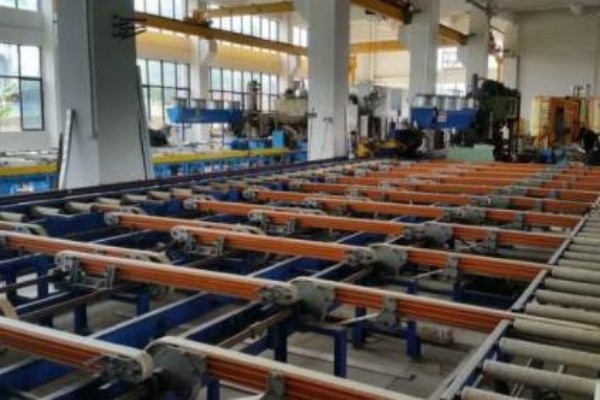
5. Real-World Example — Henan Huawei Aluminum Co., Ltd Solves a Cracking Problem
Background
A large cookware factory producing 24–30 cm frying pans reported a 0.9–1.2% cracking rate in the deep drawing stage using 3003 H12 discs sourced from multiple suppliers. Cracks consistently formed at the punch shoulder area during the second draw.
Engineering Intervention by Henan Huawei Aluminum Co., Ltd
Henan Huawei Aluminum engineers conducted a multi-variable diagnostic:
- Performed metallography and tensile tests on the customer’s incoming discs → elongation values fluctuated between 11–16%, unsuitable for deep draw.
- Recommended conversion to 3003-O temper with strict annealing curve control (final average grain size 70–85 μm).
- Implemented edge-polished blanking to remove micro-notches.
- Provided lubrication calibration (target film thickness: 60–110 mg/m²).
- Optimized die radius from 5t to 6.5t to reduce bending strain.
Results
- Cracking rate reduced from 1.2% → 0.06%
- Second-draw stability improved, allowing 12% higher line speed
- Surface quality improved, reducing downstream polishing time
This case illustrates that cracking is rarely from a single cause — it is the interaction of temper, lubrication, edge quality, and die geometry.
6. Prevention Strategies: A Complete Engineering Checklist
A. Material Selection
- Choose 3003-O for deep drawing; only use H12/H14 for shallow stamping
- Require elongation ≥ 20% (verify across coil width and direction)
B. Tooling Optimization
- Increase die radius (≥ 6× thickness for deep draw)
- Maintain polished die surfaces (Ra < 0.4 μm)
- Balance blankholder force — too high = tearing, too low = wrinkles → later fractures
C. Lubrication Control
- Maintain stable oil application
- Avoid dry zones near the blank edges
- Ensure chemical compatibility with non-stick coatings
D. Process Tuning
- Reduce drawing speed when cracking is localized
- Use multi-stage draws for high-ratio parts
- Adjust punch entry to ensure concentric loading
E. Coil & Disc Quality Requirements
- Mandate edge deburring
- Reject discs with significant coil crown or wedge-shape thickness
- Require supplier anneal curve logs
7. Common Misconceptions That Increase Cracking Risk
- “Higher hardness makes forming easier.”
Hardness increases springback and fracture sensitivity. - “Lubrication quantity doesn’t matter.”
Inconsistent oiling is one of the top three causes of shoulder cracks. - “Draw ratio alone determines failure.”
Grain orientation anisotropy can induce cracks even at low ratios. - “All O tempers are the same.”
O temper quality depends heavily on furnace soak time, cooling rate, and coil age.
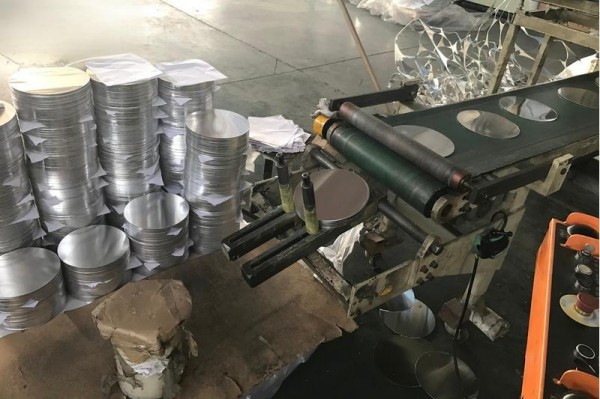
8. FAQ — Practical Answers for Engineers
Q1: Why do cracks always appear in the same direction?
Rolling texture anisotropy causes uneven strain distribution; verify L and LT direction properties.
Q2: Are larger discs more prone to cracking?
Yes — larger blanks create higher flange tensile stress during draw.
Q3: Does alloy choice matter?
3003 offers better deep-draw capability than 1050/1060 due to Mn solid solution strengthening; cracking is less common when elongation is controlled.
Q4: Can lubrication alone solve cracking?
It reduces risk but cannot compensate for low-elongation or improperly annealed material.
Q5: What is the fastest way to diagnose cracking?
Check elongation → inspect edge quality → measure die radius → verify lubrication uniformity.
Conclusion
Preventing aluminum disc cracking requires a holistic approach combining proper material temper, grain structure stability, tooling geometry, lubrication engineering, and coil quality control. Cracking is a predictable behavior when mechanical stress exceeds the material’s deformation capacity — and with proper process design, it is highly controllable. Suppliers such as Henan Huawei Aluminum Co., Ltd demonstrate that stable annealing, consistent mechanical properties, and engineering support can dramatically improve manufacturing yield and forming reliability.