

Unveiling the Marvel of Hot – Rolled Aluminum Circular Sheets for Food – Grade Cookware Substrates
Introduction
In modern life and industrial production, food – grade hot – rolled aluminum discs for cookware substrates play a crucial and irreplaceable role. With the continuous improvement of people’s living standards, the requirements for cookware are not only limited to basic functions but also extend to aspects such as safety, durability, and heat – conduction efficiency. The food – grade hot – rolled aluminum disc, as a key raw material for high – quality cookware, has attracted extensive attention.
In the cookware manufacturing industry, the choice of materials directly affects the quality and performance of products. Hot – rolled aluminum discs stand out due to their excellent comprehensive properties. They are widely used in the production of various cookware, such as frying pans, saucepans, and pressure cookers. Moreover, in the context of global industrial development, the demand for high – performance and safe cookware materials is on the rise, making the study of food – grade hot – rolled aluminum discs more and more important. This article will comprehensively introduce its chemical composition, parameters, mechanical properties, characteristics, advantages, applications, etc., to help readers have a more in – depth understanding of this important material.
Chemical Composition
Main Elements
The chemical composition of food – grade hot – rolled aluminum discs for cookware substrates is crucial as it determines their performance and properties. The main elements in these aluminum discs are as follows (see Table 1):
| Element | Symbol | Function in Aluminum Discs | Typical Content Range (%) |
| Aluminum | Al | As the main component, aluminum accounts for the vast majority of the disc’s composition, usually over 90%. It endows the aluminum disc with excellent electrical conductivity, thermal conductivity, and good corrosion resistance. These properties make it suitable for heat – conducting applications in cookware, such as quickly and evenly transferring heat during cooking, ensuring efficient cooking and preventing the pan from being easily corroded during long – term use | 90 – 98 |
| Copper | Cu | Although the content of copper is relatively low, it can significantly improve the hardness and strength of the aluminum alloy. In cookware, this helps the aluminum disc maintain its shape and structure during the cooking process, even when subjected to high – temperature and mechanical stress. For example, in high – heat – resistant frying pans, the appropriate addition of copper can enhance the pan’s durability | 0.1 – 5 |
| Manganese | Mn | Manganese is added to improve the heat – resistance and corrosion – resistance of the aluminum alloy. In cookware, it can withstand the high – temperature environment during cooking and resist the corrosion of food ingredients and cleaning agents, extending the service life of the cookware. For instance, in some high – end saucepans, manganese – containing aluminum alloys can better adapt to long – term cooking and cleaning | 0.1 – 2 |
| Magnesium | Mg | This light metal is often used to enhance the strength and hardness of the aluminum alloy. In the context of cookware, it provides additional structural support to the aluminum disc, making it more resistant to deformation during normal use | 0.1 – 3 |
Table 1: Main Elements in Food – Grade Hot – Rolled Aluminum Discs
Trace Elements
In addition to the main elements, there are also some trace elements in food – grade hot – rolled aluminum discs, which play an important role in fine – tuning the alloy’s properties (see Table 2):
| Element | Symbol | Function in Aluminum Discs | Typical Content Range (%) |
| Titanium | Ti | Even in small amounts, titanium can enhance the heat – resistance and strength of the aluminum alloy. It also contributes to improving the wear – resistance and corrosion – resistance. In cookware, this means that the aluminum disc can better withstand the friction during cooking and the corrosion of acidic or alkaline food ingredients, maintaining its surface integrity and performance over time | 0.01 – 0.1 |
| Zinc | Zn | Zinc is mainly used to improve the corrosion – resistance of the aluminum alloy. It can also assist in the heat – treatment process of the alloy, optimizing its internal structure and properties. For example, in some cookware used in humid environments, the addition of zinc can effectively prevent the aluminum disc from rusting | 0.01 – 0.5 |
| Silicon | Si | Silicon can improve the fluidity of the aluminum alloy during the manufacturing process, making it easier to form into the desired shape. It also has a positive effect on the tensile strength, hardness, and high – temperature strength of the alloy. In the production of aluminum discs for cookware, better fluidity ensures a more uniform and smooth disc surface | 0.01 – 1 |
Table 2: Trace Elements in Food – Grade Hot – Rolled Aluminum Discs
These elements, whether main or trace, interact with each other to endow the food – grade hot – rolled aluminum disc with a series of excellent properties required for cookware substrates.
Parameters
Size Parameters
The size parameters of food – grade hot – rolled aluminum discs are crucial for their application in cookware manufacturing. Different production methods result in different size characteristics and tolerances (see Table 3):
| Production Method | Diameter Range (mm) | Diameter Tolerance (mm) | Thickness Range (mm) | Thickness Tolerance (mm) |
| Stamping Forming | Typically within 1000 | ±0.3 (when thickness ≤ 4mm) | 0.2 – 12 | ±0.02 – 0.28 (for some specific cold – rolled cases) or ±0.28 – 0.55 (for hot – rolled, 2.5 – 12mm) |
| Circular Saw/Shearing | Up to 3500 (when using saw – cutting or shearing methods) | +3 / – 0 (when diameter ≤ 600mm) | 0.2 – 200 | Varies according to different thickness ranges and production processes, with hot – rolled having a larger tolerance range in some cases, such as ±0.28 – 3.3mm |
Table 3: Size Parameters of Aluminum Discs under Different Production Methods
For example, in the stamping process to produce small – and medium – sized aluminum – disc – based cookware, a diameter of 200 – 300mm with a thickness of 2 – 3mm is often used, and the strict diameter tolerance of ±0.3mm can ensure the accurate fit of the cookware components during the assembly process.
Tolerance Standards
The flatness tolerance of food – grade hot – rolled aluminum discs is also strictly controlled. It is now graded and controlled in the range of 0.3 – 0.5%, which is more in line with the actual production needs of different – thickness cookware. For example, for thinner aluminum discs used in some lightweight cookware, a flatness tolerance of 0.3% can ensure a smooth surface and good heat – transfer performance. While for thicker aluminum discs used in high – end cookware with high – strength requirements, a flatness tolerance of 0.5% can meet the balance between processing difficulty and product quality requirements.
The allowable error of size data is of great significance in actual production. It not only affects the processing cost and efficiency but also directly determines the quality and performance of the final cookware product. If the allowable error is too large, the assembled cookware may have problems such as uneven heating, affecting cooking effects; if the allowable error is set too small, it will increase the processing difficulty and cost, and may even lead to a large number of defective products due to overly strict requirements that are difficult to achieve in actual production.
Mechanical Properties
Tensile Strength and Yield Strength
The tensile strength and yield strength of food – grade hot – rolled aluminum discs for cookware substrates are key mechanical properties. The tensile strength represents the maximum stress the material can withstand before breaking during a tensile test, while the yield strength is the stress at which the material begins to deform plastically.
For different alloy – numbered aluminum discs, their strength ranges vary (see Table 4). For example, the 1060 – series aluminum alloy, which is mainly pure aluminum, has a relatively low tensile strength, usually in the range of 60 – 100 MPa. This is because pure aluminum has a relatively simple atomic structure, and the binding force between atoms is relatively weak. However, its excellent electrical and thermal conductivity makes it suitable for some cookware with relatively low – strength requirements but high – thermal – conductivity requirements, such as some simple – structure heat – conducting pans.
The 3003 – series aluminum alloy, with the addition of elements like manganese, has a tensile strength in the range of 120 – 160 MPa. Manganese atoms are dissolved in the aluminum matrix, which can strengthen the alloy through solid – solution strengthening. In cookware, this alloy is often used in the production of pans and pots that need to withstand certain mechanical stress during the cooking process, such as being stirred or lifted.
The 5052 – series aluminum alloy, containing magnesium as the main alloying element, has a higher tensile strength, generally in the range of 170 – 240 MPa. Magnesium can significantly improve the strength of the aluminum alloy. This alloy is very suitable for making high – end cookware that requires both high strength and good corrosion – resistance, such as high – quality pressure cookers. These cookers need to withstand high internal pressure during use, and the high – strength 5052 – series aluminum alloy can ensure their safety and durability.
| Alloy Number | Tensile Strength (MPa) | Yield Strength (MPa) |
| 1060 | 60 – 100 | 20 – 45 |
| 3003 | 120 – 160 | 85 – 110 |
| 5052 | 170 – 240 | 70 – 120 |
Table 4: Tensile and Yield Strengths of Different Alloy – Numbered Aluminum Discs

Elongation and Hardness
Elongation is an important indicator reflecting the plasticity of aluminum discs. A higher elongation means that the aluminum disc can undergo greater plastic deformation before breaking, which is very important for the forming process of cookware. For example, in the deep – drawing process of making a frying pan, the aluminum disc needs to be stretched into a concave – shaped pan body. If the elongation of the aluminum disc is insufficient, cracks may occur during the deep – drawing process, resulting in product defects. Generally, for food – grade hot – rolled aluminum discs used in cookware, the elongation is required to be not less than 10 – 20%, depending on the specific alloy and processing requirements.
Hardness is another crucial property. It affects the wear – resistance and durability of the aluminum disc during the use of cookware. A harder aluminum disc can better resist scratches and deformations caused by cooking utensils during the cooking process. For instance, in a kitchen where a metal spatula is often used, a harder aluminum – disc – based cookware can maintain its surface integrity for a longer time. The hardness of aluminum discs can be adjusted by alloying elements and heat – treatment processes. For example, the addition of copper and magnesium can increase the hardness of the aluminum alloy. In some cases, heat – treatment such as annealing can reduce the hardness of the aluminum disc to improve its plasticity for processing, while aging treatment can increase the hardness to enhance its performance in use.
Characteristics
Excellent Formability
Food – grade hot – rolled aluminum discs for cookware substrates possess excellent formability. During the deep – drawing process, which is commonly used in the production of cookware such as frying pans, they can be easily formed into complex shapes. For example, a flat aluminum disc can be transformed into a deep – walled frying – pan body with a smooth inner surface and uniform thickness. In the stretching process, the aluminum disc can withstand large – degree stretching without cracking or deforming unevenly. This excellent formability is due to the uniform structure and appropriate alloy composition of the hot – rolled aluminum disc. In the spinning process, which is often used for making special – shaped cookware, the aluminum disc can be precisely shaped according to the mold requirements, showing high – precision forming performance.
Good Surface Quality
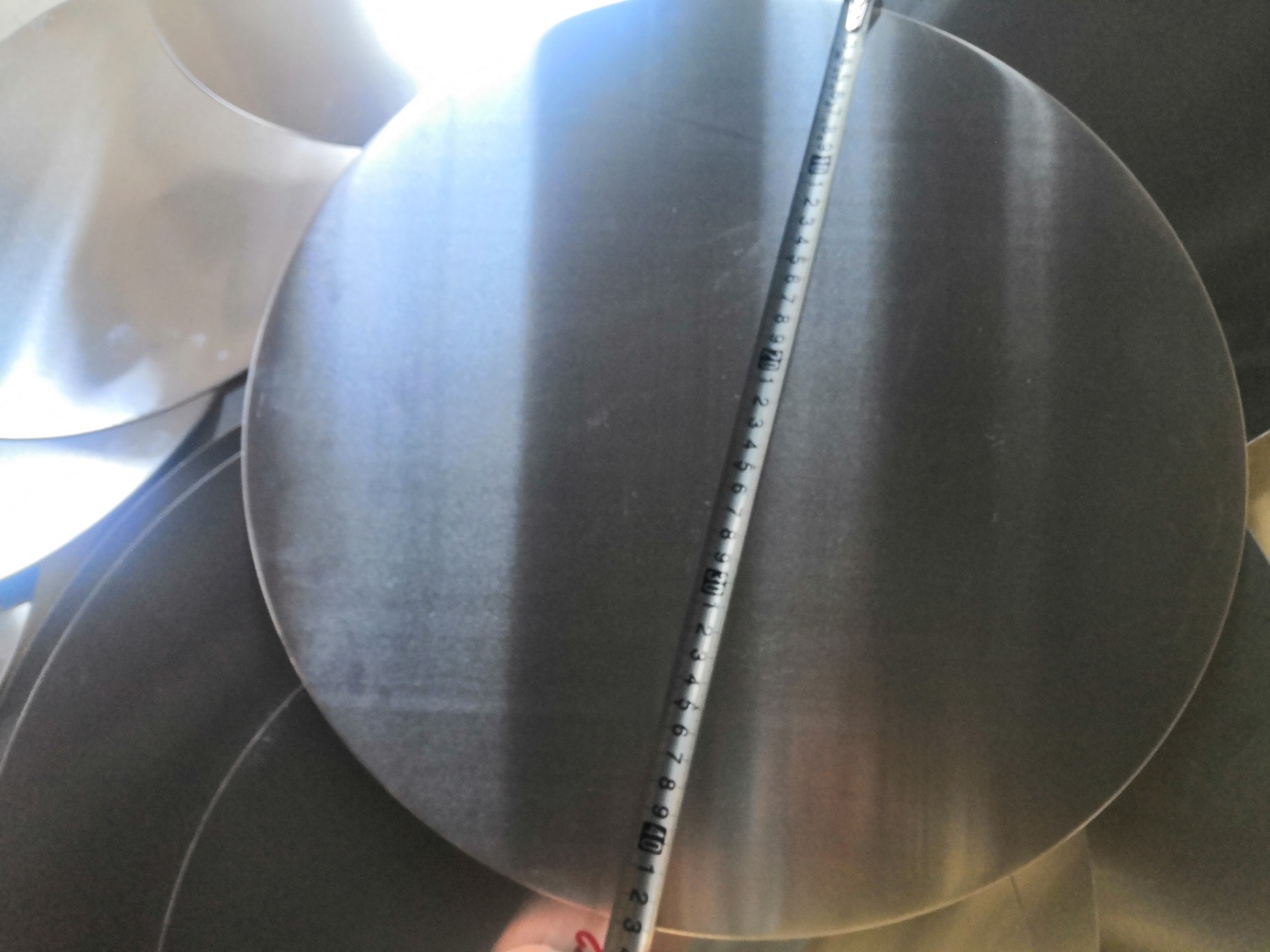
These aluminum discs have a good surface quality, with no scratches or oil stains. The surface is smooth and clean, which is very suitable for the needs of cookware, lighting, and other manufacturing enterprises. For cookware manufacturing, a clean and smooth surface is conducive to the subsequent processing of the non – stick coating. If there are scratches or oil stains on the surface of the aluminum disc, it may affect the adhesion of the non – stick coating, resulting in problems such as peeling of the coating during use, which not only affects the appearance of the cookware but also reduces its service life. In the lighting industry, a smooth – surface aluminum disc can be used to make high – quality lamp housings. It can not only ensure the aesthetics of the lamp but also help with heat dissipation, improving the luminous efficiency and service life of the lamp.
Advantages
High Thermal Conductivity
Food – grade hot – rolled aluminum discs for cookware substrates have high thermal conductivity. Aluminum has a relatively high thermal – conductivity coefficient, which is much higher than that of some common metals used in cookware, such as iron. This high thermal conductivity allows the cookware made from these aluminum discs to heat up quickly when placed on a heat source, such as a stove or an induction cooker. For example, in the process of frying an egg in a frying pan made of a hot – rolled aluminum disc, the heat from the stove can be rapidly transferred to the entire bottom of the pan within a short time, usually within 1 – 2 minutes. This ensures that the egg is evenly heated, preventing the formation of over – cooked or under – cooked areas. The high – speed heat transfer also means that less energy is wasted during the cooking process, reducing cooking time and saving energy. In a large – scale catering kitchen, where multiple pots and pans are used simultaneously, the high – thermal – conductivity aluminum – disc – based cookware can significantly improve cooking efficiency, enabling chefs to complete cooking tasks more quickly and meet the high – volume food – production needs.
Corrosion Resistance
These aluminum discs have excellent corrosion – resistance properties. In a kitchen environment, which is often humid and may contain various acidic or alkaline substances from food ingredients and cleaning agents, corrosion – resistance is crucial for the long – term use of cookware. Aluminum has a natural ability to form a thin but dense oxide film on its surface when exposed to air. This oxide film acts as a protective layer, preventing the underlying aluminum from further oxidation and corrosion. For instance, even if a saucepan made of a hot – rolled aluminum disc is frequently washed with water and exposed to the humid air in the kitchen, it can maintain its structural integrity and surface quality for a long time, usually several years. In addition, through surface – treatment processes such as anodizing, the corrosion – resistance of the aluminum disc can be further enhanced. Anodized aluminum discs can withstand more severe corrosion environments, such as contact with acidic foods like tomatoes or lemon juice during cooking. The anodized layer can prevent the aluminum from reacting with these acidic substances, ensuring the safety and durability of the cookware.
Applications
Cookware Manufacturing
Food – grade hot – rolled aluminum discs are extensively used in cookware manufacturing. Common cookware items made from these aluminum discs include aluminum pots, frying pans, and pressure cookers.
- Aluminum Pots: Aluminum pots made from hot – rolled aluminum discs are popular due to their excellent heat – conduction performance. They can quickly transfer heat from the heat source to the food inside, ensuring efficient cooking. For example, when boiling water in an aluminum pot, it can reach the boiling point in a shorter time compared to pots made of some other materials. The high – strength aluminum alloy used in the hot – rolled aluminum discs also enables the pot to maintain its shape during long – term use, even when frequently heated and cooled.
- Frying Pans: Frying pans made of hot – rolled aluminum discs can heat up evenly, which is crucial for frying foods. When frying an omelette, the even heat distribution ensures that the omelette is cooked uniformly, without any under – cooked or over – cooked parts. The formability of the aluminum discs allows for the production of frying pans with various shapes and depths, meeting different cooking needs.
- Pressure Cookers: Pressure cookers need to withstand high internal pressure during use. The high – strength and corrosion – resistant properties of hot – rolled aluminum discs make them ideal for this application. The aluminum discs can maintain their structural integrity under high pressure, ensuring the safety of users. Additionally, the good heat – conductivity of the aluminum discs helps in quickly building up and maintaining the high – pressure environment inside the pressure cooker, reducing cooking time significantly.
Other Applications
- Hardware Products: In the field of hardware, hot – rolled aluminum discs are used to make items such as lamp housings and water heater shells. Lamp housings made of aluminum discs can not only provide good protection for the internal lighting components but also assist in heat dissipation, which is beneficial for extending the service life of the lamps. Water heater shells made from aluminum discs can resist corrosion in a humid environment, ensuring the long – term use of the water heater.
- Household Appliances: For household appliances, hot – rolled aluminum discs are often used in the production of the heat – conducting chassis of electric kettles. The high – thermal – conductivity of the aluminum discs enables the electric kettle to quickly heat water, improving the efficiency of boiling water. In addition, in some high – end kitchen appliances, aluminum discs are used in components that require good heat – transfer and corrosion – resistance properties, such as the heating elements of induction cookers.
Why choose us?
Eco-alum (Eco-alum Aluminum Co., Ltd.) has a wide range of business scope, covering the sales of metal materials and products, hardware product research and development and sales, electronic products and communication equipment sales, and also involves cutting-edge businesses such as information technology and new material technology research and development, providing customers with comprehensive aluminum product-related services.
Conclusion
In summary, food – grade hot – rolled aluminum discs for cookware substrates possess unique properties in terms of chemical composition, parameters, mechanical properties, characteristics, and advantages. Their carefully designed chemical composition, with main elements like aluminum, copper, manganese, and magnesium, as well as trace elements such as titanium, zinc, and silicon, endows them with a series of excellent properties. The size parameters and tolerance standards ensure their adaptability to various cookware – manufacturing processes.
In terms of mechanical properties, different alloy – numbered aluminum discs, such as 1060, 3003, and 5052 series, have their own tensile strength, yield strength, elongation, and hardness characteristics, meeting the diverse needs of cookware with different functions and usage scenarios. The excellent formability and good surface quality make them easy to process and suitable for the production of high – quality cookware.
The high thermal conductivity and corrosion – resistance of hot – rolled aluminum discs are two of their most prominent advantages. The high – speed heat transfer not only improves cooking efficiency but also saves energy, while the corrosion – resistance ensures the long – term safe use of cookware in a complex kitchen environment.
These aluminum discs are widely used in cookware manufacturing, including aluminum pots, frying pans, and pressure cookers, bringing convenience and high – quality cooking experiences to people’s daily lives. Moreover, they also have applications in other fields such as hardware products and household appliances, further demonstrating their versatility and importance in modern manufacturing.
As people’s demand for high – quality cookware and household products continues to increase, food – grade hot – rolled aluminum discs, with their excellent comprehensive properties, will play an even more crucial role in the future market. Their application prospects are broad, and they are expected to drive the continuous development and innovation of the cookware and related industries.