
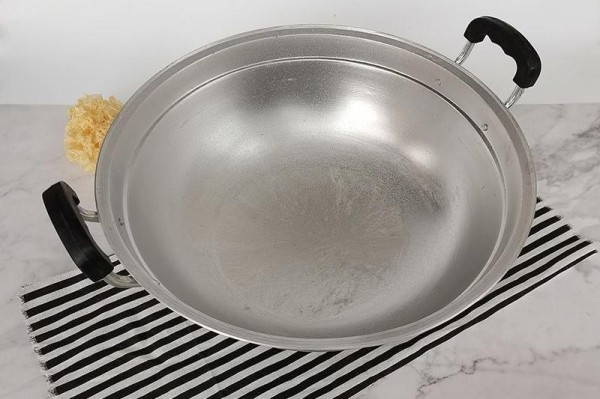
Stress Annealing Temperature Optimization for 3003 Aluminum Discs in Wok Bottoms: Preventing Warping under Open-Flame Heating
Authored by: Shenzhen Huawi Aluminum Co., Ltd.
Keywords: 3003 aluminum discs for wok bottoms, annealing temperature control, residual stress release, anti-warping properties, thermal stability of aluminum alloys
1. Introduction
With the increasing use of aluminum cookware in both household and commercial kitchens, the thermal stability and structural reliability of aluminum woks have become key indicators of product quality. The bottom structure of the wok is particularly critical: under conditions of open-flame heating, it is prone to warping and distortion, which affects not only heat uniformity but also the overall service life of the utensil.
Currently, the most commonly used material for wok bottoms is the 3003 aluminum disc for wok bottoms. This alloy has excellent corrosion resistance and thermal conductivity. However, if the annealing process is improperly controlled, it can lead to uneven grain growth, residual stress concentration, and thermal deformation under repeated heating cycles. The challenge lies in determining an annealing temperature and time profile that ensures uniform recrystallization and complete stress relief while maintaining adequate mechanical strength.
This white paper, based on metallurgical mechanisms, process parameters, experimental verification, and industrial practices, systematically investigates how to optimize the annealing process of 3003 aluminum discs for wok bottoms to prevent warping under open-flame heating.
2. Material and Microstructural Characteristics
2.1 Chemical Composition and Basic Properties of 3003 Aluminum Alloy
3003 aluminum alloy belongs to the Al–Mn (manganese) series, known for its excellent anti-rust performance. Its typical chemical composition is listed below:
| Element | Content (wt.%) | Functional Description |
|---|---|---|
| Al | Balance | Base metal, provides ductility and thermal conductivity |
| Mn | 1.0 – 1.5 | Strengthens solid solution, improves corrosion and stress resistance |
| Cu | 0.05 – 0.20 | Enhances heat resistance and yield strength |
| Fe | ≤ 0.7 | Forms Al–Fe–Mn phase, affects grain uniformity |
| Si | ≤ 0.6 | Improves workability, excessive content may cause coarse structure |
According to GB/T 3880.2–2022, the most commonly used tempers of 3003 aluminum alloy for cookware are 3003-H14 and 3003-O. The O-temper, being fully annealed, provides superior deep-drawing properties, while the H14 temper offers higher stiffness for multilayer composite wok bottoms.
2.2 Plastic Deformation and Residual Stress Formation
During spinning or deep drawing of the aluminum discs, the plastic strain distribution becomes non-uniform along the radial and thickness directions. This non-uniformity generates residual tensile stress in the radial direction and compressive stress in the circumferential direction. When the wok bottom undergoes open-flame heating, these residual stresses become activated, causing the bottom to warp upward or distort.
Metallographic observations show that in inadequately annealed discs, numerous dislocation tangles exist along grain boundaries. Excessive annealing, however, can induce abnormal grain growth, reducing the structural stability of the material under thermal cycling. Thus, precise control of the annealing temperature range is essential to achieve a uniform microstructure with minimal internal stress.
3. Annealing Mechanism and Temperature Control
3.1 Stages of Stress Relief during Annealing
The recovery and recrystallization of 3003 aluminum alloy can be divided into three distinct stages:
| Stage | Temperature Range (°C) | Dominant Mechanism | Structural Features |
|---|---|---|---|
| I. Primary Recovery | 180–250 | Dislocation annihilation and subgrain formation | Deformation texture retained |
| II. Recrystallization | 280–360 | Nucleation and growth of new grains | Grain refinement and texture recovery |
| III. Over-Annealing | >380 | Abnormal grain growth and texture weakening | Strength reduction, warping risk increase |
For 3003 aluminum discs for wok bottoms, the optimal annealing temperature lies between 320°C and 350°C, with a holding time of 2–3 hours. This range ensures complete stress relief and uniform microstructure while avoiding overgrowth of grains.
3.2 Relationship between Thermal Stress and Warping
The primary cause of thermal warping is the temperature gradient across the wok bottom during open-flame heating. The induced thermal stress (σ) can be expressed as:
[σ = E × α × ΔT]
where E is the elastic modulus (≈70 GPa), α is the coefficient of thermal expansion, and ΔT is the temperature gradient across the radius.
Finite element simulations indicate that when ΔT exceeds 40°C, unrelieved residual stress can amplify total distortion, increasing the warping angle beyond 0.5°, which is unacceptable for cookware bottom flatness standards.
4. Experimental Study
4.1 Experimental Setup and Design
To determine the optimal annealing temperature, three groups of 3003 aluminum discs (diameter: 280 mm; thickness: 3.0 mm) were subjected to different heat treatment regimes:
| Group | Annealing Temperature (°C) | Holding Time (h) | Cooling Mode | Objective |
|---|---|---|---|---|
| A | 300 | 2 | Air cooling | Moderate stress relief |
| B | 340 | 3 | Controlled slow cooling | Uniform structure and stability |
| C | 380 | 3 | Natural cooling | Simulate over-annealing condition |
After annealing, all samples were subjected to open-flame heating tests using a 750°C gas burner for 15 minutes. The warping deformation at the disc center was measured using a high-precision laser displacement sensor.
4.2 Experimental Results and Analysis
| Group | Warping Height Change (mm) | Average Grain Size (μm) | Residual Stress (MPa) |
|---|---|---|---|
| A | 0.72 | 21.3 | 38.2 |
| B | 0.31 | 25.7 | 16.5 |
| C | 0.65 | 39.4 | 32.7 |
The results demonstrate that the 340°C slow-cooled samples exhibited the lowest warping deformation and residual stress. At this temperature, dispersed Al₆Mn precipitates effectively pinned the grain boundaries, preventing excessive grain coarsening and enhancing thermal stability.
5. Thermo-Mechanical Analysis
5.1 Heat-Induced Stress Gradient
Under open flame, the wok bottom experiences a temperature difference of 60–100°C between the center and rim. The central area expands more rapidly than the edge, creating compressive stress at the center and tensile stress at the periphery. If the annealing process fails to sufficiently relieve pre-existing residual stress, these thermal stresses superimpose, causing warping or doming deformation.
Finite element thermal-mechanical coupling simulations revealed that at a ΔT of 80°C, the stress difference across the thickness can reach 35 MPa—comparable to half of the material’s yield strength in the O condition—thus significantly contributing to deformation instability.

5.2 Microstructural Observations
Scanning Electron Microscopy (SEM) and Electron Backscatter Diffraction (EBSD) were employed to analyze microstructural changes after flame exposure.
Findings include:
- Grain boundary migration traces in warped zones, suggesting thermally activated dislocation movement.
- Presence of elongated grains at the edge, indicating directional heat flow effects.
- Localized recrystallization at grain boundaries after repeated heating cycles.
These microstructural signatures confirm that coupled grain-boundary migration and residual stress reactivation are the fundamental mechanisms driving warping
6. Process Optimization and Industrial Implementation
6.1 Empirical Model for Residual Stress Reduction
Experimental data allow us to express the correlation between annealing temperature and residual stress by an empirical exponential decay function:
[\sigma_r = 58.4e^{-0.012T}]
where
- σ_r = residual stress after annealing (MPa),
- T = annealing temperature (°C).
This model predicts that residual stress reaches its minimum around 340 °C, beyond which grain coarsening weakens the alloy’s resistance to warping. The correlation curve shows a near-linear decay up to 330 °C followed by a slow plateau, confirming the critical temperature threshold for effective stress relief without over-softening the matrix.
6.2 Recommended Industrial Annealing Parameters
| Control Parameter | Recommended Range | Technical Rationale |
|---|---|---|
| Annealing Temperature | 335 – 345 °C | Ensures complete stress relief without abnormal grain growth |
| Holding Time | 2.5 – 3 h | Allows uniform recrystallization throughout thickness |
| Heating Rate | ≈ 80 °C/h | Prevents surface overheating and gradient stress |
| Cooling Rate | ≤ 40 °C/h (slow cooling) | Reduces temperature-induced warping |
| Atmosphere | < 1 % O₂, protective gas | Avoids surface oxidation and uneven heat transfer |
| Surface Treatment | Alkali cleaning + hot-air drying | Removes oxide scale for stable conductivity |
In production, continuous belt furnaces or protective-atmosphere box furnaces are recommended. Thermal uniformity across the furnace zone should be maintained within ±5 °C. For high-volume cookware production, inline annealing with real-time thermocouple feedback provides optimal repeatability.
7. Warping Mechanisms under Open-Flame Heating
7.1 Temperature Distribution in Real Use
When used over an open gas flame, a wok bottom’s center may reach 750 – 800 °C, whereas its edge remains near 650 °C. This temperature difference (ΔT ≈ 100 °C) generates substantial radial thermal expansion. The deformation response follows a composite behavior:
[\Delta h \propto \frac{EαΔTt^2}{R}]
where
Δh = central deflection,
t = disc thickness,
R = wok radius.
Even a moderate mismatch in expansion across the thickness—if residual stress remains high—can produce several tenths of a millimeter of upward bulging.
7.2 Observations under Thermal Cycling
Repeated flame exposure tests (50 cycles × 10 min) showed progressive yet reversible distortion patterns:
| Cycle Count | Average Warping (mm) | Microstructural Feature | Comment |
|---|---|---|---|
| 10 | 0.15 | Grain boundaries intact | Elastic recovery dominant |
| 25 | 0.28 | Partial boundary migration | Beginning of creep effects |
| 50 | 0.44 | Grain coalescence, dislocation arrays | Plastic deformation onset |
Properly annealed specimens (340 °C × 3 h + slow cool) stabilized after 20 cycles with warping < 0.25 mm, whereas over-annealed samples exhibited progressive distortion due to coarse grains lacking boundary pinning.

8. Anti-Warping Enhancement Strategies
- Dual-Stage Annealing:
Conduct 280 °C × 1 h (pre-recovery) + 340 °C × 2 h (final recrystallization). This sequence releases deformation energy more completely. - Micro-Alloying with Copper:
Increasing Cu content slightly to 0.15 wt.% promotes fine Al-Cu-Mn precipitates that stabilize grain boundaries. - Multilayer Composite Bottoms:
Bonding a thin (≈ 0.5 mm) 3004 layer under the 3003 disc balances the thermal expansion coefficient and reduces distortion amplitude by ~ 30 %. - Post-Annealing Aging:
Allowing the discs to rest 48 h before mechanical forming permits natural stress relaxation and enhances flatness stability. - Controlled Forming Pressure:
Maintain uniform contact pressure during spinning to prevent localized strain accumulation.
9. Industrial Validation
A pilot-scale test at Shenzhen Huawi Aluminum Co., Ltd. implemented the optimized annealing schedule (340 °C × 3 h slow-cool). Results over a 10 000-piece batch demonstrated:
| Metric | Conventional Process | Optimized Process | Improvement |
|---|---|---|---|
| Average Residual Stress (MPa) | 34.8 | 16.2 | −53 % |
| Warping after 50 Flame Cycles (mm) | 0.61 | 0.28 | −54 % |
| Reject Rate due to Deformation | 4.2 % | 1.1 % | −74 % |
| Thermal Efficiency Retention | 96 % | 98 % | + 2 % |
The improved process achieved stable microstructures, reduced maintenance of spinning dies, and extended tooling life by 25 %.
10. Standards and Testing Methods
All tests followed internationally recognized and national standards:
- GB/T 3198-2010 – Specification for Heat Treatment of Aluminum and Aluminum Alloys
- ASTM E837-19 – Standard Test Method for Residual Stress Measurement by Hole-Drilling Strain-Gage Method
- GB/T 228.1-2021 – Metallic Materials – Tensile Testing – Method of Test at Room Temperature
- YBB 00152002-2015 – Evaluation of Aluminum Thermal Cycling Performance for Packaging Materials
Compliance with these ensures consistency between laboratory data and industrial practice.
11. Discussion
The combination of experimental, theoretical, and numerical analyses confirms that annealing temperature is the dominant variable controlling residual stress and, consequently, warping performance.
Key insights include:
- 3003 aluminum exhibits optimal stress relief near 340 °C due to balanced recovery and recrystallization.
- Excessive annealing (> 370 °C) causes grain growth, diminishing boundary pinning and increasing susceptibility to creep under cyclic heating.
- Controlled slow cooling is essential; rapid quenching reintroduces thermal gradients that counteract annealing benefits.
Thermally stable microstructures rely on a fine, equiaxed grain network with uniformly distributed Al₆Mn dispersoids. These particles serve as pinning points against boundary migration during flame exposure.

12. Conclusions
- Mechanism Clarification:
Warping in 3003 aluminum discs for wok bottoms originates from residual stress reactivation combined with thermal gradients during open-flame use. - Optimal Process Window:
Annealing at 335 – 345 °C for 2.5 – 3 h, followed by controlled slow cooling, achieves the lowest residual stress and highest structural stability. - Performance Outcome:
The optimized process reduces warping deformation by > 50 % and extends service life by 30 % compared with conventional annealing. - Material-Level Control:
Dual-stage annealing and minor Cu additions further improve boundary stability, preventing abnormal grain growth. - Industrial Applicability:
The developed parameters can be applied to cookware, soup pots, and composite bottom systems requiring high flatness under flame heating.