

Core Differences Between 1050 and 1060 Aluminum Discs
Aluminum discs are among the most widely used foundational aluminum materials.
With excellent plasticity, thermal conductivity, and corrosion resistance, they serve as core raw materials in cookware manufacturing, lighting components, traffic signage, electrical parts, and deep-drawing applications. Within the pure aluminum series (1xxx), 1050 and 1060 aluminum discs are the two most commonly used products on the market.
While they appear similar and share comparable baseline properties—both being high-purity industrial pure aluminum—many purchasers and manufacturers often confuse them during material selection.
In reality, these two alloys exhibit subtle yet critical differences in chemical composition, mechanical properties, formability, thermal/electrical conductivity, and surface quality. Each also offers distinct advantages in cost and application suitability. Accurately distinguishing their characteristics enables companies to select the most cost-effective raw material based on production requirements, product positioning, and budget.
This article provides a comprehensive analysis of the differences between 1050 and 1060 aluminum discs to serve as a complete reference for industrial material selection.
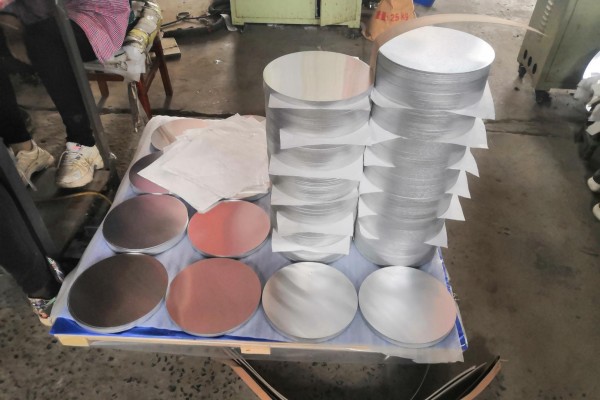
1. Basic Definitions & Key Parameter Overview
1.1 1050 Aluminum Discs: Cost-Effective General-Purpose Pure Aluminum
1050 aluminum discs belong to the national standard 1xxx series of industrial pure aluminum, with an aluminum content of no less than 99.5%.
They represent a highly versatile, foundational material that retains the core advantages of pure aluminum: excellent corrosion resistance, stable thermal and electrical conductivity, outstanding formability, and easy weldability and stamping.
These properties make 1050 suitable for the vast majority of conventional processing techniques. Thanks to its balanced performance and affordable price, 1050 is the preferred material for general civilian and industrial applications.
Typical specifications:
- Tempers: O, H12, H14
- Thickness range: 0.3mm – 6.0mm
- Diameter range: 80mm – 1200mm
- Surface finish: Standard mill finish, meeting most conventional production needs.
1.2 1060 Aluminum Discs: High-Purity Specialty Material for Deep Processing
1060 aluminum discs also belong to the 1xxx series but feature an elevated aluminum purity of ≥99.6%, with significantly reduced impurity levels compared to 1050.
This higher purity enhances ductility, deep-drawing performance, surface aesthetics, and conductivity while minimizing issues common in deep processing—such as cracking, poor formability, and surface defects. As such, 1060 is the specialty alloy of choice for high-end, deep-processed products.
In terms of dimensions and tempers, 1060 aligns closely with 1050. The fundamental distinction lies not in size but in material purity and the derived performance benefits.
2. Chemical Composition: The Root of Performance Differences
All performance gaps between these two alloys stem from subtle variations in chemical composition—primarily aluminum purity and impurity content. Lower impurities and higher purity result in greater microstructural uniformity and stability, leading to superior overall properties.
| Element | 1050 Aluminum Disc | 1060 Aluminum Disc |
|---|---|---|
| Aluminum (Al) | ≥99.5% | ≥99.6% |
| Silicon + Iron (Si+Fe) | ≤0.40% | ≤0.35% |
| Copper (Cu) | ≤0.05% | ≤0.05% |
| Manganese (Mn) | ≤0.05% | ≤0.03% |
| Magnesium (Mg) | ≤0.05% | ≤0.03% |
| Zinc (Zn) | ≤0.05% | ≤0.05% |
The data clearly shows that 1060 boasts higher aluminum purity and lower total impurities (Si+Fe) as well as reduced Mn and Mg content. This reduction mitigates internal structural inconsistencies, significantly improving toughness and uniformity.
However, this constitutes a marginal upgrade; in standard processing scenarios, the practical difference is minimal. The distinction becomes pronounced only in high-precision and deep-processing applications.

3. Mechanical Properties: Balancing Strength and Ductility
Mechanical properties directly determine an aluminum disc’s performance in stamping, drawing, and deformation resistance. 1050 and 1060 offer complementary characteristics tailored to different processing needs.
| Property | 1050 Aluminum Disc | 1060 Aluminum Disc |
|---|---|---|
| Tensile Strength | 60–95 MPa | 55–95 MPa |
| Yield Strength | ≥20 MPa | ≥18 MPa |
| Elongation Rate | 20–35% | 25–40% |
| Hardness | Slightly Higher | Slightly Lower |
| Formability | Excellent | Superior |
1050 offers marginally higher hardness, yield strength, and tensile strength, providing better resistance to minor deformation. It is ideal for conventional stamped products requiring structural stability. In contrast, 1060 trades some strength for significantly higher elongation and flexibility, resulting in superior toughness and crack resistance. It is the optimal choice for complex forming and large-deformation processes.
4. Deep Processing Performance: The Critical Divide in Drawing & Spinning
For products requiring deep drawing or spinning—such as cookware and precision enclosures—formability is far more critical than baseline strength. This is where the primary selection criteria between the two alloys emerge.
4.1 1050 Aluminum Discs: Suited for Conventional Medium-Shallow Drawing
1050 delivers excellent production stability and good spin-formability, with consistent yield rates and lower raw material costs, offering strong cost-efficiency. However, its limited elongation makes it suitable only for medium-shallow drawing and simple shapes.
Deep drawing or complex curvatures may lead to edge cracking and uneven textures. Typical applications include frying pans, standard cookware, pot lids, lamp housings, and traffic signs.
4.2 1060 Aluminum Discs: Engineered for High-Precision Deep Drawing & Complex Forming
1060 excels in deep processing. Its higher elongation allows for greater draw depths and lower earring rates, effectively reducing cracking, deformation, and edge defects. Finished products exhibit uniform wall thickness and precise geometry.
It is the preferred material for rice cooker inners, electric kettle bodies, pressure cookers, high-end custom cookware, and precision rotating components.

5. Thermal, Electrical & Corrosion Resistance Comparison
5.1 Thermal Conductivity: A Key Advantage for Premium Cookware
Thermal performance is critical for cookware, directly impacting heating uniformity and efficiency. 1050 has a thermal conductivity of approximately 222 W/m·K, while 1060 reaches 234 W/m·K. The higher purity of 1060 enables faster heat transfer and more even dissipation, eliminating hot spots and enhancing cooking performance—a primary reason why premium cookware favors this alloy.
5.2 Electrical Conductivity: Essential for Electrical Components
In electrical applications, 1060 again holds the advantage. 1050 offers about 61% IACS conductivity, whereas 1060 achieves 62–63% IACS, ensuring more stable conduction with lower losses. Consequently, 1060 is the default choice for capacitor cans, busbars, conductive fittings, and electrical reflectors.
5.3 Corrosion Resistance: Nearly Identical
Both alloys form a dense, protective oxide layer, delivering excellent corrosion resistance against moisture, weak food acids, industrial atmospheres, and outdoor weathering. Due to their minimal purity gap, their corrosion performance is virtually identical, making both suitable for outdoor, sanitary, and industrial environments.
6. Surface Quality & Cost Considerations
6.1 Surface Quality: 1060 Offers a Superior Finish
Thanks to higher purity and fewer impurities, 1060 discs feature a smoother, finer base surface free from particulate defects. During anodizing, polishing, or coating, it yields more uniform coloration, higher gloss, and better reflectivity—resulting in a noticeably more premium appearance. This makes 1060 the go-to for high-end decorative parts, reflective lighting fixtures, and premium cookware. 1050 provides adequate flatness for standard aesthetic requirements.
6.2 Cost: 1050 Delivers Greater Value
Cost is pivotal in large-scale production. While processing costs are comparable, 1060’s stricter raw material purity requirements typically make it 1–3% more expensive than 1050 (subject to market fluctuations). For high-volume commodity products, this gap translates into significant savings, cementing 1050’s role in cost-driven manufacturing.
7. Application Fields Comparison
Based on their distinct strengths in purity, formability, conductivity, surface quality, and cost, 1050 and 1060 serve clearly segmented markets across five major sectors.
7.1 Primary Applications of 1050 Aluminum Discs
- Cookware: Medium-shallow drawn items like frying pans, non-stick pans, lids, and stockpots—where stable forming and adequate heat transfer meet mass-market needs.
- Lighting: Standard lamp housings and bases without stringent reflectivity or textural demands.
- Traffic & Outdoor: Road signs and basic outdoor decorative aluminum, leveraging reliable corrosion resistance.
- Industrial Fabrication: Generic stamped parts, sheet metal components, and equipment enclosures focused on processability and yield.

7.2 Primary Applications of 1060 Aluminum Discs
- Premium Cookware: Deep-drawn, complex-shaped items such as rice cooker liners, kettle bodies, pressure cookers, and gourmet cookware—prioritizing flawless forming and thermal performance.
- Electrical Precision: Capacitor cans, busbars, reflective shields, and conductive parts requiring minimal electrical loss.
- Lighting & Décor: High-end reflector cups, architectural anodized finishes, and decorative lighting demanding optical precision and surface perfection.
- High-Precision Industry: Intricate spun components and heavily deformed stamped parts for advanced engineering applications.
8. Precise Selection Guide: Choosing Based on Needs
8.1 Prioritize 1050 When:
- Cost efficiency and large-batch production are paramount.
- Applications include: standard non-stick pans, frying pans, lids, general stamped parts, basic lamp covers, road signs, and any product without extreme deep-drawing or surface-quality requirements.
8.2 Prioritize 1060 When:
- Product quality, deep processing, and high precision are critical.
- Applications include: rice cookers, electric kettles, pressure cookers, high-end lighting reflectors, anodized decorative parts, capacitor cans, busbars, and complex spun or deep-drawn components.
9. Conclusion
Both 1050 and 1060 aluminum discs are high-quality 1xxx series pure aluminum materials offering excellent corrosion resistance, thermal conductivity, and formability for a wide range of industrial and consumer goods.
Their core divergence lies in purity and positioning: 1050 is the cost-optimized generalist, balancing moderate strength and affordability for scaled production. 1060 is the high-performance specialist, delivering enhanced ductility, superior surface quality, and better physical properties for deep processing and premium applications.
Effective material selection does not mean always choosing the “higher-grade” option. Instead, align your choice with processing complexity, performance targets, and budget constraints.
Opt for 1050 to maximize value in conventional products, and choose 1060 to elevate quality and reduce rejection rates in sophisticated, deep-drawn goods—achieving the optimal balance between excellence and economy.