
1060-O State Aluminum Discs: 30% Minimum Elongation, Engineered for Deep-Drawing Stainless Steel Composite Cookware
In the modern high-end cookware manufacturing industry, material selection directly determines product quality, production efficiency, and ultimately, market competitiveness. This is especially critical in the production of Deep-Drawing Stainless Steel Composite Cookware, where materials must possess not only excellent thermal conductivity but also exceptionally high ductility to withstand complex multi-stage deep-drawing processes.
Among various aluminum alloys, 1060-O State Aluminum Discs have emerged as the ideal substrate for deep-drawn composite cookware, owing to their high purity, excellent formability, and minimum elongation of 30%. They ensure stability during the deep-stamping process while significantly enhancing the cookware’s heating efficiency and durability.
This article provides a systematic, multi-dimensional analysis of the critical value of 1060-O aluminum discs in deep-drawn stainless steel composite cookware manufacturing, covering material properties, manufacturing processes, technical specifications, quality control, procurement guidelines, and industry applications.
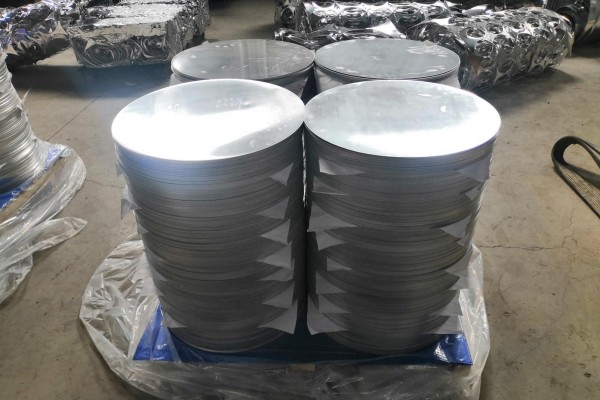
1. Metallurgical Definition of 1060-O State Aluminum Discs
1060 aluminum alloy belongs to the 1000-series commercially pure aluminum family per standards like ASTM B209 (UNS A91060). Its defining characteristic is a very high aluminum content (≥99.6 wt.%) and a very low total alloying element content (≤0.4 wt.%), which dictates its fundamental properties.
1.1 Chemical Composition and Phase Diagram Positioning
| Element | Standard Range (wt.%, Typical) | Metallurgical Impact |
|---|---|---|
| Al | Balance (≥99.6%) | Forms the Face-Centered Cubic (FCC) matrix, responsible for high ductility and thermal conductivity. |
| Fe+Si | ≤0.60% (Typically Fe~0.25%, Si~0.20%) | Primary impurities. Form brittle intermetallic phases (e.g., Al3Fe, α-AlFeSi). Controlling their content is key to ensuring ductility. |
| Cu, Mn, Mg, Zn | Each ≤0.05% (Total <0.15%) | Trace impurities. Provide negligible solid solution strengthening; kept low to avoid impairing formability. |
The “O State” designation refers to the Fully Annealed Condition. This involves heating cold-rolled material to approximately 340-410°C, holding, and then slow cooling, which results in:
- Significant reduction in dislocation density: Eliminates work hardening.
- Formation of equiaxed recrystallized grains: Achieves a uniform, stable FCC grain structure.
- Minimized yield strength and maximized elongation: Provides optimal initial conditions for deep drawing.
2. Key Mechanical Properties and Correlation to Formability Theory
2.1 Fundamental Mechanical Properties (per ASTM E8/E8M)
| Property | Typical Range | Engineering Significance |
|---|---|---|
| Tensile Strength (Rm) | 60 – 95 MPa | Indicates ultimate load-bearing capacity. Low value suggests lower forming force requirement. |
| Yield Strength (Rp0.2) | 20 – 35 MPa | Very low yield strength is critical for deep drawing success, indicating easy initiation of plastic flow. |
| Elongation (A50mm) | ≥30% (Can reach 35-40%) | Core Indicator. Characterizes uniform plastic deformation capability, directly linked to the Limiting Drawing Ratio (LDR). |
| Strain Hardening Exponent (n-value) | 0.20 – 0.25 | Moderate value indicates the material work-hardens during deformation, resisting local thinning and promoting uniform deformation. |
| Plastic Strain Ratio (r-value) | 0.6 – 0.8 (Anisotropic) | Relatively low, indicating similar resistance to deformation in the thickness direction versus the plane, helping reduce but not eliminate earing. |
2.2 Engineering Criticality of ≥30% Elongation
Deep drawing is essentially a process of hole expansion and drawing under biaxial tensile stress. The primary failure mode is localized necking and fracture at the punch radius.
- Forming Limit Diagram (FLD): The high elongation of 1060-O translates to a higher safe region for Major Strain (ε1) on the FLD curve, accommodating strain distribution variations caused by die geometry and friction.
- Feasibility of Multi-Stage Drawing: After the first draw, the material work-hardens. While inter-stage annealing can restore ductility, starting with a very high-elongation material like 1060-O can reduce the number of anneals required, potentially enabling two consecutive draws, improving efficiency.

3. Functional Interface Analysis in Deep-Drawn Composite Cookware Structure
In the typical “stainless steel-aluminum-stainless steel” tri-ply composite structure, the aluminum layer plays a dual structural and functional role.
| Layer | Material (Example) | Core Function | Interface Requirement with Al Layer |
|---|---|---|---|
| Outer Layer | 430 / 304 Stainless Steel | Structural support, aesthetics, environmental corrosion resistance | Requires metallurgical bonding via roll bonding. Interface shear strength must exceed the aluminum’s own shear strength. |
| Core Layer | 1060-O Aluminum | 1. Heat Conduction; 2. Plastic Deformation Medium; 3. Stress Buffer | Must possess perfect formability itself and not form brittle intermetallics at the interface after bonding. |
| Inner Layer | 304 / 316L Stainless Steel | Food contact, corrosion resistance, durability | Same as above, requires strong metallurgical bonding. |
Core Engineering Value of the Aluminum Layer:
- Thermal Management: Utilizes aluminum’s high thermal diffusivity (~97 mm²/s) to quickly eliminate hot spots under the stainless steel layers (diffusivity ~4 mm²/s), enabling isothermal cooking.
- Forming Compatibility: During deep drawing of the composite blank, the aluminum layer, through its extensive plastic deformation, coordinates the deformation of the inner and outer stainless steel layers (which have far lower formability), preventing cracking or delamination of the steel.
- Weight Reduction: Lowers the overall weight of the composite cookware body.

4. Quantitative Comparison of Deep-Drawing Advantages for 1060-O Discs
4.1 Formability Performance Comparison
| Material Grade & Temper | Elongation A50mm | Limiting Drawing Ratio (LDR) Theoretical | Relative Formability Assessment |
|---|---|---|---|
| 1060-O | 30 – 40% | 2.0 – 2.2 | Optimal. Suitable for deep parts with depth/diameter ratio >1. |
| 3003-H14 | 10 – 20% | ~1.8 | Fair. Suitable for shallow draws. H14 temper requires inter-stage annealing. |
| 5052-O | 22 – 25% | ~1.9 | Good. But Mg content increases strength, reducing ultimate elongation. |
| 1100-O | 25 – 35% | ~2.0 – 2.1 | Excellent. Performance close to 1060, sometimes interchangeable. |
4.2 Earing Behavior and Control
Earing originates from the crystallographic texture of the rolled sheet. 1060-O, due to recrystallization annealing, typically develops a weak cube texture {100}<001>.
- Earing Percentage: High-quality 1060-O discs require earing ≤ 3%. Formula: (Hmax– Hmin)/H0× 100%. Low earing directly reduces trim scrap, improving material yield.
- Control Methods: Optimizing texture type by adjusting final cold-rolling reduction and annealing parameters.
4.3 Engineering Significance of Thermal Properties
| Material | Thermal Conductivity (W/m·K, 25°C) | Thermal Diffusivity (mm²/s, 25°C) | Contribution to Cookware Heating Uniformity |
|---|---|---|---|
| 1060 Aluminum | ~220 | ~97 | Dominant Role. Significantly reduces temperature differential ΔT between pot center and edge (can be controlled within 10°C). |
| 304 Stainless Steel | ~16 | ~4.2 | Thermal barrier layer; relies on aluminum for heat spreading. |
| Composite Structure | — | — | Overall equivalent thermal diffusivity is much higher than single-layer stainless steel. |
5. Key Points for Full-Process Quality Control
5.1 Raw Material (Disc) Key Inspection Items
| Inspection Category | Specific Items & Standards | Test Method | Impact of Non-Conformance |
|---|---|---|---|
| Dimensional Tolerance | Thickness: ±0.02mm; Diameter: ±0.5mm | Micrometer, Laser Scanner | Causes uneven composite sheet thickness, wrinkling, or tearing during stamping. |
| Mechanical Properties | Rp0.2, Rm, A50mm, n-value | Universal Testing Machine (with extensometer) | Insufficient elongation directly causes cracking during stamping. |
| Formability Specific | Limiting Drawing Ratio (LDR), Erichsen Cupping Value (IE) | Simulative Cup Drawing Test, Erichsen Tester | Directly predicts maximum drawing depth in production. |
| Surface Quality | Free from oxidation stains, roll marks, oil, scratches. Roughness Ra ≤ 0.4μm | Visual, Optical Microscope, Profilometer | Affects composite bonding strength, leads to surface defects. |
| Microstructure | Grain Size: Grade 6-8 (ASTM); Size & Distribution of Secondary Phases | Metallographic Microscope | Coarse grains or continuous network of secondary phases cause orange peel or cracking. |
5.2 Stamping Process Window
- Die Clearance: Recommended (Sheet thickness × 1.05 – 1.10). Too small increases friction/wear; too large causes wrinkling.
- Blank Holder Force (BHF): Must be precisely optimized. Too low causes wrinkles; too high increases tensile stress leading to bottom rupture.
- Lubrication: High-performance extreme pressure (EP) lubricant is essential to lower the coefficient of friction (target μ < 0.10) and homogenize material flow.
- Punch Speed: Medium to low speed is preferred, allowing time for sufficient plastic flow and avoiding adiabatic shear band formation.
6. Suggested Core Elements for Procurement Technical Specification (TS)
A professional procurement TS should include:
- Material Standard: Clearly reference ASTM B209, EN 485-2, or equivalent national standard.
- Temper: Clearly specify “O Temper (Fully Annealed)”, with a maximum hardness limit (e.g., ≤25 HBW).
- Key Performance Guarantees:
- A50mm Elongation: ≥ 30% (Minimum)
- Yield Strength Rp0.2: ≤ 35 MPa (Maximum)
- Erichsen Value (IE): ≥ 8.5mm
- Earing Percentage: ≤ 3%
- Dimensional & Geometrical Tolerances: Thickness, diameter, flatness.
- Surface & Internal Quality: Free from visual defects, grain size grade requirement.
- Certification & Reports: Require mill test reports (chemical, mechanical) and 3rd party material certificates per batch (if applicable).
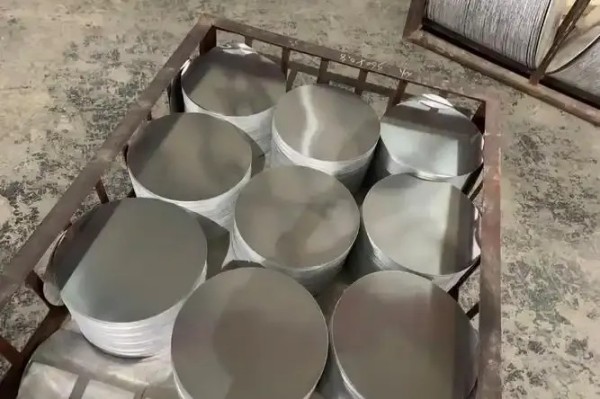
7. Conclusion: The Irreplaceability of 1060-O State Aluminum Discs
Within the manufacturing system for deep-drawn stainless steel composite cookware, 1060-O State Aluminum Discs are not merely raw material but a precisely engineered functional medium. Their value is demonstrated in:
- Purity of Metallurgical Design: High purity combined with the fully annealed condition provides ductility near the theoretical limit for FCC metals, guaranteeing performance under extreme forming conditions.
- System Compatibility: Its moderate n-value, controlled anisotropy, and compatible coefficient of thermal expansion with stainless steel ensure stability during the bonding-forming multi-physics coupled process.
- Predictable Quality: Through strict chemical control, heat treatment, and comprehensive inspection, its performance variation is minimized, providing process window robustness for automated, high-volume production.
Therefore, selecting 1060-O state aluminum discs that meet the above professional specifications is the most cost-effective strategic decision for controlling the yield, performance consistency, and long-term reliability of deep-drawn composite cookware at the source. As cookware evolves towards higher energy efficiency and more complex geometries, the depth of understanding and precision in applying this material will become a key differentiator in a manufacturer’s core competitiveness.