
Core Formula for Calculating the Weight of Aluminum Rings
The core formula for calculating the weight of an aluminum ring is:
Weight = Volume × Aluminum Density
An aluminum ring is essentially a hollow cylindrical structure. Therefore, its actual volume must be calculated first, and then multiplied by the material density to obtain the weight. The detailed steps are as follows.
I. Key Parameters
1. Aluminum Density
- The density of pure aluminum is 2.7 g/cm³ (or 2700 kg/m³).
- Common aluminum alloys such as 3003, 6061, and 1060 have slightly different densities, typically within the range of 2.68–2.73 g/cm³.
- For industrial calculations, 2.7 g/cm³ is commonly used as a standardized value to simplify calculations.
2. Dimensional Parameters of the Aluminum Ring
The following three dimensions must be measured or specified. All units must be consistent (cm or m is recommended):
- Outer diameter D → outer radius R = D / 2
- Inner diameter d → inner radius r = d / 2
- Height (or thickness) of the ring h

II. Volume Calculation of the Aluminum Ring
The volume of an aluminum ring is calculated as:
Volume = Volume of outer cylinder − Volume of inner cylinder
The cylinder volume formula is:
[V = \pi r^2 h]
Therefore, the aluminum ring volume is:
[V = \pi \times (R^2 – r^2) \times h]
Or calculated directly using diameters:
[V = \pi \times \left[\left(\frac{D}{2}\right)^2 – \left(\frac{d}{2}\right)^2\right] \times h]
For industrial accuracy, π = 3.14 is sufficient.
III. Weight Calculation of the Aluminum Ring
Multiply the calculated volume by the aluminum density:
[m = V \times \rho]
- If V is in cm³ and density is 2.7 g/cm³, the result is in grams (g). Divide by 1000 to convert to kilograms (kg).
- If V is in m³ and density is 2700 kg/m³, the result is directly in kilograms (kg).
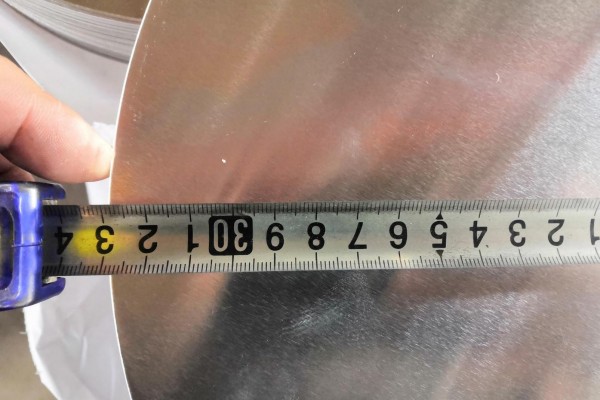
IV. Example Calculation
Assume an aluminum ring with the following parameters:
- Outer diameter D = 20 cm
- Inner diameter d = 16 cm
- Height h = 5 cm
Step 1: Calculate radii
- R = 10 cm, r = 8 cm
Step 2: Calculate volume
[V = 3.14 \times (10^2 – 8^2) \times 5]
[V = 3.14 \times (100 – 64) \times 5 = 565.2\ \text{cm}^3]
Step 3: Calculate weight
[m = 565.2\ \text{cm}^3 \times 2.7\ \text{g/cm}^3 = 1526.04\ \text{g} = 1.526\ \text{kg}]
V. Notes and Practical Considerations
- Unit consistency
Dimensions and density units must match; otherwise, significant order-of-magnitude errors may occur. - Manufacturing deviation
If chamfers, fillets, machining allowances, or uneven thickness are present, theoretical values may differ from actual weight by 3%–5%. For mass production, sampling and weighing are recommended for calibration. - Alloy density variation
High-strength aluminum alloys such as 2024 have a density of approximately 2.78 g/cm³, and the density value should be adjusted accordingly in calculations.
VI. Reference Table: Aluminum Disc Weight Calculation Examples
| No. | Aluminum Disc Diameter (D) | Thickness (h) | Radius r = D/2 (cm) | Volume per Disc V = πr²h (cm³) | Weight per Disc m = V × 2.7 (g) | Weight per 100 Discs (kg) | Typical Application |
|---|---|---|---|---|---|---|---|
| 1 | 100 mm = 10 cm | 2.0 mm = 0.2 cm | 5.0 | 3.14 × 5² × 0.2 = 15.7 | 42.39 | 4.24 | Cookware aluminum discs |
| 2 | 50 mm = 5 cm | 0.5 mm = 0.05 cm | 2.5 | 3.14 × 2.5² × 0.05 = 0.98 | 2.65 | 0.27 | Electronic component spacers |
| 3 | 80 mm = 8 cm | 1.0 mm = 0.1 cm | 4.0 | 3.14 × 4² × 0.1 = 5.02 | 13.56 | 1.36 | Hardware stamping blanks |
| 4 | 150 mm = 15 cm | 1.5 mm = 0.15 cm | 7.5 | 3.14 × 7.5² × 0.15 = 26.49 | 71.53 | 7.15 | Cookware pot base material |
| 5 | 200 mm = 20 cm | 2.0 mm = 0.2 cm | 10.0 | 3.14 × 10² × 0.2 = 62.8 | 169.56 | 16.96 | Large cookware panels |
| 6 | 300 mm = 30 cm | 3.0 mm = 0.3 cm | 15.0 | 3.14 × 15² × 0.3 = 211.95 | 572.27 | 57.23 | Industrial equipment covers |