
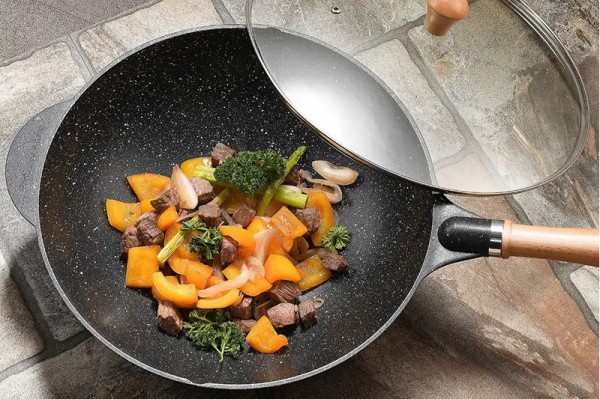
Precision Thickness Control of Aluminum Discs and Its Impact on Cookware Forming Quality
Introduction
Reliable aluminum disc thickness control has become a decisive factor for manufacturers seeking to produce stable, high-precision cookware with consistent forming performance. As global cookware brands raise expectations for product durability and heating uniformity, the tolerance window for aluminum discs has narrowed significantly. This article provides a deep technical analysis of thickness standards, the mechanics behind forming defects, and why even minor deviations can directly influence the outcome of cookware production.
1. Why Thickness Accuracy Matters in Cookware Manufacturing
Cookware components—especially pots, pans, pressure vessels, and spinning-based kitchenware—undergo severe deformation. During deep drawing, spinning, or hydraulic forming, aluminum experiences high strain levels. When thickness varies, the strain distribution becomes irregular, and this directly affects:
Key Effects of Thickness Deviations
- Drawability and crack resistance
- Wall uniformity and surface finish
- Mechanical strength and fatigue life
- Thermal conduction and heating uniformity
- Material yield rate and scrap ratio
Even a ±0.02 mm variation can shift the forming outcome from smooth to unstable, particularly with alloys like 1050, 1060, and 3003, which are widely used in cookware.
2. Engineering Standards for Aluminum Disc Thickness
Industrial thickness standards are defined by ISO 209, EN 485, and ASTM B209. However, cookware-grade discs require tighter tolerances than the general-purpose sheet.
Typical Nominal Thickness Range for Cookware
- 0.6–1.2 mm for frying pans
- 1.2–2.0 mm for stock pots
- 2.0–4.0 mm for pressure cookers and induction bases
Recommended Tolerances
- Standard industrial tolerance: ±0.04–0.08 mm
- Cookware-grade tolerance: ±0.015–0.03 mm
- High-end tolerance: ±0.01–0.02 mm
This difference in precision directly correlates with forming stability and end-user safety.
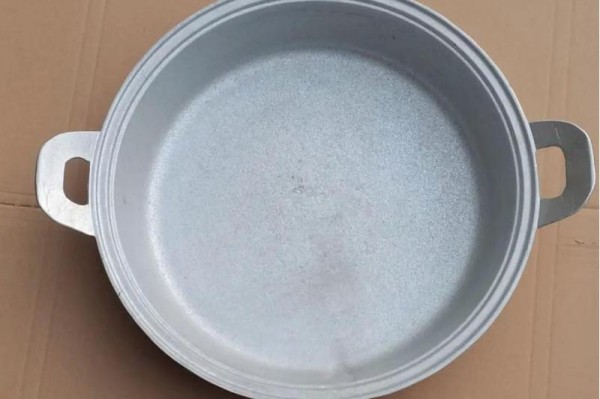
3. How Thickness Tolerances Influence Forming Mechanics
To understand how thickness variation affects cookware forming, it’s important to examine the underlying deformation behavior.
3.1 Deep Drawing Sensitivity
During drawing, the material stretches toward the punch radius.
- Thinner areas strain faster, leading to local thinning or cracks.
- Thicker areas resist deformation, causing wrinkling or uneven flange flow.
3.2 Spinning Sensitivity
Spinning requires constant radial stiffness:
- Local thickness differences create wavy rims, uneven walls, and dimensional asymmetry.
3.3 Thermal Implications
Cookware bases require balanced heat transfer:
- Variations >0.03 mm can lead to hot spots, heating delays, or distortion over time.
4. Sources of Thickness Deviations in Manufacturing
Understanding root causes enables better upstream prevention.
4.1 Rolling Variations
- Crown, wedge, residual stress, and gauge drift influence coil uniformity.
4.2 Blanking/Stamping Effects
- Off-center blanking produces asymmetric thickness distribution.
4.3 Material Metallurgy
- Grain size inconsistencies affect yield point and deformation response.
4.4 Press and Tooling Factors
- Tool wear alters shear force and worsens thickness gradient.
A strong control system must address both metallurgical and mechanical sources of deviation.
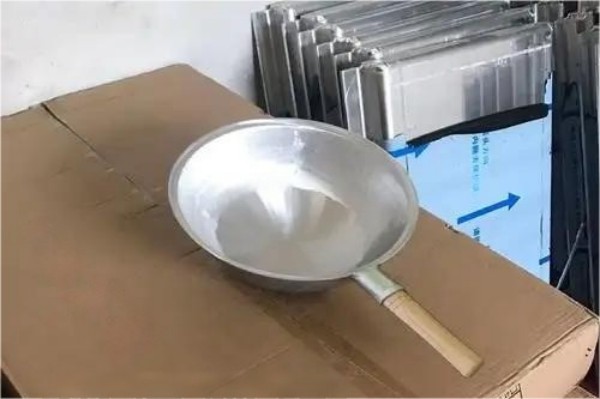
5. Advanced Thickness Control Strategies for Modern Factories
5.1 Rolling Accuracy Enhancements
- AGC (Automatic Gauge Control)
- AWC (Automatic Width Control)
- Tension-leveling lines to reduce coil wedge
5.2 In-Process Thickness Monitoring
- Laser scanning systems for coil mapping
- Real-time SPC with Cp/Cpk analysis
- Multi-point sampling across each blank
5.3 Forming Optimization
- Multi-stage drawing dies
- Controlled lubrication to reduce drag
- Optimized punch speed to minimize strain localization
These allow factories to reduce defect rates and stabilize forming quality.
6. Recommended Thickness Standards for Cookware Applications
Table 1. Recommended Thickness for Different Cookware Types
| Cookware Type | Alloy | Typical Thickness (mm) | Recommended Tolerance (± mm) |
|---|---|---|---|
| Frying Pan | 1050 / 1060 | 0.6–1.20 | 0.015–0.025 |
| Saucepan | 3003 | 1.0–1.60 | 0.02–0.03 |
| Stock Pot | 3003 / 5052 | 1.2–2.0 | 0.02–0.03 |
| Pressure Cooker Body | 3003 / 5052 | 2.0–4.0 | 0.015–0.025 |
| Induction Bottom | 3003 + Stainless Clad | 3.5–5.0 | 0.02–0.03 |

7. Comparison: Standard vs. High-End Thickness Tolerance
Table 2. Thickness Tolerance Comparison
| Parameter | Standard Industrial Sheet | Cookware-Grade Disc | High-End Premium Disc |
|---|---|---|---|
| Tolerance Range | ±0.04–0.08 mm | ±0.02–0.03 mm | ±0.01–0.02 mm |
| Edge Stability | Moderate | Good | Excellent |
| Deep Drawing Performance | Unstable in thin areas | Stable | Highly stable |
| Yield Rate | 92–96% | 96–98% | 99%+ |
| Suitable Application | General forming | Regular cookware | Luxury cookware, pressure vessels |
This clearly shows why cookware manufacturers increasingly demand tighter control.
8. Conclusion
Consistent aluminum disc thickness control is essential for delivering cookware with high forming accuracy, improved durability, and uniform heating performance. As competition intensifies in the global cookware industry, manufacturers that invest in advanced rolling precision, intelligent inspection, and process-level optimization will gain a significant quality and cost advantage. Tighter tolerance control not only enhances production stability but also strengthens market competitiveness and end-user satisfaction.